 PIO
FORUM PIO
FORUM
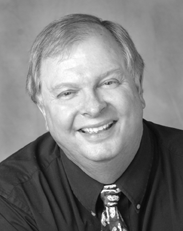
by Dennis Meredith
PIO Rabbis: A Proposal
We science writers are certainly a collegial lot, and like my fellow
PIOs, I’ve been happy to give advice to colleagues new to their
jobs. However, I’ve come to realize that for PIOs needing help,
making such mentoring connections is invariably haphazard, and they
are often unsure where to turn for advice on the sometimes complex problems
they encounter. These problems might include institutional politics,
editorial issues, media strategy, career guidance, and nuts-and-bolts
questions about setting up an e-mail newsletter or persuading a reluctant
researcher to cooperate with reporters.
Sometimes even experienced PIOs find themselves at the limit of their
experience, and while they enjoy a more extensive network of advisors,
they might still want to seek specialized advice and not know where
to turn.
So, in this column I’d like to propose that NASW create a more
formal cadre of volunteer advisors, which I’ve dubbed “PIO
Rabbis,” (PIORs)—named for the system among cops in which
rookies seek out experienced mentors to guide them.
In what follows, I’ll sketch out my initial ideas about the
structure and features of the PIOR service, with the hope that my colleagues
will let me know whether they believe that it’s basically a good
idea and where the holes in my thinking might lie. Of course, recognizing
that no good deed, or idea, goes unpunished, I’ll be willing to
get the service rolling, if it seems viable. As I see them, the key
issues seem to be:
Eligibility. Basically, anybody is eligible who believes
they have something to contribute to help fellow PIOs. Importantly,
a Rabbi need not be one whose head is grey and/or balding and who fondly
remembers the feel of carbon paper. Also, Rabbis can and should come
from a range of institutions, including universities, foundations, corporations
and government labs, since each of these represent unique environments
with unique problems.
Journalists are emphatically welcome as Rabbis! In fact, they could
view service as a PIO Rabbi not only as an aid to PIOs, but to their
fellow journalists. After all, sound advice for PIOs from journalists
could reduce the number of hitches that sometimes occur in the interchange
between PIOs and journalists. And, for journalists, there’s the
admirably selfish motive that establishing helpful relationships with
PIOs can enhance their contacts among the PIO community.
Accessibility. Rabbis would volunteer by filling
out and submitting an online form that would enter them into a PIOR
database on the NASW site. The form would include a brief bio and a
checkoff list of advisory services a Rabbi is willing to provide. PIOs
seeking advice could search the database for the Rabbi with the right
qualifications to help with the problem he/she has encountered. The
PIOR site would be managed by a volunteer administrator who would proof
applications for completeness and post them on the site. The PIOR administrator
would not act as an arbiter of who can be listed, but only as a facilitator.
Commitment. PIORs can sign up for as long or short
a term as they wish, with the option of removing their listing whenever
they wish. Also, PIORs can reasonably expect only occasional phone calls
or e-mails from those seeking their help. And in signing up, they can
place whatever limits they wish on scope and extent of consults.
For journalists who volunteer as Rabbis, it would be understood that
their service doesn’t constitute a chance for PIOs to pitch stories,
but only to seek a reporter’s point of view on such issues as
handling a story or reporter-related issue. Of course, there is nothing
to prevent journalists from negotiating with PIOs to do a story that
turns out to be irresistibly juicy.
Duties: Whatever service or advice the Rabbi is willing
to provide. The checkoff list mentioned above could be quite extensive,
detailing the kinds of help a Rabbi is willing to offer. These services
could include tactical advice on a problem with a researcher, guidance
on how to manage freelancing, or editorial review of an article. Of
course, Rabbis would not be expected to routinely edit an advisee’s
work. Nor would Rabbis be expected to act as referees or arbitrators
between PIOs, or between PIOs and faculty, etc. However, when asked
by one or both sides of a dispute, a Rabbi could offer advice for settling
the problem.
Pay. None but the psychic reward of helping fellow
PIOs. However, it might be possible to winkle funds from NASW for honorary
geegaws and gimcracks commemorating their honorable service. Also, any
Rabbi would be permitted to accept token rewards from grateful advisees.
For example, an advisee might offer the Rabbi a refreshing beverage
of the Rabbi’s choice upon their next meeting.
Liability. Also none. It should be explicitly stated
that Rabbis will not be held legally or ethically liable for the outcome
of their counsel. It is entirely up to the advisee to decide whether
to take a Rabbi’s advice. What’s more, an advisee would
have the option of consulting as many Rabbis as he/she wishes on a given
question. And, Rabbis could recommend other colleagues whom they believe
have the appropriate expertise.
Confidentiality. All consultations between Rabbis
and advisees would be considered confidential unless both parties agreed
on specific conditions of disclosure. Thus, the PIOR service would complement
the nasw-pr listserv, where discussion is public.
One exception to confidentiality might be if a journalist-Rabbi explicitly
negotiates permission from an advisee to follow up on a story they discuss.
Also, the advisee might give permission for the problem and its solution
to be shared with the science writing community in the pages of ScienceWriters
columns—provided that names and identifying details are omitted.
So, that’s the concept. Please drop me a note at meredith@nasw.org
with any comments, ideas, or brickbats. For example, do you think the
provisional name appropriate? Alternative names to Rabbis might be Counselors,
Mentors, Guides or “Legends”—the term used by the
San Diego chapter of PRSA. And most importantly, I'd like to know whether
PIOs would, indeed, use the service. If the PIOR idea seems workable
and useful, I'll be happy to propose it to the NASW Board at their next
meeting. And if the board agrees, we will work to create a service that
will offer a rich resource of experience to our colleagues.
Finally, I should give fair warning: if we do launch PIORs, I am not
above brazen “persuasion” to enlist volunteers.
#
Dennis Meredith is director of the Office of Research Communications
at Duke University. He can be reached at dennis.meredith@duke.edu
or 919-681-8054. He welcomes comments and topic suggestions for future
columns.
- Return to NASW homepage.
- Return to
NASW Members' Lobby.
- Return
to ScienceWriters Newsletter homepage.
-
|