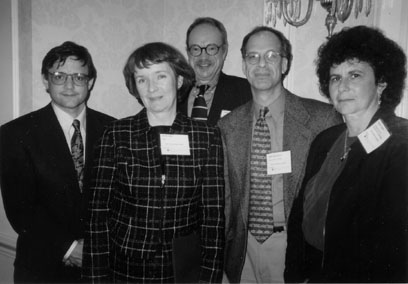
NASW Vice-President Joseph Palca (far left) presented awards to (l-r) Kate King, David Sanford, Michael Waldholz, and Susan Cohen. SW photo by Lynne Friedmann.
Susan Cohen, a freelancer writing for Washington Post Magazine, Kate King of CNN, and Michael Waldholz and David Sanford of the Wall Street Journal are the winners of the 25th annual National Association of Science Writers Science-in-Society Journalism Awards. The annual awards are intended to encourage and recognize outstanding investigative and interpretive science reporting in both print and broadcast media. It honors probing coverage that explains why an issue in the sciences matters to society.
Awards are given in three categories—broadcast, magazine and newspaper—with $1,000 and certificates going to the winners. Publishers and broadcasters of the winning entries also receive certificates.
The 1997 awards were presented November 4, in Roanoke, Va., at the annual banquet of the Council for the Advancement of Science Writing. The event is held in conjunction with the council’s annual New Horizons in Science Briefing for journalists, hosted this year by Virginia Tech.
Cohen, a West Coast freelancer, was recognized for her feature article, “Tangled Lifeline.” Her entry—”superbly well-reported and graced by good, solid, engaging writing,” said the judges—revealed a disturbing tale about research blended with commerce. It was a “first-rate piece of investigation and exploration of the ethical ambiguity of collecting and marketing cord blood.”
Drawn from newborns’ umbilical cords, cord blood is a source of stem cells for bone-marrow transplants, especially valuable for those who face difficulties in finding donors with similar lineage.
The story explored “the evolving role of commerce and government
in research and treatment,” as well as society’s attempt to balance
“the rapid delivery of innovation and the unrestrained marketing of
fear.” The piece ran Aug. 18, 1996.
King, a producer with CNN, received her award for “Killer Algae.”
The story showed how researchers are piecing together clues to a puzzling mystery in which tiny organisms that can thrive in polluted waterways recently killed fish and possibly caused nervous system damage to humans.
The judges praised King for producing an “elegant little piece” on a significant environmental issue that was “well-reported,” “well-constructed,” “dramatic and suspenseful.” The story aired November 9, 1996.
Waldholz, staff writer, and Sanford, editor, with the Wall Street Journal, won for a groundbreaking “absolutely superb” series on the emergence of protease inhibitors as a powerful treatment for patients with AIDS.
The series, which ran from June 1996 through December 1996, showcased comprehensive and cutting-edge reporting of the latest developments in AIDS research and their potential promise in clinical care, beautifully blending research findings with societal impact.
Waldholz, working on a story about the discouraging progress of AIDS treatments to date, came to the realization well before many of the clinicians he was interviewing that a new drug regimen involving protease inhibitors was succeeding in clinics all over the country, giving its users hope that they could remain healthy for many years.
In one article of the eight-part series, Sanford put a human face on the new development, describing for the first time in public how he now must cope with the prospect of a long life after years of preparing his affairs in anticipation of death from AIDS.
More than 70 entries were received in the award program. They were reviewed by an NASW committee, co-chaired by freelance writer and book author Joel Shurkin and Karen Watson, manager of the news service at the University of California, Davis.
Members of the screening committee were Marcia Barinaga, Science magazine; Blake Edgar, Pacific Discovery; Richard Hart, C/Net; and Charles Petit, San Francisco Chronicle.
The final judges were Glennda Chui, San Jose Mercury News; Deborah Franklin, Health magazine; and Janet Basu and David Salisbury, Stanford University News Service.