How One Writer Found His Passage to Eden -- Via a Fulbright Grant
by Dan Drollette
Like many journalists I have met, I’d always wanted to travel overseas.
I knew that for someone like me, interested in science and ecology, traveling
abroad would be a wonderful opportunity to research articles about a new
environment, see exotic wildlife, learn about a different culture, and gain
fresh perspectives on the way we run our national parks and environmental
policies in the United States. But how to do this, especially on the slender
income of a master’s student at New York University’s Science
and Environmental Reporting Program? Grants were available, but most applications
required a proposal for a specific writing project. Like pitching an article
to an editor, the key to winning a grant was a well thought-out idea. But
what topic and which foundation?
My choice of topic came serendipitously. To help pay for tuition, I worked
part-time as a photo editor at an advertising studio located on the city’s
all-too-colorful Bowery. Every now and then, my boss would invite some of
his cronies over for a few beers and cigars, and they would sit around and
show us slides from their latest work. One day, a famous underwater photographer
from National Geographic dropped in, fresh from an extended visit
to the Antipodes. His pictures of a place called Lord Howe Island were breathtaking
to me—made all the more so by the fact that I had just finished clearing
away empty wine bottles and a dead rat from the front stoop of the boss’s
graffiti-encrusted building.
The underwater photographer raved about his experiences on this sub-tropical
Australian national park 400 miles out in the South Pacific, whose 293 citizens
had banded together to protect endangered native birds and marine life.
Wildlife restoration programs were funded with proceeds from the island’s
harvest of palm nuts.
I thought to myself, “This guy should know something about islands—he’s
been taking underwater photos for 30 years.” Maybe this experiment
in environmental protection was the stuff of a grant proposal.
I went to the Australian consulate in Rockefeller Center and began to
read up about this island and other Australian parks in their library.
Two years later, I found myself sitting in a cottage next to the Lord
Howe Island lagoon, listening to outback guide Ray Shick give hints about
local bushcraft while a passing tropical squall drummed upon the tin roof.
Ray was a fount of information about life on this pristine, Manhattan-sized
isle and the effort to protect it from large-scale development. (“We
were greenies before anyone else,” said the proprietor of a nearby
lodge.) After an afternoon spent listening to tales of island men lost at
sea and the secrets of harvesting Kentia palm nuts—Howea forsteriana
seedlings are the island’s major export—I headed to my bicycle.
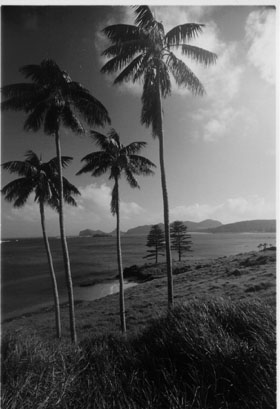
Through the palm fronds and banksia flowers I could see the surf crashing
into the sides of 2,887-foot tall Mount Gower.
A year ago I was researching toxic waste sites in Queens, I thought to myself.
I wouldn’t be here if it weren’t for that Fulbright Postgraduate
Traveling Fellowship.
The Fulbright program was started at the end of World War II, as a way
to promote peace through the mutual exchange of citizens. In setting up
the program, Senator J. William Fulbright drew upon his own youthful experience
as a Rhodes scholar at Oxford University, England; he once said “The
best way to appreciate others’ viewpoints, their beliefs, the way they
think, and the way they do things is to interact with them directly on an
individual basis—work with them, live with them, teach with them, learn
with them and learn from them.” Or, as he wrote in his autobiography,
“It is hard to shoot someone you know.”
Since 1946, more than 70,000 Americans and 130,000 foreigners have participated
from 130 countries. Illustrious Fulbrighters include composer Philip Glass,
actor Stacy Keach, scientist Nancy Wexler, novelist John Updike, and former
Secretary General of the United Nations Boutros Boutros-Ghali. The program
offers several different scholarships under its umbrella, including teacher-exchange
programs, grants to give or attend seminars (the Senior Scholar program)
and funds to cover solely the costs of overseas travel.
Of all the Fulbrights, the Full Grants, also known as Postgraduate Traveling
Fellowships, are most in demand. They provide for everything from round-trip
airfare to health and accident insurance.
In all cases, the choice of research topics is open to whatever interests
the applicant; in Australia this past year, American postgraduate fellows
looked at everything from the diet of brushtail possums to the implications
of Aboriginal land claims.
Application forms are available at most universities, or by writing the
foundation’s headquarters at the Institute of International Education
(IIE) at 809 UN Plaza, New York, NY 10017. Applicants don’t have to
be affiliated with academia to apply, although it can be a plus, as many
institutions maintain a database of old applications that were successful.
These can give an idea of the structure of a winning grant. Schools also
sometimes have scholarship advisors who can help you prepare for the interviews.
If you don’t have the help of a university advisor, you can still
get the benefit of such preparatory sessions by attending workshops on navigating
the application procedure, given to prospective applicants by the IIE. These
are usually administered by the organization’s Walter Johnson.
 After years of handling applications, he’s seen it all. “Applicants
can be too clever for their own good,” he says, citing the time someone
used a photocopier to shrink their proposal to fit the maximum allowed size—with
the resulting type so tiny it was unreadable. Johnson and others recommend
a few steps to up the chances of acceptance:
After years of handling applications, he’s seen it all. “Applicants
can be too clever for their own good,” he says, citing the time someone
used a photocopier to shrink their proposal to fit the maximum allowed size—with
the resulting type so tiny it was unreadable. Johnson and others recommend
a few steps to up the chances of acceptance:
- Read the application handbook. Johnson says budding Margaret Meads
constantly apply to study in Papua New Guinea—a country which says
in the handbook that it does not want any more anthropologists. “Half
the battle is just following the steps correctly,” said Fulbright
winner Valerie Cass.
- Take advantage of the competition statistics found in the back of each
Fulbright information booklet. For example, nearly half the applicants
to Canada received fellowships last year, while only six percent of the
candidates to the United Kingdom won awards. The chance of being accepted
to lovely Albania is high—only two people applied in all of 1994.
- Establish contact in the land you wish to visit. As Fulbrighter Joan
Jeffri puts it, “The best way to negotiate the application process,
as far as I am concerned, is to have someone request you!” NYU Dean
Robin Nagle said that evaluators favor applicants who have a connection
to an academic institution in the host country. “A letter of affiliation
is one of the best ways to have a proposal stand out,” she said. Getting
such a letter is daunting but not impossible; I did it all over the Internet.
I found promising leads in my field by downloading course catalogs from
Australia, then tracked down the person in charge and e-mailed a resume
and a description of my project. Eventually, I struck up a rapport with
a faculty member who mailed a four-sentence letter saying he would oversee
my work. (It all would have been difficult without e-mail: airmail takes
two weeks to reach the land down under, while surface mail takes three
months.)
- Think of what you want to do and then write the best grant proposal
you can. Columbia University’s Eduardo Macagno, who once evaluated
students on behalf of the Fulbright and other international scholarship
programs, considers the applicant’s written outline to be crucial.
Macagno said “Your grant proposal has to be clear and succinct and
to the point. No complicated English that requires four or five readings
to get the idea.” Macagno also recommended having a colleague read
and critique the proposal before submitting it. “You always benefit
from that,” he said.
- Don’t sacrifice other commitments. One student applied simultaneously
for the Fulbright, Rhodes, Truman and British Marshall Scholarships; she
says she barely avoided academic probation and was still awaiting word
on acceptance.
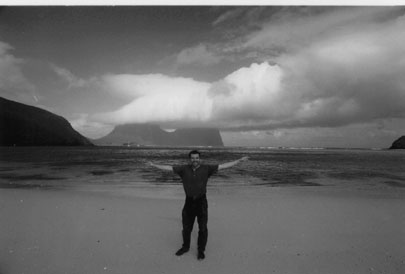 When it came time to write my application, I had a list of places I
wanted to visit, and reasons why I felt they were important. I wanted to
experience Australia’s national parks firsthand and observe their conservation
efforts in order to see what America can learn from the Australian experience.
I had a personal interest in the topic as well—as a college student,
I’d worked as a seasonal employee and part-time volunteer at Yellowstone,
the world’s first national park. Besides Lord Howe, I was attracted
to Shark Bay, where the park concept is taken one step further, and wild
dolphins interact with human beings. It’s unlike a traditional preserve
or zoo; as a ranger later told me, “We have to use our common sense
and make it up as we go along.” Or, as the manager of a local tourist
development put it: “There’s a lot of money riding on the back
of those fish.”
When it came time to write my application, I had a list of places I
wanted to visit, and reasons why I felt they were important. I wanted to
experience Australia’s national parks firsthand and observe their conservation
efforts in order to see what America can learn from the Australian experience.
I had a personal interest in the topic as well—as a college student,
I’d worked as a seasonal employee and part-time volunteer at Yellowstone,
the world’s first national park. Besides Lord Howe, I was attracted
to Shark Bay, where the park concept is taken one step further, and wild
dolphins interact with human beings. It’s unlike a traditional preserve
or zoo; as a ranger later told me, “We have to use our common sense
and make it up as we go along.” Or, as the manager of a local tourist
development put it: “There’s a lot of money riding on the back
of those fish.”
Upon arrival in the land down under, I felt as though I had stepped into
a world of mirror-images. Everything is reversed: people drive on the opposite
side of the road, light-switches flick down to turn on, swans are black,
and ski season is in July. Luckily, the people speak English—of a sort.
The Aussies’ rhyming slang is almost impenetrable to the newcomer:
your best friend is sometimes called your “China plate,” as “plate”
rhymes with “mate.” And I had to buy an Australian-English dictionary
to decipher the newspapers, in which words such as “rort” and
“twee” appear with distressing regularity. (Rort: to trick or
scheme. Twee: excessively dainty.) At least now I can watch movies like
“Muriel’s Wedding” or “Shine” and
catch all the inside jokes.
In my encounters with Australian culture, I also had some lively pub
discussions about freedom of the press—Australia does not have a First
Amendment or Bill of Rights, and I have actually met law students who laugh
at such notions. (I found myself quoting passages from old Journalism 101
textbooks to clear up factual errors and misconceptions.)
 Figuring out how to use my time most effectively was also tricky. Was
it better to spend every moment researching stories now, and then write
them up later when I returned home after a year? Or write things as they
occurred? I finally chose the latter, with the emphasis on taking the time
to experience as much as possible. It seems to have been the right choice:
since arriving here, I learned from an Aboriginal elder how to make a traditional
boomerang, swam with dolphins, fell in love, flew with the Royal Flying
Doctor Service, fell out of love, and discovered the safest way to hold
a miniature kangaroo without getting hurt (by the tail, upside-down, at
arm’s length). I wrote for publications such as Science, Scientific
American, and Newsday on subjects ranging from the social life
of dolphins to the search for the last Tasmanian tiger to stolen dinosaur
fossil tracks.
Figuring out how to use my time most effectively was also tricky. Was
it better to spend every moment researching stories now, and then write
them up later when I returned home after a year? Or write things as they
occurred? I finally chose the latter, with the emphasis on taking the time
to experience as much as possible. It seems to have been the right choice:
since arriving here, I learned from an Aboriginal elder how to make a traditional
boomerang, swam with dolphins, fell in love, flew with the Royal Flying
Doctor Service, fell out of love, and discovered the safest way to hold
a miniature kangaroo without getting hurt (by the tail, upside-down, at
arm’s length). I wrote for publications such as Science, Scientific
American, and Newsday on subjects ranging from the social life
of dolphins to the search for the last Tasmanian tiger to stolen dinosaur
fossil tracks.
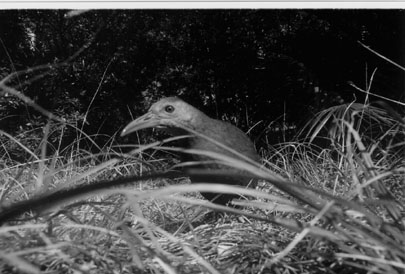
Of course, not all is gravy. I’ve been bitten by poisonous spiders
and stalked by cassowaries—six-foot high birds that look like escapees
from Jurassic Park and leap into the air to disembowel prey with
their claws. The 16-hour time zone difference between this part of Australia
and the east coast of the United States makes calling people back home horrific,
and this “tyranny of distance”—as one Australian sociologist
calls it—means that it’s easy for editors to ignore you. Publisher’s
checks can take months to arrive from the US, and as much as five weeks
to clear the Australian bank. This makes budgeting a fiasco, although some
editors have been kind enough to have their accounting departments send
checks by electronic transfer. But the chance to do interesting articles
makes up for some of this. Things were so interesting, in fact, that I requested
an extension on my visa after my grant expired in order to stay longer and
cover more stories. And there is something very appealing about being able
to call yourself a “foreign correspondent,” and get clips with
datelines saying “Tasmania.” As for Lord Howe, excerpts from the
material I gathered have appeared in everything from a chemistry journal
to the Boston Globe. I’m still awaiting word about my doing
an extended essay on this unique national park, but at press time, Australian
Geographic was still considering it.
When friends and colleagues ask if I thought the Fulbright was worth
the effort, I say “Absolutely.” The only problem is that once
you get the travel bug, you keep wanting more: I’ve noticed that when
I do finally go back to the States, my return flight has to pass through
Indo-China, and the ticket allows me to make four stopovers for as long
as a year...
Dan Drollette was a 1993 recipient of a Nate
Haseltine/Council for the Advancement of Science Writing scholarship. Portions
of this article are reprinted from 21stC magazine. Photos by Dan
Drollette.
Return to ScienceWriters table
of contents.