Joe Palca Honored for Winning ACS Grady-Stack Award
“You shouldn’t wear lipstick when you’re
drinking a glass of champagne.”
That unique reporting style of Joe Palca, science correspondent for National
Public Radio, has earned him the top chemistry reporting award from the
world’s largest scientific society. Palca has just been named the 1998
recipient of the American 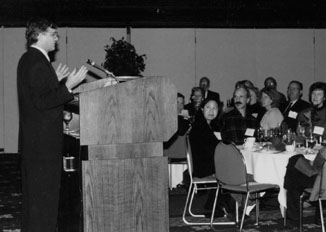 Chemical Society’s James T. Grady-James
H. Stack Award for Interpreting Chemistry for the Public. The annual award,
which includes a $3,000 prize, is the Society’s highest honor for public
communication about chemistry. It was established in 1955 to recognize,
encourage and stimulate outstanding reporting that increases the public’s
knowledge and understanding of chemistry, chemical engineering and related
fields. Champagne is truly “chemistry in a bottle,” says Palca.
In a New Year’s Eve report broadcast on NPR’s “Morning
Edition,” Palca used the beverage to explain the chemical process
of fermentation, especially the special second fermentation step that gives
champagne its characteristic bubbles—actually carbon dioxide that has
been dissolved in the liquid.
Chemical Society’s James T. Grady-James
H. Stack Award for Interpreting Chemistry for the Public. The annual award,
which includes a $3,000 prize, is the Society’s highest honor for public
communication about chemistry. It was established in 1955 to recognize,
encourage and stimulate outstanding reporting that increases the public’s
knowledge and understanding of chemistry, chemical engineering and related
fields. Champagne is truly “chemistry in a bottle,” says Palca.
In a New Year’s Eve report broadcast on NPR’s “Morning
Edition,” Palca used the beverage to explain the chemical process
of fermentation, especially the special second fermentation step that gives
champagne its characteristic bubbles—actually carbon dioxide that has
been dissolved in the liquid.
The CO2 is responsible for the distinctive ‘pop’ when a bottle
is opened, and for producing the small amount of foam on the top of a glass
of champagne. And that’s where Palca’s lipstick advice comes in.
Lipstick, he says, has an anti-foaming agent that causes the foam bubbles
in champagne to burst. If you like the foam, “and who doesn’t,”
adds Palca, don’t wear lipstick. The same holds true for beer, he says.
Return to ScienceWriters table of contents.