
|
| Volume 49, Number 1, Spring 2000 |
by Deborah Nelson and Rick Weiss
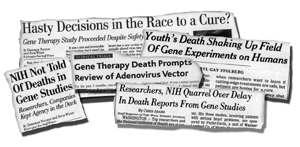 A couple of months after we launched
our running investigation into a fatal gene therapy experiment
at the University of Pennsylvania, we got wind of a rumor circulating
at the school. According to the whispers, the Washington Post
reporters were getting their "inside" information from
a big leak at the FDA. Looking around our desks, barely visible
under the teetering piles of documents we'd painstakingly collected
from so many far-flung sources to build our story, we weren't
sure whether to laugh or groan.
A couple of months after we launched
our running investigation into a fatal gene therapy experiment
at the University of Pennsylvania, we got wind of a rumor circulating
at the school. According to the whispers, the Washington Post
reporters were getting their "inside" information from
a big leak at the FDA. Looking around our desks, barely visible
under the teetering piles of documents we'd painstakingly collected
from so many far-flung sources to build our story, we weren't
sure whether to laugh or groan.
If only it had been so easy. We didn't have a leak at the FDA. Information on the Penn experiment and other problems in gene therapy came in frustratingly small drips squeezed from public records, peer-reviewed studies, conscientious scientists, and fretting ethicists.
We felt as if we were struggling over one of those 500-piece jigsaw puzzles, except the pieces didn't arrive all together in a shrink-wrapped box. They were scattered in dozens of places from the obvious to the obscure: a footnote at the end of a published study, a paragraph culled from meeting minutes, a chart in the program for a scientific conference.
It all started in the closing moments of a two-hour phone conversation between Deborah, newly hired as an investigative reporter, and an academic about a wide range of topics, none of them related to gene therapy. As they prepared to hang up, the academic mentioned hearing that a volunteer had died from gene therapy-the field's first acknowledged casualty after a decade of failed efforts to treat disease by manipulating genes.
But the academic didn't know when or where the death might
have occurred. And, while Deborah had spent some time investigating
medical research, she didn't know squat about gene therapy. But
if something has gone wrong, no matter what the subject, it usually
must be reported somewhere. Finding that somewhere seemed like
the place to start.
In the case of gene therapy, somewhere turned out to be the NIH
Office of Recombinant DNA Activities (now renamed Office
of Biotechnology Activities). The agency provided the adverse
event report-a public record-that described the September 17 death
of a volunteer in a gene therapy experiment on adults with ornithine
transcarbamylase (OTC) deficiency, a rare liver disorder.
With documents in hand, Deborah quickly realized she needed
a translator, so she went in search of a newsroom colleague knowledgeable
about gene therapy. That turned out to be Rick, who was well-suited
because he'd covered the field since the first experiment and
lived just a few blocks from her-so we could share cab rides on
the many late nights to come.
Actually, we didn't expect there to be many late nights to come.
We figured we'd throw together a quick-breaking news story, maybe
a human-interest follow, and then go back to what we'd been working
on before the death. Little did we know that during the next several
months, we'd become almost inseparable, even becoming proficient
at sitting down together at a single keyboard and hammering out
stories by taking turns writing sentences and editing each other's
words on the fly.
The first story ran September 29, jolting the gene therapy field and the public. (We weren't first. A Tucson newspaper had already published a well-done piece on the death of the local teen, Jesse Gelsinger. Surprisingly, it went unnoticed outside the readership area.) We did a follow-up piece, and Deborah prepared to move on. But a couple of developments intervened.
First, the unit's researcher, Alice Crites, had found old minutes of a 1995 meeting of the Recombinant DNA Advisory Committee (RAC), the National Institutes of Health review body for gene therapy experiments, on the agency Web site. The experiment had been reviewed by the committee at that meeting, and some of its members had raised serious questions about the design and wisdom of the study, the minutes showed. Calls to the RAC members who'd expressed reservations led to calls to other scientists, which led to the discovery of safety studies that seemed to foreshadow Jesse's death and an abstract on the interim study's own safety data, printed in a conference program, that raised concerns among some attendees at the time it appeared.
Second, Internet and clip searches on our first day of reporting revealed that the lead investigator, Jim Wilson, had co-founded a private biotech company that maintained close financial ties with the institute he ran at Penn. In two separate conversations that day, Jim told Rick that his company had no interest in the OTC experiment, so we didn't make an issue of it in those early stories. Yet something about the company-scientist relationship didn't sit well with Deborah's editor, Marilyn Thompson, who told her to stick with the business angle a little longer just to make sure.
Rick wasn't sold yet on the need for more digging, and Deborah swears she could detect a glimmer of horror in his eyes every time she approached him bearing new scientific records to translate, which by this time had escalated to several times a day.
But all that changed when she finally came up with a document that grabbed his attention: The first evidence that Wilson's company did in fact have a financial interest in the experiment, noted in a paragraph in an addendum to the study protocol, which coincidentally had been reprinted in a small medical journal that came out right after Jesse's death. It said that Wilson, his company Genovo, and Penn had a financial interest in the successful outcome of the study.
Now joined at the hip as a team, we found another reference to Genovo's financial interest in an older journal article on gene-delivery research that we now realized was related to the OTC experiment. When we presented the information to the CEO of Genovo, he reluctantly acknowledged that, while his company had no direct interest in OTC deficiency per se, it had a financial interest in the genetically engineered virus used in the experiment to deliver the genes to the volunteers' livers.
In addition, SEC documents and online press releases showed the company had attracted tens of millions of dollars from companies interested in developing ways to deliver genes to the liver and lungs-and Wilson himself had said he considered OTC the perfect disease for testing a liver delivery system that could be used for an array of diseases.
Rick called Wilson and had a heart-to-heart talk with him in which he candidly expressed his distress that Wilson had been less than forthcoming about the Genovo interests. It was a difficult conversation since Rick had covered Wilson's work over a number of years and both knew each other pretty well. Rick told Wilson he wasn't sure he'd be able to trust him any more. Wilson responded that he also felt bad but that he thought it must have been a miscommunication. Rick said he wanted to believe that-after all, who can say they've never heard something wrong? But before long, a painstaking review of the records on the study uncovered other discrepancies.
For example, the original consent form reviewed by the RAC disclosed that monkeys died after receiving a high dose of a similar genetically-altered virus carrying the OTC gene. Yet the monkey deaths had disappeared from the consent form that Jesse received, which we got from Penn after obtaining Jesse's father's permission.
But one of the most startling pieces of evidence that Wilson had something to hide came one evening as we were getting ready to close a long story for the next morning's paper that spelled out much of the previous history of the OTC experiment in animals and in the patients leading up to Jesse.
Deborah called Jim to go over the facts and our interpretation of them. As is her practice when time allows, she went over the story with him from start to finish. When she reached a section that parroted his earlier representation to us that none of the volunteers preceding Jesse had suffered any serious side effects, he nervously cleared his throat. Maybe, he said, you'd better say there were no life-threatening adverse events.
Further discussion revealed that there had been at least one serious adverse event and maybe more. Few details beyond that were forthcoming that evening, but we changed the story to reflect that, in fact, there had been serious side effects not previously disclosed by Wilson. Only later, after the FDA completed its investigation, did the agency release records that showed four successive volunteers had suffered side effects so serious that Penn should have halted the study and notified the federal agency immediately in every case-but didn't do so for the third or fourth patients.
Actually, we had a hint even before the FDA came out with its report that more than two patients might have experienced serious adverse events. The story of how we got there offers an example of how some experience reporting on (and, in Rick's case, doing) science can help in investigating scientific research.
Our perusal of the OTC protocol had revealed certain "stopping rules" that required the study to be suspended in the event of certain problems. One of those rules stated that if any patient experienced a "Grade 3" toxicity, then the researchers had to contact the FDA and suspend the study until that reaction was understood and the FDA gave permission to restart the trial. Elsewhere in the protocol (we had to look through a lot of fine print to find it), Grade 3 liver toxicity was defined as five times the normal level of liver enzyme measurements.
We had already found an abstract with interim patient safety data, published in the program of a scientific conference, and it summarized the combined and averaged liver enzyme levels per cohort of patients who received the same dose of experimental treatment.
To figure out how many people may have experienced Grade 3 toxicity we had to first find the upper limit of normal for those tests, which Rick had on hand from the days when he used to conduct those tests as a medical technologist. (Knowing that each hospital lab can have somewhat different definitions of "normal" because of idiosyncratic differences in equipment and standards, we cut some slack in our estimates.)
Then we had to deal with another complication: Normal values for these tests are different for men and women, and it wasn't noted in the raw data which patients were which. To get past that roadblock, we relied on another part of the protocol, which called for the first two volunteers at each new dose level to be women (a safety provision, since for arcane genetic reasons it was less likely that women would suffer serious adverse effects). Applying that information to the raw data chart, along with the high normal values for each gender multiplied by five, we could see whether individuals whose liver values we had access to were in fact below the Grade 3 toxicity level.
Through those and various other calculations, we realized that in one particular cohort there was no way that the average could be as high as it was unless one or more volunteers had Grade 3 liver enzyme measurements. Yet the study hadn't been halted. Indeed, as the FDA eventually announced, that agency was never told about two of the four patients who suffered those side effects.
Interestingly, the FDA also ultimately busted Penn for enrolling Jesse as the second member of a cohort on the basis of the protocol rule that required the first two to be women. It hadn't occurred to us in our earlier calculations that this rule, too, might have been broken, and that our assumption that the first two volunteers in previous cohorts had been women might have been wrong!
As evidence mounted, a third element drove us to pursue this story. Deborah had spoken frequently to Jesse's dad, Paul Gelsinger, who told us that his son had gone into the experiment with the best of intentions. He thought he was signing up for a low-risk experiment that might help future generations of children born with more serious and fatal versions of the disease. He was a hero, Paul said.
That made it all the more important to us to do justice to this story by thoroughly investigating the troubling evidence of problems in this and other gene therapy experiments. His death prompted us to look into other gene therapy experiments, leading us to discover through interviews and public records that some of the country's leading gene therapy scientists weren't reporting deaths and illnesses of volunteers to the NIH as required.
One lesson that came out of our reporting, especially for Rick, who has covered science for 15 years and become friendly with many scientists, including Wilson, was that there are real downsides to growing so familiar with sources that it becomes difficult to remain sufficiently skeptical of what they tell you.
Of course we all are wary of overenthusiastic predictions of clinical efficacy or boastings about the scientific import of a particular advance. And none of us want to live our working lives in constant suspicion that we're being lied to. But at a time when so much rides on success for scientists-from fame to financial windfalls-it seems more important than ever that we all maintain a higher level of skepticism than ever, and ask the hard questions that in the past might have seemed impertinent. You never know where one niggling discrepancy is going to lead.
Deborah Nelson and Rick Weiss are reporters for the Washington
Post.