
|
|
| Volume 49, Number 1, Spring 2000 |
IN REMEMBRANCEby Lewis Cope, NASW President 1991-92 Victor Cohn was the dean of the science-writing profession. He changed how our whole nation learns their health news. How every American learns about new treatments. How every American learns about new prevention approaches. How every American can cope with our tangled health-care system. Before Vic became a science writer 53 years ago, medical reporting was rare. And what there was of it was mostly only technical stuff. How this and that study was done, and not much more. Victor showed journalists how to broaden, how to humanize, how to simplify medical news reporting without writing down to people. And, how to write it beautifully. He, more than anyone else, made good, solid medical reporting popular. The journalistic roots that Vic planted and cultivated have flowered into a major field of reporting. Victor could cover the shooting of a sitting President--and did. With great distinction. He could cover the first footsteps of humans on the moon-and did. With great distinction. But he also could cover what moms and dads should know-needed to know-when their kids had winter colds. And, he did. He pioneered telling Americans how they could get through the labyrinth of our managed care system. He was telling reporters long ago about the importance of health costs. That no report about a new treatment, no report about any "medical miracle" was complete without telling what it would cost patients. When he wrote about prevention, it wasn't how to prevent a heart attack-it was how to protect your heart. In humanizing and reaching the broadest possible audience for medical reporting, Victor never lost sight of the need for separating the good studies from a lot of the chaff of medical research. "Never lost sight" is an understatement. He preached it. He wrote a book about it. He constantly talked about it to science writers. To veterans as well as new members of the profession. To new members, by the way, that Victor always was available to help in any way possible. So every time you read a medical story in a newspaper, or hear one on TV, you are seeing or hearing our Vic. Every time every American reads a medical story, or hears one on TV, they are seeing or hearing our Vic. But Victor was much more than a pioneering journalist. He was a fine person. One of the finest I ever knew. He was a godfather to our youngest daughter, and always took time to talk to and help all three of our daughters. They called him "Mr. Vic," an honorific that I believe was just as important to him as the honorary doctorate degree he was awarded by Georgetown University Medical School. Yes, Victor loved people. And, he never lost his sense of humor. He still addressed the mail to me as "Lew Cope, Boy Reporter." When I went to work for Vic at the Minneapolis Tribune, 33 years ago, he offered this advice: "Lew, you need to go downtown and buy a vest; one with a lot of pockets in it. The editors will be sending you a flood of memos, telling you how to run your life. Just file them away in one of the vest pockets. "Then when an editor asks you how you're doing on his idea, just remember which pocket you put his memo in, pull it out, wave it, and say 'I'm working on it right here.' The editor will go away happy and probably forget his idea. And, you can go about your business." |
Victor Cohn, 80, a prize-winning science writer for the Washington Post whose interests ranged from space exploration to the treatment of poliomyelitis and the use of statistics in medicine and related fields, died of lung cancer February 14 at his home in Washington, DC.
A native of Minneapolis and a graduate of the University of Minnesota, Cohn began writing about science while serving in the Navy during World War II. While stationed in San Diego, he edited a confidential fleet journal on technical developments in such fields as radar and rocketry.
After the war, he returned to the Minneapolis Tribune, where he had started working shortly before the United States became involved in the conflict, and continued to cover science. In 1968, he moved to Washington and joined the Post, where he was a reporter and editor until retiring in 1993.
In the course of his career, he became the first person to win the AAAS Science Journalism Award on two occasions. He also won the Lasker Award for Medical Journalism, for a series of articles that led to better care for mentally ill children; the James T. Grady Award of the American Chemical Society, for his coverage of the Apollo 11 flight to the moon; the first National Press Club Award for Excellence in Consumer Reporting, for his coverage of unneeded hospital construction and the fact that it was causing higher hospital bills; and two Science-in-Society Awards from NASW, one for medical writing in general and one for a series on the increasing practice of rationing medical care.
Cohn's books included News and Numbers: A Guide to Reporting Statistical Claims and Controversies in Health and Other Fields, which was a standard reference work in its field, and Sister Kenny: The Woman Who Challenged the Doctors, about the health-care worker who advocated exercise as a treatment for polio.
After retiring from the Post, Cohn became a research fellow of the American Statistical Association. He also was a visiting fellow at the Harvard University School of Public Health. He is a past president of NASW (1960-61) and was a founder of the Council for the Advancement of Science Writing, which in 1999 established the Victor Cohn Medical Science Writing Award.
Cohn had a reputation for meticulous reporting and a willingness to help colleagues stumped by the arcana of science.
(Source: Washington Post)
Cohn Award Memorial FundThe Council for the Advancement of Science Writing is accepting contributios in the memory of Victor Cohn to fund an endownment to benefit the newly established Victor Cohn Medical Science Writing Award. To make a contribution, send a check (made payable to CASW) to CASW, P.O. Box 404, Greenlawn, NY 11740. |
|
|
|
|
|
|
Journalism owes a lot to the science-writing pioneers. The big story was the economy when they founded NASW in 1934. After the war, the big story was science. Editors who could handle economics and warfare didn't know what to make of it. But they didn't have to scramble to invent a new kind of journalism. It was already there-well-grounded, mature, and ready to go. Seasoned science writers picked up the ball and mentored newcomers.
When I joined the Christian Science Monitor in 1950, Nick was already a legend there. He had moved on to the public information office at the USGS. He left behind a solid legacy. The point had been made that the science writer stood as tall in the Monitor news hierarchy as the political reporters or foreign correspondents. His successor didn't have to fight that battle, but did have a lot to live up to. Nick's mentoring on the few occasions when we met at scientific meetings helped to meet that challenge.
With his passing, the last of the NASW pioneers has gone. The roster listing members by date of joining jumps from 1934 to 1946. Nick used to say he wasn't a founder because he didn't attend the founding meeting. Nevertheless, he joined so soon afterwards we can consider him a founding member. He was active and went through the NASW offices-vice president 1939, president 1947. After he left the paper, he worked in public information for USGS, General Electric, and the National Institutes of Health. However, there's more to his career than science journalism. A Harvard-educated botanist, his American Men of Science listing cites research on "xerophytes in relation to varying habitat; planetary satellites; flora and fauna of Panama Canal Zone."
Then there's his military service, which raises an intriguing question. To judge from sketchy notes in the Monitor's archives, he had a long service in the reserves as well as active wartime duty. While he was nominally in artillery, he seems to have done a lot of intelligence work. His final wartime assignment was military intelligence in China from which he emerged a lieutenant colonel with a commendation from his commanding general. In a note in the archive file, he answers someone's question as to what it takes to be a military intelligence officer, saying, it took "many service schools and special studies followed since early training began in 1923." Do the math. Nick was born in 1907. He would have been 16 in 1923. Is the date a typo? Nick graduated from Harvard in 1932. Or was my predecessor a young James Bond wannabe? Checking that one out through Pentagon archives was more investigative journalism than this reporter wanted to tackle.
Nick, I wish I had known you better. Your legacy, which I inherited, shows that, as a science writer, you did well.
(Contributed by Robert Cowen, Christian Science Monitor.)
Former NASW member Bill Struble died at his home in Marshfield, MA on January 27 at age 77. Struble, a consummate science writer who worked at MIT for 23 years, spent most of his career in the institute's news office.
Known for accuracy, accessibility, and his deep knowledge of science and scientists, Struble was also a friend to many of the nation's science writers. Paul Raeburn, now at Business Week, remembers him well:
"Bill Struble got me started. My very first job was in the MIT news office. I didn't know what a lede was, or an inverted pyramid. In fact, I knew less than nothing. He took me under his wing and taught me from A to Z. He was my professor of journalism, my dean, everything. He was also one of the ultimate gentlemen in our business, which was reflected in his graceful ways of writing."
Dennis Meredith, a former managing editor MIT's alumni magazine, Technology Review, recalled Struble as "charming and low-key, and he really knew his science. As a young science writer, I used him as a model who wasn't flashy, but very respected and solid. Bill was a very adept writer, and I had the feeling that the faculty respected him deeply. He understood it, and he could explain it." Meredith now heads Duke University's news service.
Struble joined the MIT news bureau in 1959 after serving as science editor of the Rochester, NY, Times-Union, where he and long-time NASW member Harry Schmeck were colleagues. He had earlier worked at the Endicott, NY, Daily Bulletin, and the Binghampton Sun, his hometown paper.
A 1946 graduate of Hobart College-having interrupted his education to serve in the US Army Signal Corps during World War II-Struble studied languages at the Sorbonne in Paris, Yale University, and Middlebury College. He was fluent in French, German, and Russian.
"He once told me he had joined the choir of a Russian church to polish up on his Russian," said Bob Di Iorio, a former MIT news office colleague. "He was a great aficionado of classical music."
Di Iorio also recalled that "the jokes Bill liked best were those that were on him. I remember he once got a letter addressed to William St. Ruble. So he went around for a long time being St. Ruble."
An abiding interest in science and science writing was reinforced for Struble when he spent an academic year in Columbia University's advanced science writing fellowship, which served as a model for some of the fellowship programs that exist today.
He came to MIT at a time when much of the news in science was "atomic," and he excelled in explaining to us neophytes what the heck it all meant. During his time at MIT, Struble also wrote and edited a number of the university's publications, including Reports on Research, Technology Review, and a vast number of science-based news releases.
His positions at MIT included being managing editor of Technology Review, then editor, and later he was named director of publications for the institute. In that latter position he oversaw design and production of all of MIT's publications.
Almost as a career swan song, Struble also won appointment to the International Institute of Applied Systems Analysis, and spent a year or more in Austria editing materials at the agency's headquarters in a splendid chateau near Vienna.
After retiring form MIT in 1982, Struble and his wife, Margaret, who died several years ago, opened a bookstore in Plymouth, MA, which they ran for two years.
(Contributed by Bob Cooke, Newsday)
IN REMEMBRANCEby Laurie Garrett, NASW President 1995-96 Last year I had the pleasure of participating in a wonderful festival Ian organized, ScienceNOW! Though he was recuperating from his first hospitalization, Ian was a bundle of energy and enthusiasm. One afternoon we sipped wine at sunset at a bistro on the Yarra River and Ian recalled a day more than a decade previously when we had tromped across the fresh lava flows of Kilauea, Hawaii. Characteristically, Ian savored the memory of his awe and wonder over Earth's molten force. He took true delight in science and nature, having never, I think, lost the sense of joy in discovery that, sadly, is so often lost in most adults. His departure comes far, far too soon. He will be sorely missed. |
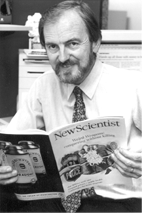
Ian Anderson, the first Australasian editor of New Scientist, died on March 20 after a long battle with cancer of the peritoneum of the heart-a form of cancer so rare that only a handful of oncologists in the world have ever treated it. He was 53.
Ian was raised in Melbourne, Australia, and began his career as a journalist at the city's Sun News-Pictorial. He later spent several years as deputy information officer at Monash University. Ian went overseas with his biochemist wife, Robin, as she pursued her career in cancer research at Stanford University. Later, they went to London, where Ian freelanced and worked for the British Schools Council.
|
|
|
Ian researched and wrote hard-hitting features. For example, his expose on how Britain kept Australia in the dark over the conduct and environmental impact of nuclear testing in the South Australian desert put pressure on the UK government to make a commitment to clean up the test site. This series earned him the two Michael Daley awards for excellence in science journalism. He was also the recipient of the 1998 Public Communication Award from the American Society for Microbiology.
Ian was a member of the inaugural committee of Australian Science Communicators--an increasingly important lobby group for science awareness-and served as the organization's second president. He was the driving force behind the establishment ScienceNOW!, an annual gathering in Melbourne of science and the media to promote Australia's young researchers and present their stories to the general public.
Ian was also a passionate Australian Rules Football fan and a fixture at the annual Australian Open Tennis tournament. Until his illness, he was a handy tennis player and golfer. He loved folk music and early recordings. His collection of 78 rpm records and players were his pride and joy.
(Source: New Scientist)