|
|
| Volume 49, Number 1, Spring 2000 |
by Suzanne Clancy
|
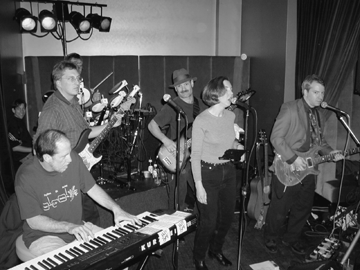
Wild Typeby Paul Raeburn When the Baltimore rock band Wild Type played its first gig three-and-a-half years ago, it quickly found out how perilous a musician's life can be. "The neighbors called the police," says keyboardist Bert Vogelstein, Ph.D. He and the others escaped arrest. And, it's a good thing: Otherwise the band might not have survived to rock the house at the DCSWA party in February during the AAAS meeting. When Vogelstein isn't playing Jerry Lee Lewis with Wild Type, he plays a starring role at Johns Hopkins University as the world's leading authority on the genetics of colon cancer. And, that's not all--all of the members of Wild Type are, or were, in Vogelstein's lab. "Once a week, for three hours, we forget cancer and concentrate on the music," Vogelstein said between sets at the DCSWA party. "When you're playing music, you can't think about anything else. The rest of the time, we're thinking about cancer-which is not that much fun." Besides Vogelstein, Wild Type is made up of Pat Morin, Ph.D. (lead guitar and bandleader), Ellie Carson-Walter, Ph.D. (lead vocals), Chris Torrance, Ph.D. (rhythm guitar, backup vocals), Bob Casero, Ph.D. (bass), and Ken Kinzler, Ph.D. (drums). One clue to the band's secret life? It sells Wild Type T-shirts at its performances to benefit pediatric cancer patients. "We tell students we're not just nerds--we're nerds with expensive electronic instruments." Paul Raeburn is senior editor of Science and Technology at Business Week. |
In April, NCSWA members heard an intriguing talk by UC Berkeley developmental psychologist Alison Gopnik, co-author of The Scientist in the Crib. Like scientists, children are learning machines, said Gopnik, constantly changing and adapting their assumptions about the world in accordance with the information they receive. The parents in the audience were relieved to learn of Gopnik's conviction that the Mozart tapes and other supposed environment-enriching tools on the market are no better at helping kids learn than simply crawling around on the floor with them, playing with whatever is available and, importantly, spewing lots of baby talk.
Also in April, NCSWA members and families braved a tour of the Jepson Prairie vernal pools (southwest of Sacramento) at their windiest. Led by the only docent with a permit to dipnet from the pool, members saw lots of creatures that live in the murky waters, including inch-long tadpole shrimp and bright orange clam shrimp. Some members with small children had to leave, but those who persevered against the wind were rewarded with carpets of tiny, spring wildflowers including goldfields, golden violets, tidy tips, and meadowfoam.
PSSWA continues to thrive. The group met in February to hear book-writing tips from three members: Bill Dietrich (The Final Forest: The Battle for the Last Great Trees of the Pacific Northwest), Linda Shepard (Lifting the Veil: The Feminine Face of Science), and David Gordon (The Compleat Cockroach: A Comprehensive Guide to the Most Despised-and Least Understood-Creature on Earth).
In February, DCSWA members welcomed colleagues to the nation's capital for the annual AAAS and NASW meetings. DCSWA and two dozen local media and research institutions sponsored a lively evening at Cities, a chameleon of a nightclub and restaurant in the multi-cultural, trend-setting neighborhood of Adams Morgan. Cities, which periodically switches its cuisine among the famous cities of the world, became Venice for the evening, serving smoked seafood and eastern Mediterranean dishes. An enthusiastic crowd rocked with Wild Type, a group of talented musicians who also happen to be leading cancer researchers at NIH and Johns Hopkins University. Check out party photos at www.nasw.org/dcswa.
DCSWA's March program focused on the future of genomics and bioinformatics. More than 130 science writers met with Celera Genomics president J. Craig Venter; Gerald Rubin, head of the Berkeley Drosophila Genome Project and vice president for biomedical research at the Howard Hughes Medical Institute; and Michael Brennan, CEO of Genelogic, a leading genomics and bioinformatics company located in Gaithersburg, MD. The evening included tours of Celera's sequencing machines, computers, and other facilities.
Suzanne Clancy, Ph.D. is science writer at The Salk Institute
in La Jolla, CA. Send information on regional meetings and events
to suzanne_clancy@qm.salk.edu.