 |
| Volume 51, Number 2, Spring 2002 |
2001 SCIENCE JOURNALISM AWARDS BESTOWED BY AAAS
The awards, sponsored by The Whitaker Foundation, were presented during the AAAS annual meeting, held in Boston in February. Online David J. Tenenbaum, Sue Medaris, Terry Devitt, Darrell Schulte, and Amy Toburen of The Why Files won for their online site "Buried Treasure" (Oct. 5, 2000). The site utilized the multimedia capabilities of the Internet and succeeded in making obscure topics, such as coal liquefaction, interesting to a general audience. Newspapers with a circulation of more than 100,000 Scott Shane of The Baltimore Sun was recognized for his special series, "A Quiet Crusade" (Oct. 22-24, 2000). He was praised for painting a vivid portrait about a Johns Hopkins University program to bring much-needed vitamins to the people of Nepal. Newspapers with a circulation of less than 100,000 Richard Monastersky of The Chronicle of Higher Education won for the articles, "Nowhere Men: Scientists Debate What Happened to Neanderthals?" (Sept. 8, 2000), "Under the Volcano" (March 30, 2001), and "Where Have All the Frogs Gone?" (April 20, 2001)." Monastersky demonstrated a mastery of the science beat and wrote with an edge. His reporting was thorough and had some of the best explications of the debate to date. Magazines Heather Pringle won for the "Secrets of the Alpaca Mummies" that ran in Discover (April 2001). Her strong narrative drew from a wonderful confluence of agriculture, archeology, and zoology. The story conveys a fantastic sense of history. Radio Christopher Joyce of National Public Radio was recognized for his programs on All Things Considered: "Stargazing 1: International Gemini Telescope Project" (June 4, 2001), "Wasp Observed Reprogramming a Spider to Adjust Webbuilding Technique" (July 20, 2000), and "How Life Got Started on Earth Researched" (Jan. 29, 2001). Joyce created original radio programming on the process of science, applying the effective use of sound effects to establish environment, as he covered unique topics that may not normally receive attention from the general media. Television Betsey Arledge, Julia Cort, and Robert Krulwich of WGBH/NOVA won for their two-hour program "Cracking the Code of Life" (April 17, 2001). They followed the race to decode the human genome between the Human Genome Project and Celera Genomics. The producers won the award for portraying the impact of science on society and keeping a well-exposed topic stimulating through an exciting mix of interviews, sharp writing, and graphics. Since the inception of the awards program in 1945, more than 300 individuals have been honored for their significant achievements in the field of science reporting. The Whitaker Foundation, which supports research and training in biomedical engineering, has sponsored the AAAS Science Journalism Awards since 1995. Independent screening and judging committees comprised of scientists and science journalists selected the winning entries based on their scientific accuracy, initiative, originality, clarity, and value in fostering a better public understanding of science. (Source: AAAS news release) |
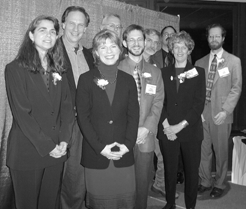 Twelve
journalists-including Scott Thane, Richard Monastersky, Heather Pringle,
Christopher Joyce, and teams of writers from The Why Files and WGBH/NOVA
were the winners of the AAAS 2001 Science Journalism awards.
Twelve
journalists-including Scott Thane, Richard Monastersky, Heather Pringle,
Christopher Joyce, and teams of writers from The Why Files and WGBH/NOVA
were the winners of the AAAS 2001 Science Journalism awards.