SCIENCE EXAMINED AS QUINTESSENTIAL SPECIAL INTEREST
reviewed by Rick Borchelt
 Fans
of Dan Greenberg's withering sarcasm and acerbic wit have had to content
themselves in recent years with back issues of Science
and Government Report, the legendary D.C. rap sheet about
the foibles of national science policy that he edited for 26 years.
But since retiring from the editorship, he's been making up for lost
opportunities to tweak the noses of the science establishment writing
Science,
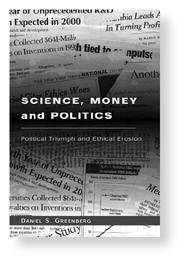
Money, and Politics (University of Chicago Press, 2001), a
recap, in vintage Greenberg style, of the politics and finance of
science from the end of World War II to the end of the 20th century.
This is a story, Greenberg tells us, of how science "left the
cloistered laboratory to make its claims on resources in the clamor
of competitive America," spawning along the way "a supportive,
inventive bureaucracy that has eroded the right values of science
and transformed it into a clever, well-financed claimant for money."
And that's just the set-up from the book's first paragraph. Fans
of Dan Greenberg's withering sarcasm and acerbic wit have had to content
themselves in recent years with back issues of Science
and Government Report, the legendary D.C. rap sheet about
the foibles of national science policy that he edited for 26 years.
But since retiring from the editorship, he's been making up for lost
opportunities to tweak the noses of the science establishment writing
Science,
Money, and Politics (University of Chicago Press, 2001), a
recap, in vintage Greenberg style, of the politics and finance of
science from the end of World War II to the end of the 20th century.
This is a story, Greenberg tells us, of how science "left the
cloistered laboratory to make its claims on resources in the clamor
of competitive America," spawning along the way "a supportive,
inventive bureaucracy that has eroded the right values of science
and transformed it into a clever, well-financed claimant for money."
And that's just the set-up from the book's first paragraph.
It's been more than 30 years since Greenberg's last thumb-your-nose
book about scientific officialdom, The
Politics of Pure Science, first released in 1967 and regularly
updated (most recently in 1999). In the earlier book, Greenberg first
described the early postwar development of a defined scientific establishment"
that by the end of the 20th century has become a rampant entitlement
program gorging itself at the public trough. The players have increased
in number and aggressiveness, Greenberg says, and the result has been
the formation of "the quintessential specialinterest group,"
so powerful "they make the oil industry look like a piker."
Greenberg's harshest criticisms are devoted to an examination of
programs aimed at public understanding of science. As Greenberg describes
it, public
enlightenment about science could be passed over as a worthy, unselfish
public service were it not tainted with the political conviction that
the public understanding of science is essential for public support
of science. Instead, Greenberg tells us, programs to enhance the public
understanding of science manifest "the cargo-cult mentality in
science: Like the post-World War II Pacific Islanders who faithfully
tended abandoned airstrips and piers in hopes of shipments of goods
again coming over the horizon, scientists anguish over, and promote,
the public understanding of science as indispensable to public financing
of their work." This relationship does not, and never did, exist;
"nonetheless, the delusional association pervades the politics
of science and generates voodoo assertions, questionable behavior,
and career opportunities."
Greenberg's harshest
criticisms are devoted to an examination of programs aimed at
public understanding of science.
|
The proof, he notes, is that science has prospered in the 50 years
since the Second World War in the face of declining scientific literacy
and minimal civic involvement in the process of scientific discovery.
Indeed, Greenberg says, this is how the scientific establishment likes
it: "Scientific leadership does not seek to encourage public
participation in the politics of science. Rather, it seeks public
support for more money for science, without public interference in
the use of the money."
Greenberg ties all these arguments firmly back to finance. He contrasts
quotes from various NIH luminaries
direly predicting a looming fiscal crisis for health science funding
with the actual data for NIH funding: Beginning in 1996 at $12 billion,
the agency recently claimed a $20 billion war chest, all "without
a molecule of evidence of a commensurate increase in the public understanding
of science or any indication of wobbling in public and political sentiment
for even
greater support." NIH's pale public image may be a blow to its
institutional pride, he notes, but has apparently been without fiscal
consequence. By contrast, the
public-relations powerhouse at NASA
has presided over flat or declining budgets during the same period.
Mass media are the willing and eager compatriots in this ruse, Greenberg
alleges. In the case of cancer research, for example, he notes that
"good news about
cancer must be emphasized and, if need be, manufactured, to keep up
public spirits and support. The press collaborates, though in occasional
fits of professional conscience, it balks and questions the contrived
optimism that shades the news of cancer and so much else in the scientific
enterprise," but with limited corrective action. The 1998 New
York Times coverage of Judah
Folkman's research in tumor therapy merits special attention from
Greenberg, but the problem is endemic and epidemic in science journalism.
Harsh words from
one of its own.
But Greenberg is principled to a fault, and he even recounts his
own role in furthering a scheme he spends much time debunking in his
book: The necessity
for grassroots political action by the scientific community. Following
the 1995 takeover of the House of Representatives by the Republican
Party and subsequent budget-cutting plans that would have had the
effect of eviscerating civilian science and technology spending, Greenberg
penned an MIT Technology Review
article, "Scientists Must Join the Fray." "With
characteristically clouded journalistic foresight, I argued that political
action, rather than mere petitions for kindness, was the only route
to salvation for science. The article evoked no interest-a frequent,
deserved fate of journalistic prophecy and prescriptions. Science
continued to abstain from ballot-box politics, and came out of the
supposed crisis with budgets plumper than ever."
In his review of this book, San
Francisco Chronicle Science Writer Keay Davidson opined that
"We need more Greenbergs. Too many science writers cover science
as uncritically as fashion reporters cover fashion." Anyone who
watches the annual fashion review of the Academy Awards done by Joan
Rivers might question that last statement; Greenberg's is a no-holds-barred
survey in the Rivers mold. But Keay's point is well taken. Dan Greenberg's
is a clarion call for fellow science writers to follow the money trail
before putting pen to paper.
#
Rick Borchelt is the director of communications and public affairs
for the Whitehead Institute
for Biomedical Research in Cambridge, Mass.
-
Return to NASW homepage.
- Return
to NASW Members' Lobby.
- Return
to ScienceWriters Newsletter homepage.
|