 |
| Volume 51, Number 2, Spring 2002 |
ON THE LISTSby Bob Finn
On Feb. 26, Lee Siegel, a science news specialist at the University of Utah, asked for advice on an "ongoing pain in the rear": requests for news releases and other publicity by faculty members who have won various honors and awards. "If someone wins a Nobel, another BIG award, or even is elected to National Academies membership, then fine, I'll do a brief release," wrote Lee. "But most of these requests deal with incredibly esoteric honors from the researcher's specialty professional organization." Lee said he continues to get such requests even though he explains to the faculty member that the media rarely use such material and that he would be better off publicizing something newsy about research. A number of the PIOs who responded said their institutions were happy to place such notices in the alumni magazine or the faculty-staff newsletter. "People get internal recognition, which is what they really want anyway," said Sally Pobojewski, a senior science writer at the University of Michigan, "and no one cares that we don't send the stuff to journalists, who don't care." But Lee said that at his institution the editor of the faculty-staff newsletter regards mentions of such awards to be a waste of space since no one reads them. Others begged to differ. Eric Mankin, associate director of USC's news service, for example, wrote, "In my experience they are the first thing scanned in such a paper, particularly if the names of the awardees are bold-faced. … I believe you are needlessly alienating the people you need to work with by the global disparagement of the in-house news value of this kind of news: You're saying that something very important to them is nothing." Several PIOs mentioned that they do an e-mail or Web-based digest of such awards that's sent to faculty, local papers, and other interested individuals. Walter Neary, assistant media-relations coordinator at the University of Washington Health Sciences, for example, pointed to UW's awards Web page at depts.washington.edu/mednews/awards.html and noted, "Faculty like this section. Since the information is searchable on the Web, this information is available to reporters who are researching the background on a faculty member-which is often the only reason a reporter would care about any or many of these awards." Michael Kenward, a British freelance writer, suggested that when faced with demands for publicity on an award, "Pass the buck back to them: 'By all means write a press release. We'll read it for you to check style and can even provide you with the labels for both the envelopes you will need.'" Several discussants pointed out that PIOs could use the occasion of an award to pump the faculty member about interesting-and potentially more newsy-research and to publicize that instead. But A'ndrea Messer, a science PIO at Penn State, said that this idea, "seems a stretch to me as most of the ones I see are from extremely senior faculty who frankly are receiving them for something they did a long time ago, or over a long time period, and most often, not about things they are doing now. I find my time better spent by looking at the presentations slated for upcoming conferences, the publications coming out by researchers, the patents and disclosures filed by the university, and visiting and talking to people in hallways." A'ndrea also said that her office simply does not have the staff to write "live obits" on award winners. Amy Stone, a freelance science and medical communications specialist in Georgia, said that the solution is to use interns. "A perfect job for an intern is to compile a monthly 'Our Gang'-type of column. When I was a clerk at the Atlanta Journal-Constitution 100 years ago, part of my job on the business desk was to compile the 'Newsmakers' column. I got tons of press releases, distilled them down to one or two sentences, used a couple of photos to create this weekly column. There is a lot that can be learned journalistically from such a seemingly simple endeavor. Mainly: accuracy. Spelling people's names correctly, not to mention their titles and their awards is vital. Secondarily: writing to space. If you've got 20 inches, you can't write 25 inches worth of copy. So, an intern would actually be learning something, or at least honing some of the skills they may use in their future profession." Finally, in a post filled with no fewer than six creative suggestions
for dealing with these pesky awards, Elizabeth Luciano, a science
and technology writer at the University
of Massachusetts, wrote, "I try to keep a sense of humor.
I've come up with a name for these very prestigious awards that no
one has ever heard of: they're Schmoetzenheimers. They are awarded
by the Heinrich and Greta Schmoetzenheimer Foundation for Facilitating
Linkages and Fostering Community. I'm thinking of putting a poster
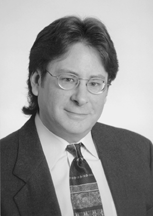
on my door… 'Headquarters of the Bob Finn Bob Finn administers NASW's Web site and e-mail lists at nasw.org. His e-mail address is cybrarian@nasw.org. |
 Nasw-pr
attracts less traffic than nasw-talk or naswfreelance, but it seems
to have the highest signal-to-noise ratio. Its subscribers don't have
a lot to say (at least not on the list), but when they do engage in
discussion it tends to be highly focused and filled with useful information
and opinions.
Nasw-pr
attracts less traffic than nasw-talk or naswfreelance, but it seems
to have the highest signal-to-noise ratio. Its subscribers don't have
a lot to say (at least not on the list), but when they do engage in
discussion it tends to be highly focused and filled with useful information
and opinions.