
|
|
| Volume 47, Number 1, Spring 1999 |
by Jon Franklin
[Editor's Note: I can't remember when my computer stumbled across WriterL, but it was a number of years ago. WriterL describes itself as a "private, subscription-only listserver tailored for the discussion of feature writing, explanatory journalism, literary journalism, book journalism and the high-level reportage that is generally associated with such writing." What attracted me originally was that it came out of Jon Franklin's science journalism class at Oregon State University. (Since then it has traveled with him to other venues.)
Franklin had been the subject of an interview in a June 1985 issue of ScienceWriters because he had won two Pulitzer prizes for his work on the Baltimore Evening Sun--but my interest now derived from Franklin's passion for the use of explicitly literary devices in the practice of journalism. What I heard him say was that expository writing was great, but sometimes narrative drive was even better. With Franklin's permission, ScienceWriters reprints here, from back issues of WriterL, some tricks of our trade.--H.J.L.]
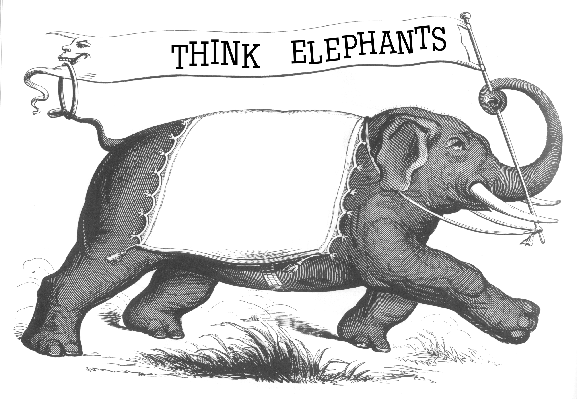 Think elephants.
If we're going to talk about smoke and mirrors, foreshadowing should be high on the list. It is one of the most powerful tricks in the writer's arsenal, yet one that only a very small number of journalists can use to full effect.
Foreshadowing, to the green eyeshade type, is giving the reader a warning, up high, that you're going to talk about a subject down below. For this reason, I started this post with the command to think elephants. I hit you with them first thing, with a hammer. There is no mistake about the intent. My lead tells you I'm going to talk about elephants down below, and I'd damned well better do it. The sentence, "Think elephants," accomplishes that, albeit obtrusively. It is, then, foreshadowing.
But why do we want to foreshadow about the elephants? What does that accomplish? Why not just wait until we get to the elephants and then write a transition to the effect that, now, dear reader, we are going to turn to the issue of elephants? What does it accomplish to know, 'way ahead of time, that we're going to do elephants? The answer is that it allows us to prepare ourselves. It allows us not to be blindsided. It is, in effect, a warning.
Why do we want to be warned? What does it mean to prepare ourselves to receive information?
Our minds work like computers, with several levels of memory. We have active volatile memory, long-term memory like that found on a hard disk, bits of unorganized memory on floppy backups. We do different things at different levels.
To find something on a backup disk you have to rummage through some physical file, find the right disk, figure out what you labeled the documentÉbig work. Preparation. It's easier to find stuff on your hard disk, probably because if you're like most of us it's better organized than your backup files, but it does take a few moments to find it and a millisecond or so to read it out. In contrast, things you've called up into your volatile memory are accessible so easily that we can say it's instant.
So, what do we do, if we need something that we have, say, in boilerplate? We find it on our hard disk and read it into volatile memory by block copying, or saving, or putting it on our clipboard, or whatever they call it in the program we're using.
When I said "Think elephants," I pulled your boilerplate about elephants into active memory. By now, some 30 or so lines into this little essay, your elephant file is pretty accessible. You are also probably getting irritated with me because of the way I'm doing it, but we'll get to that a bit later.
Anyway, elephants are in your active memory and I better get to them. Okay. Your elephants are probably different than mine, since your experiences are different. The word "elephant" is a code for a file...that's what language (as opposed to grammar) is. Codes for files. Your elephant file contains a vision of an animal you and I would recognize in the zoo and would agree was an elephant. It also carries a connotation of "very large, strong animal." So your file might contain an elephant-brand luggage, which my file does not. Various ones of us might also haul out files about en-dangered animals, Dumbo, pink elephants, and the like.
Now, then, I've fulfilled my promise about elephants. We've talked about them, and in the process I've said something about how the mind handles information. And this something turns out to be incredibly valuable to the writer of dramatic or explanatory prose.
Now the irritation. You were irritated because I hit you in the face with the damned elephant, and then kept you hanging. It had a purpose, but the means to the end was not benign. But those who were watching closely may have noticed that I did it again...when I acknowledged your irritation and promised to talk about it later. That was still irritating, but less so than the elephant lead, simply because by that time you were irritated and I acknowledged that, and gave it a name. So there was an exchange. I validated your feeling, and you cut me a little more slack. Now we are getting more into the kinds of relationship that a good writer wants to have with the reader.
The really useful thing is that the process of calling stuff up into active memory does not rely on conscious communication with the reader. That is, I don't have to say "think elephants" or "we'll get to that later." The same hauling-out process occurs each time we use a word or a phrase that's tagged to a file in the reader's long-term memory system. This means we can play exactly the same game with the reader without the reader ever knowing what's happening.
Up front, when I hit you in the face with the elephant, I also slipped in the phrase "smoke and mirrors," which opened the subject that I have just transitioned into...which is magic tricks. Foreshadowing with the elephant isn't magic because you see it.
We make it magic by doing it invisibly, by foreshadowing the thing we want to prime the reader for in the course of doing something else. Then the reader doesn't know what we've done, is not irritated, and is pleasantly surprised a few paragraphs (or chapters) later when he or she suddenly encounters the foreshadowed subject and literally feels smarter (or more intuitive) than otherwise might be the case.
Professional-league foreshadowing, in other words, is the way a light-fingered writer opens the reader's mind to something without the reader knowing it, and thus rigs a psychological trap that will be sprung someplace below. Using foreshadowing with the proper degree of cunning we can perform a long list of tricks, from amplifying the reader's ability to understand a difficult point to increasing the intensity of a dramatic moment. Rigging the trap is technique, sleight of hand, craft. Walking into it is to experience magic, to be moved, to be frightened, to find yourself suddenly delightfully perceptive.
There is a fascinating relationship that involves the distance between the time the trap is set and the time it's sprung. If the trap is to be very straightforward, as is often the case in strictly explanatory writing, it often serves the purpose of the writer to spring the trap only a short time (story time) after it's set. But often, in dramatic writing or in the more usual hybrid explanatory drama, the impact of the foreshadowing is directly proportional to the distance between the placement of the foreshadowing and the closure that is provided.
This relationship is illustrated in real life by the delayed retrieval of irrelevant information. It is a standard principle of gestalt psychology. You are telling a friend, say, about this guy you know, and you can't remember his name. Truth is, the name isn't relevant, but when you can't remember it it becomes more important than it is. So that night, while you're asleep, your subconscious mind goes ruffling around in all your backup files until, at about two o'clock in the morning, it produces the name...
So there are several principles. We will understand more if our minds are opened, and prepared, before we encounter information. We are more apt to be delighted if this understanding, be it emotional or intellectual or some combination, is unexpected. ...
If you want your foreshadowing to be effective, you have to make it part of what's happening at the time. It has to be invisible, which means that you have to be writing at two levels--the level of right-now, and the level of preparing-the-reader-for-later.
If you
want your foreshadowing to be effective, you have to make it part
of what's happening at the time. It has to be invisible, which
means that you have to be writing at two levels--the level of
right-now, and the level of preparing-the-reader-for-later.
Often I will tell a student, for instance, that a certain line has to be removed from the introduction to a story--that it doesn't belong. And he'll argue that it has to stay because it's foreshadowing. Too bad. If I can recognize that it doesn't fit the right-now, the what-is-to-come will never be. I won't read that far, and neither will the reader.
So what happens is that when we write we pack all these levels in behind the right-now, so that the reader lives in story present while being ginned up for what's around the corner.
I should point out explicitly what you've probably already picked up from the context, which is that information gets inserted into the mind the same way it gets extracted...from volatile memory to disk to a backup file on a disk thrown in a drawer. Someone whose ability to handle or pass along volatile memory has been wiped out lives always in the past, able to remember what happened in childhood while being unable to retain things that were told to him five minutes earlier.
This implies that there are two basic kinds of foreshadowing, the kind where you prepare the mind for insertion and the kind where you prepare the mind for extraction. Often you do both, as when you want to haul out the idea of elephants so that you can teach the reader, later, something you want them to know about the animals. If I raise your curiosity about a certain subject early in a piece, then you will feel rewarded when, later in the piece, I start feeding you the information for which I have created a need. It's a lot like advertising neckties, in that sense.
Depending on the situation, you may want to do multiple kinds of foreshadowing. At the slickest, several things are foreshadowed at once by each action which, itself, has a meaning in the story present. So you may want to raise a psychological issue in the reader's subconscious mind early in the piece and then dribble out reinforcing pieces of foreshadowing as the story goes along. The dribble may become increasingly conscious, until you literally say, "Think elephants," or it may remain unconscious until the reader turns the corner and suddenly is in the presence of an elephant. If you did it right he will then respond in exactly the emotional and intellectual fashion for which you have set him up. Yet he will think it's his idea.
Think about that for a minute. You have made meeting the elephant an experience instead of an exercise. People take away things from experiences--attitudes, expectations, etc.--that they don't take away from exercises. And they believe them. So the writer quite literally uses these techniques to reprogram the reader. The best writers make us what we are, and we love them for it.
This also tells us why, where good writing is concerned, you can never understand it by reading it only once. The first time through, you're too busy falling into traps to see how they are set. You have to read it again and again, until you no longer respond, before you can see the clockwork.
I am particularly fond of using Freudian methods to help my sources remember the things I want them to remember (that is, what happened, not what I want them to make up). One very simple technique--and I bet most of us practice this, without giving it much thought--is the "pre-interview" when we tell the subject what we are going to talk about, often in the process of arranging the interview. This sets the subject's mind off in search of memories of things that he or she may have long since filed away. Though those experiences are not forgotten, neither are they recently remembered, and the process for exhuming them may take several days. (That it takes time and energy to haul up old memories is pretty uncontroversial stuff.) Your subject will thus remember more, more clearly, than if you had asked them cold.
In fact, this is a version of the common experience of trying to remember, say, a great aunt's name, and being unable...and then waking up at two o'clock in the morning with the name on your tongue. The word for this is "closure," and the subconscious mind labors to achieve it even while you are asleep.
Another example: It is helpful, when you want to recreate something from very long ago, to muck around with the subject's mind (that is, have an extended conversation) that plows back and forth across the same field of interest. Pretty soon the subject will start remembering things that otherwise might never have been recalled.
Memory is really quite remarkable. We can remember very small details, assuming they were important to us--though their importance, as in Ed Ward's perfect if unconscious tally of the restaurants in one neighborhood. This is the same mechanism that might make a person notice a mother's slights subconsciously while not being able to face them consciously. We are all two people--or more--working furiously, all the time, at sometimes quite different tasks.
Anyway, memory is remarkable as well for its variability. When I was interviewing a long series of accident victims (for my first book, Shocktrauma), I was surprised and then fascinated to find out what perfect recall many people had of the accident. They remember the species of bugs on the grille of the truck that hit them, specific technical language of the emergency medical teamÉthat kind of stuff. Adrenaline burns information into the soul, apparently. But time, and the healing process, also covers it up and to get at it you often have to convince the subject to recreate the moment.
Forgetting is just as important, though we usually don't think of it that way. The mind collects what it thinks is of value (subconsciously or otherwise), works with it to draw life's conclusions, and then files it away. What it does NOT think is important, it discards. Thus, if a subject truly cannot remember a thing, it may not have seemed important (this assumes he or she isn't blocking as a result of some sort of trauma). If a subject can't remember, in other words, the writer really has to ask the question of whether the question he or she thinks is important might not be off pointÉand the whole set of questions being asked may have to be rethought.
There are obviously many variations on this, but the point is that memory is powerful and complicated, and that what we make of it depends on the psychological model we're using. It is really very unsophisticated, on the writer's part, to assume that the relationship of recall to memory is direct or one-to-one, or that there isn't information not only in what is remembered but how it is remembered and in what context. ...
The bottom line here is that we have at our command many powerful techniques that are utterly dependent not only on the writer's sense of the human mind but of reality. It seems to me that this puts special burdens on us to, first, consciously discuss our assumptions and, second, explore the dangers and define the ethical dilemmas they pose.
It's a complicated, convoluted business, to be sure. But then, any art is. That's what makes it exciting.
[A colleague] cites what he calls the "doctor-as-hero syndrome," which indicates that he thinks either that doctors are inappropriate people to consider heroes, or that what they do is not heroic, or perhaps that we should not have heroes. This may be a total mischaracterization of his thoughts, but his words are written against a background of what I think is a pretty generalized journalistic attitude against heroes of almost any sort. In the age of the kill-trained reporter, journalistic admiration for the human institutions of civilization--or, perhaps, just of those that still function--is just not cool.
I think
the current picture of medicine, as the critics pile on and the
editorial writers come down out of the hills to kill the wounded,
is as lopsided today as it was in the Fifties.
I am obviously not saying that all physicians are heroes, and I recognize that there have been times in history when they have been portrayed that way (in the Fifties and early Sixties, for example). This was not good. I also recognize that medicine is in the throes of its own institutional crisis. But as someone who has first-hand knowledge of medical science, I think science in general and medical science and practice in particular has come in for far more than its share of criticism in recent years. In fact, I think the current picture of medicine, as the critics pile on and the editorial writers come down out of the hills to kill the wounded, is as lopsided today as it was in the Fifties. I don't think it improves matters that it's lopsided in the opposite direction. ... I happen to feel strongly that the world needs heroes, and that they are there to be had...that heroes, both large and small, hold our world together and offer us whatever hope we can hold out for our children and theirs. Besides, having covered both surgeons and sociopaths, I must say that I frankly prefer to hobnob with the former. Finally, and probably most importantly, I think they make very good stories--and they are often stories that tell us constructive things, and reinforce the value of our civilization in the process. And I think the latter is important, too. ... Or, let me be more crass: Does anyone here really think you can have literature without heroes?
Another major issue is the intensity and importance of the pre-writing phase. By this I mean the extended period that good journalists devote not only to reporting but to interpreting their reporting, reshaping their theses, and going back to report and interpret some more. In addition, I'm referring to the discipline involved in such pre-writing, which is to say it's not just a formless task. Though there are surely many ways to do it, mine consists of writing down five-line synopses, stipulating theses, making outlines, creating timelines, and testing one against the other.
I don't downgrade the importance of writing, and of the literary tricks of the trade. But in my experience, writing is the icing on the cake, the last thing one does after the story is reported, interpreted, re-reported, re-interpreted, digested, re-reported, and so forth. And then the writing process often sends the writer back for yet another round of research and interpretation.
Often the writers I work with feel, as a result of their training (if you'd call it that) by magazine editors, that if they have to think through a story twice they are somehow a failure. That is, if they have to think it through a second time they must have screwed up the first time.
This is an innocent thing. They don't understand that they have been trained to produce an inferior product and, as a result, have adopted a second-drawer view of the business and, far worse, of themselves. They don't understand what makes other writers, who get paid more, so "good." The result is that when I ask for top-drawer work, they feel somehow inadequate, inferior...though they're just working through the perfectly normal "growth pattern" that produces the literary piece.
But I wanna write!" laments a reporter, after two weeks
of e-mail trying to isolate and analyze the story she's got. In
the process she reveals that she is in the habit of writing as
soon as possible, thus negating any possibility of actually BUILDING
a mind-blowing piece out of what is really some damned fine reporting.
But the actual writing is the end game. The idea that one can
simply buzz through a piece is a fantasy pushed by an industry
that benefits by keeping the product mediocre and writers in their
place. Such writers never discover the discipline which, while
painful, gives them access to power. I think this needs to be
discussed here.
How many of you out there--the successful literary journalists--spend less than 80 percent of your time and energy in pre-writing?
Yes,...pre-writing should include finding the idea/perception/thesis itself, though I have always thought of that phase as sort of semi-separate. That may be because my stories often develop over a lifetime. Things interest me, I try to figure out what they mean, and I eventually open a file to collect what I notice in the press. Finally, one day, I know what needs to be said. In a certain sense, when you do it that way, what you're doing is pushing the art back, 'way back, to the conceptual beginnings. That is, you derive the ideas from yourself and your imagination, even though the flesh those ideas take on is both factual and truthful. Another way of saying that is that we often know things before we understand them and can put faces on them and facts to them.
When you cook ideas this way, though, you have to be prepared for some devastating losses. We all have such parochial viewpoints, even though we try hard not to, so eighty percent of what seems to us like "the truth" is no such thing. About much of the remainder we are mistaken. But the few things we get right, if we can pick them out of the white noise--THAT'S where your career takes off.
Let me try to respond to [a] question about the difference between the prewriting that a literary journalist does and the done by a daily newspaper journalist...
Basically the difference relates to the difference in the purposes and the value of the product. The mission of the daily newspaper is to report on the occurrence of an event, one which ties in with other events that the newspaper has been covering. Almost all news stories assume that the reader knows the context. So all the reporter needs to do is familiarize himself with the chain of events of which the present story is a part, do the interviews, and write the story. Despite the get-it-right ethic of the profession, the acceptable error rate is really quite high for these stories, and coverage is sloppy--that is, newspaper reporters frequently cover what in hindsight are the wrong stories and, when they do cover the right stories, they frequently emphasize the wrong aspects of those stories. This is all averaged out by the fact that resulting story is economically cheap. It's done quickly by low-paid labor, has a shelf life of 24 hours and is read by a small minority of subscribers who take what they read with a certain grain of salt.
That is one end of the spectrum (and it is a spectrum). At the opposite end is the story that is conceived to establish or change context in the readers' minds. It is usually a long story with considerable burden of explanation, and, since the writer will spend months or longer on it, it has to have significant monetary value. This means it must be very compelling; it must tell a story, make a new point and/or re-arrange the reader's world in some significant way. The reader must read it and find it highly useful (usually in some emotional or conceptual fashion).
What this means is that at every step the literary piece involves more research and more thinking through (and the "thinking through," by which I mean understanding the research, is much more difficult than the research itself).
Sometimes I think the ratio of cogitating to writing is a thousand to one, and that the higher it is the better off you are. That is one reason that a lot of us are in academia; it takes off the pressure so we can think more and write less...and, one hopes, better. That's the theory, anyway.
In terms of strict ratios, however, some of the stuff that has made me the most money has been the opposite. "Mrs. Kelly's Monster" took about eight hours to research and two or three days to write, and there was almost no pre-writing. Likewise, on a book-length scale, "Molecules of the Mind" was also more writing than reporting or thinking. However, in the first case I'd been studying nonfiction drama for years, in effect practicing the game, and the Monster story was really a performance. Likewise, with Molecules, I'd been covering the subject for a decade.
The point I'm trying to make is that all life prior to sitting down at the computer is prewriting, and should be considered such.
During my newspaper project days I kept records (sloppily, but records) of how many of my ideas actually got into print. I didn't count the stuff one collects and wonders about over a writing lifetime, but rather stories that I'd made the decision to actually go for. I found that, when I began to keep records, I lost two of these stories for each one I actually finished. Almost always it was because I couldn't find the central yarn. Interesting stuff, but no yarn. So I worked on my techniques for finding yarns, and by the time I left the newspaper I was completing close to two out of three.
This does not mean I was wasting two-thirds of my time at first and one-third later, because the job of reporting to find story is essentially different from reporting to find facts and action. The latter is often tedious. Reporting for story usually means talking to three or four people about what happened, and why, and then deciding if anything's coalescing. I maybe ended up with something concrete to show for at least 75 percent of my time.
That said, I think a LOT of reporters have a much, much lower efficiency rating because they don't make a clear distinction between the two stages of pre-writing: the stage in which one is looking for the story, and the stage in which one has GOT a story and is reporting it. Quite often, I see reporters actually working stories they don't yet know they have...getting stats, writing down quotes, etc. A far better procedure is to just chat with people, no notes, no nothing, for the first round. Then, once you know you have something, you will also have a pretty good idea what you want; THEN you whip out the notebook.
I was articulating a hard lesson I learned as a science writer. The probe to Jupiter, while interesting, is not nearly so interesting as the truly peculiar creature who sent it there. And anyway, the story of the first is contained in the story of the second.
Another example of the internal story, and one many of us are very familiar with, involves the discovery story. We often see this with the science or police story. A scientist pieces together reality out of evidence, but the presentation of the evidence and the epiphany may not be connected in time at all. In fact, it often weaves its way very intimately through his or her personal life.
A famous example is the discovery of the benzene ring, a pivotal moment in chemistry. The discoverer, whose name I momentarily disremember, had been working on the problem for a very long time, trying to figure out the shape of that damned molecule. Then, finally, one night, he dreamed of a snake swallowing its tail. He woke up understanding that the molecule was indeed a ring. Which it was. So the internal event--the realization--was not only entirely internal, it bubbled up from the deep unconscious through what can only be Freudian pathways.
...or, at least, that's what happened if you believe what the scientists told other people. But did it really happen that way? Or did he imagine it? Or was it a delicious lie, the kind writers tell at cocktail parties when people come up to you and say well, gee, it must be nice to have talent and not have to have a real job.
One way to tell would be to construct the narrative of which the scientist's dream was a part, and see if it (a) really IS a narrative with deep psychological aspects and if it (b) fits the man's character, by which I mean his habit of mind. Which means you have to figure out character in the process. This proves nothing, exactly, but it narrows the possibilities.
Finally you can talk to a good shrink; if you do much of this kind of work you should have some good shrinks in your little black book. Whether or not shrinks truly understand the mechanisms of the mind is something we can argue about, I suppose, but they certainly spend more time watching it and observing it than the rest of us, and they are quick to smell a rat. Later, after enough of this, you sort of become a shrink yourself.
To be honest, I used to worry about the veracity of this stuff a lot. I still do, I suppose, but since I have come to have doubts about the veracity of our reporting of external events as simple as automobile accidents, the doubts are relatively less. I am concerned more that I do the job thoroughly and honestly, and give the reader the best that can be had.
One of my favorite techniques is to isolate what might be important events (usually after an initial interview) and then get people to describe exactly what happened at those events. In the process of such detailed description, they begin to relive the events, and those that they remember in the most detail are the ones that they subconsciously consider most important. As you home in on the really important events, the precise nature of the details that are remembered give you clues as to what the person was thinking when his mind recorded those events. If a person remembers threatening details, for example, or sexually alluring ones...well, when you get in, these things are often not subtle. Once you see where you're headed you can often lead the person to the point with your questions, or even draw the curtain yourself by asking questions like, "So that was the moment you first knew so-and-so had been stealing from you?"
The response, when you hit the nail on the head, is often quite astonishing. Frequently people have not really unpacked these things before. I have had people break into tears or laughter when important emotional points are articulated.
Of course, when they stop talking and look at you disgustedly, like you were from Mars, then you have probably NOT hit the nail on the head.
I have lost confidence in my ability to draw a clear, clean line between fact and fiction. Not that it isn't there; it's just a bit hazy, because very little of what we journalists write do we actually "know." We are more like physicists, I think, in which our knowledge is based on degrees of probability.
That said, I'd rarely write that someone was anxious. I'd rather create the circumstances, and the reader would know damned well he was anxious. Not only does this get around the internal-external problem beautifully, it makes for more exciting and vivid reading.
As to the question involving the last few minutes of the life of an automobile victim, unless you have someone in the car who can tell you what he said or did, you are out of luck--at least, using standard techniques. But you can say that the last time anyone saw him was when he left the bar, that he was known to be a very careful driver who could usually be seen hunched down over the wheel, usually with a cigarette stuck between his teeth. Do that, and the reader recreates the scene; you don't have to.
And that, of course, is where the line between fact and fiction wavers and bends. You have clean hands. The reader recreates the scene, not you. Yet you are the one who suggested to the reader how that fiction might be accomplished.n
Jon Franklin is now a science writer at the Raleigh, NC, News and Observer.
WriterL is edited and moderated by Lynn Franklin and contains not only the Franklins' counsel, but also that of several hundred highly verbal subscribers. To subscribe, write to WriterL, 9650 Strickland Road, Suite 103-344, Raleigh, NC 27615.