
|
|
Volume 47, Number 1, Spring 1999 |
IN MEMORIAM
HOWARD L. LEWIS/LARRY E. JOYCE
|
|
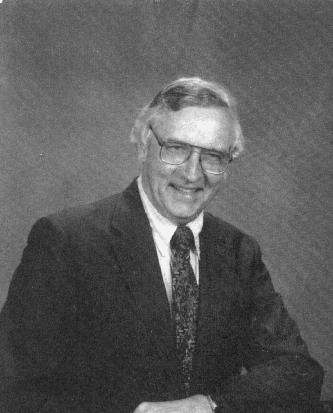
Howard Lewis |
The deaths, within days of each other, of Howard L. Lewis
and Larry E. Joyce have deprived science reporters of two trusted
sources and congenial colleagues. Both Lewis and Joyce had retired
relatively recently from the American Heart Association's national
staff in Dallas, both bravely faced terminal cancer, and both
remained friends with each other and with countless others until
the end of their lives. Lewis died April 9 in Presbyterian Hospital
of Dallas from cancer of the bile duct. Joyce, who had phoned
many mutual friends to report Lewis' death, died exactly three
weeks later at his new home in nearby Granbury, Texas, of leukemia.
Lewis, 67, is remembered particularly for making science reporters
so welcome and well-informed at AHA meetings and news forums,
for providing prompt and thorough responses to queries, and for
his calm good nature at all times. Joyce, 60, similarly is remembered
as a great boss, entertaining conversationalist, and gifted writer.
And who can forget their amiable (West Virginia and Texas, respectively)
accents? Lewis was born in Madison, WVa, earned his bachelor's
and master's degrees at West Virginia University, served in the
Air Force during the Korea Conflict, and worked for the Charleston
Daily Mail, Business Week, and Modern Hospital
before moving to Dallas as AHA's director of health and science
news in 1976, retiring to consultant work in 1996. Joyce was born
in Dallas, earned his bachelor's degree at Hardin-Simmons University
(Abilene) and master's at Texas Tech University (Lubbock); served
two combat tours in Vietnam during an Army career that saw him
receive numerous medals, pilot's wings, and the grade of lieutenant
colonel; managed the European-Middle East edition of Stars
& Stripes; and was an AHA vice president before and after
(until retiring in 1998) a five-year period as American Medical
Association senior vice president of communications and publishing.
Lewis campaigned tirelessly but good naturedly for news media
attention to science. Joyce also had campaigns, including opposition
to use of US military personnel in peacekeeping situations such
as Somalia, where his youngest son, Army Ranger Sgt James Casey
Joyce (with whom Joyce is buried in Arlington National Cemetery),
was killed. (Contributed by Phil Gunby.)
WILLIAM KITAY
William Kitay died December 22 in Charlottesville, Virginia.
He was 80 years of age and had been an NASW member since 1951.
Born in New York City, Kitay spent the majority of his 50 years
as a journalist covering the field of medicine. Kitay started
as a general assignment reporter in Ohio with the Springfield
Sun. He later joined the Toledo Blade as a features
writer and during World War II was the paper's military editor.
After the war, Kitay began writing seriously about medicine for
the Blade and later joined UPI as a staff correspondent
in Indianapolis before becoming the first full-time medical writer
at the Birmingham News in Alabama. His beat was the then
new Medical College of Alabama and he chronicled some of the earliest
efforts to operate on the heart, when open heart surgery was still
a dream. During the national polio epidemic of the late 1940s,
Kitay lived for a week in an iron lung, so he could write authentically
of what it meant to be striken with polio. During this time, his
syndicated column "All About Babies" appeared in 620
newspapers and a radio program, "Medicine Today with William
Kitay," was relayed to some 80 stations in 11 southern states
via the ABC network. In the 1950s, he returned to New York to
become the first medical writer for a new health agency that eventually
would become the Arthritis Foundation, and later worked for the
American Heart Association. In the 1960s, he turned to the field
of public relations and spent a decade representing medical colleges,
medical centers, pharmaceutical firms, professional medical societies,
and a leading liquor company for whom he created a medical research
program on hangover. Following a period of free-lance and book
writing, Kitay spent more than 20 years as editor for a number
of medical publications and peer-reviewed clinical journals. In
recent years, he continued his free-lance medical writing and
served as a consultant on medical communications for pharmaceutical
and medical product firms and organizations in the medical and
health fields. (Information provided by the family.)
DOUGLAS SORENSON
NASW has recently learned of the death of Douglas D. Sorenson
of Madison, Wisconsin. Sorensen had been an NASW member since
1962.
Return to ScienceWriters
table of contents.