 |
| Volume 51, Number 3, Summer 2002 |
FROZEN PENS IN ANTARCTICAby Aparna Sreenivasan The opportunity was too irresistible to pass up: a trip to Antarctica as the resident science writer on board a National Science Foundation Research vessel. But anxiety set in at the onset. I'd never been on a ship in open water for weeks on end. Would I get seasick? What if the scientists didn't like journalists? How would I get my copy edited? What stories would I write?
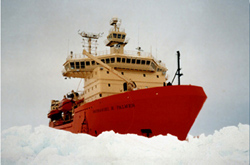
My first sight of the ship, docked in Punta Arenas, Chile, was from a distance of two miles away. The Nathaniel B. Palmer was hard to miss; six-levels and 300-feet long. The Chilean night sky was turning pink as the sun went down and an icy wind blew. Once inside, I saw that the laboratories, located on the first deck, looked like any basic wet lab at UC San Francisco--large benches, filled with intricate machines and computers. When the ship is not at sea, the labs are empty and the equipment stored in a large bunker-like facility near the docks. A week before a trip, the researchers (and any writers) work to set up and test all the equipment on board. We tied everything down with bungee cords and rope, but on the rockiest days at sea computers still tumbled off tables and people fell out of chairs. As a neophyte science writer, I worried more about myself than the equipment. I and Mark Christmas, a videographer from National Geographic, were the only media on board. My supervisor was in Washington, D.C., and reachable only by e-mail. At first, I didn't give this much thought, until I found out that once at sea e-mail access, via satellite, was restricted to twice a day. When I asked the computer technicians how to hook up to the Internet, they laughed. There was no Internet access on the ship; too expensive. If I needed reference or background material, I should have brought it with me. I didn't think to ask and no one told me before I embarked on the trip. But it turned out to be a non-issue because the ship was chock-full of experts in physical and biological oceanography. Furthermore, they liked writers and happily answered all of my basic questions about seawater, ocean animals, and the physical properties of ice. Living in a virtual age, writers have become used to instant editorial feedback. With the twice-a-day e-mail transmission restriction, the 12-hour delay often meant my copy was posted to the Web without my having had a chance to review final edits. The only way I knew my stories were out there was when researchers received e-mail from their parents, who had read the stories and perhaps found a misspelled word or incorrect phrase. Ouch! Because I played a dual role of science helper and writer, my days typically began at 8 a.m. and ended after midnight. I wrote stories before and after a 12-hour work shift in the lab. Finding a quiet place to write on board the ship was difficult. One room was designated for computer use, with five PCs and six Macs aligned along the walls. But the room was noisy as it was always occupied with scientists who laughed and talked as they graphed new data or did other work. I could use the on-board library, but the temperature was set to a chilly 55 degrees. I asked about this and was told it was kept cold because a certain scientist liked it that way. The crazy thing was this researcher wasn't even on this trip! My bunk room was an option, but it was shared with a graduate student who worked an opposing 12-hour shift and was always asleep while I typed in the semi-darkness. I felt guilty when I heard her turn over or wake up. In the end, I put on extra layers and braved the chilly library.
I had story deadlines at the end of every week. Peter West, my NSF editor, wanted digital images to accompany every story. But when I told the computer technicians of my needs, they said no dice. Sending large electronic files was expensive, so crew and scientists were only allowed to send one attachment every two weeks, and no large picture files. These rules didn't apply to Mark Christmas, who had a big budget from National Geographic to cover this type of expense. He could send whatever he wanted. But as an intern, I had far less clout. My editor went to bat for me, but it still took a week of high-level negotiating at NSF before I was given approval to send a half-dozen images per story. There were other things I know now about working in extreme conditions that I wish I'd known then. Such as, the more notebooks the better. Each time I went out on a zodiac, my pages would get soaking wet. Also, pens freeze in this type of environment, making it necessary to keep at least ten writing instruments in my jacket pocket at all times, so I could grab a new one when the one in my hand clogged, keeping the words flowing. I was glad to have such an inventory the day our zodiac traveled with four humpback whales. They were close enough to touch. A humpback mother apparently deemed us too close and appeared to spout angrily before diving deep with her baby. Platforms of ice surrounded the zodiac, whose deep orange color was contrasted against the gray sky and blue-black water. The Nathaniel B. Palmer was a mile away. Had my pens failed me, reconstructing that moment from memory, instead of from written notes, wouldn't have been the same.
A valuable piece of advice, that has nothing to do with writing, is never go on the deck in a storm without tying yourself down. Mark Christmas and I learned this the hard way when a huge wall of water knocked us down and took us for a ride across the deck. We weren't hurt, but the rest of the crew, viewing us from video cameras strategically placed along the outer decks, got a good laugh. There were 50 people on board, and six weeks traversing the Western Antarctic Peninsula turned us into a family. One day, I appropriated part of a message board to post memorable quotes from the crew. It proved to be a welcome diversion, and people checked the board daily to see if their words were featured. To my surprise, now and then I'd go the board to add a quote and find that someone had posted something that I had said! In addition to my news stories, I wrote descriptive pieces just for the crew that would be passed along for inspiration. In the end, I gained confidence and learned to trust my instincts as a writer. This, along with the amazing beauty of Antarctica, has given me one of the greatest experiences of my life. # Aparna Sreenivasan is a postdoctoral fellow at the University of California San Francisco. |