 |
| Volume 51, Number 3, Summer 2002 |
REGIONAL GROUPSby Suzanne Clancy Rocky Mountains-newest regional group! In February, four NASW members from Colorado attending the AAAS meeting in Boston were informed by Diane McGurgan that the local science writers' group is expected to put on the big Sunday night party at the annual meeting (to be held next year in Denver). Their problem: no local group. Thus, SWARM (Science Writers Association of the Rocky Mountains) was formed. For a short period of time, the four musketeers called themselves SWACO (Science Writers Association of Colorado) but the group officially became SWARM when membership extended to four states (Colorado, New Mexico, Idaho, and Utah). In May, at its inaugural meeting, Alan Stern from the Southwest Research Institute spoke to more than 20 SWARMers about the New Horizons mission to Pluto and the Kuiper Belt (http://www.plutomission.com/). An extra bonus, many members from Fort Collins, Denver, and the Boulder area met for the first time at this meeting. After his talk, Stern joined the group for dinner at the local bar where they plotted future meetings. If you're interested in joining SWARM, please sign yourself up at: http://groups.yahoo.com/group/SWARM2. New York SWINY held an October event with The Rockefeller University, featuring Jerry Hauer, the first director and commissioner of the New York City Mayor's Office of Emergency Management (OEM). Reporting directly to Mayor Rudolph Giuliani, Hauer oversaw OEM, which directs the city's overall emergency response planning as well as specialized planning for response to chemical, biological, and nuclear-related incidents. Hauer also directed the design and implementation of New York City's state-of-the-art Emergency Operations Center. Although now employed by Kroll Associates in NYC, Hauer, at the Mayor's side since Sept. 11, and consulted with federal government officials including Health and Human Services Secretary Tommy Thompson. Hauer, a member of the National Academy of Sciences' Institute of Medicine committee to evaluate research and development needs for improved civilian medical response to chemical or biological terrorism incidents, is co-author of the revised World Health Organization monograph on chemical and biological weapons. In March, SWINY members held a session, "All about Writing Groups," to help members learn about organizing and running workshops ranging from "enlivening prose" to "the business of writing." Beth Schachter, Simone de Schipper, and members of their writing groups offered tips and insights. In April, a panel of SWINY freelance writers, Vic Chase, Rosie Foster, and Beth Livermore, shared their secrets on setting up a small business (taxes, finances, and other fun stuff), setting fees, negotiating contracts, acquiring and keeping clients, managing multiple projects while lining up future assignments, and balancing work and family. Northern California NCSWA members met in April at Pyramid Alehouse, a Berkeley microbrewery. After dinner, Mary Helen Barcellos-Hoff, a cell biologist at Lawrence Berkeley National Lab, spoke about the effects of low-dose radiation on tissue. Unlike most cancer researchers who ask how cells become cancerous, Barcellos-Hoff poses the question: how do tissues become tumors? She discussed her latest research showing that exposure to ionizing radiation creates a micro-environment in the tissue surrounding breast cells that can cause even non-irradiated cells and their progeny to become cancerous. According to Barcellos-Hoff, radiation alters cell-to-cell communication, and may interfere with the ability of normal cells to recognize and suppress cancerous ones. This suggests new and possibly more effective means of treating breast cancer. For example, since the tissue's response to radiation is an orchestrated one, there may be ways to interrupt the response and keep breast tissue from developing into tumors. Philadelphia area In January, PaSWA was invited to take a behind-the-scenes tour of the New Jersey State Aquarium in Camden, N.J. A highlight was a walk along the edge of the Aquarium's Open Ocean Tank, the 760,000-gallon home to more than a dozen sharks, giant stingrays, sea turtles, and roughly 1,500 other aquatic animals native to the Atlantic Ocean off the New Jersey shore. The group learned about the daunting task of keeping such a community happy and healthy. For example, the water is chilled to maintain its temperature of 68¡ F and the entire volume of the tank is filtered every 90 minutes. Specialized diets for certain species and carefully controlled procedures for introducing new inhabitants to the community add to the challenge. On William Shakespeare's birthday in April, PaSWA met at The Wistar Institute to hear scientific biographer Leonard Warren, a long-time Wistar laboratory researcher. Warren spoke about one of his recent biographical subjects, Joseph Leidy, whose ashes reside in an urn at the Institute. According to Warren, the Philadelphia-based Leidy was a legend among his 19th-century scientific contemporaries, although he is considerably less well known today. An extraordinary comparative anatomist, Leidy is considered the U.S. founder of such fields as paleontology, parasitology, and protozoology. In fact, Warren's biography of Leidy is called Joseph Leidy: The Last Man Who Knew Everything. In May, science writers visited the University of Pennsylvania Museum of Archaeology and Anthropology, where they toured the newly constructed Mainwaring Wing for collections storage and study. More than 100,000 of the museum's most at-risk artifacts will eventually be housed in the new wing, which boasts state-of-the-art technology for long-term preservation coupled with ease of access for researchers. PaSWAns were also shown a selection of ancient Sumerian tablets, among those being consulted for the Sumerian Dictionary Project, which aims to create a dictionary of the world's first written language. New England In May, freelance writer Neil Savage arranged a theater outing to attend Copenhagen. The play imagines what took place during a 1941 meeting between Werner Heisenberg, then head of the Nazi's atomic program, and Niels Bohr, his former mentor and a resident of occupied Denmark. Earlier that same week, the Massachusetts Institute of Technology sponsored a public symposium on some of the issues raised by the play. NESW president Eugenie Samuel tempted a small cadre of members to a mini Web workshop with dinner at a renowned Thai restaurant. Then they tromped across the street to the Newton offices of New Scientist to learn the basics of html coding and Web posting in hopes that one or two will practice their new skills on the new NESW site at http://nasw.org/users/nesw/home.html, especially the page on Boston science journalism resources.
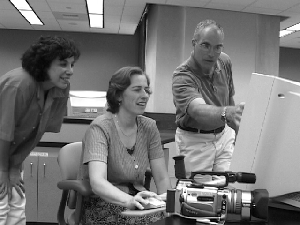
Whether you call it "backpack journalism," "multimedia storytelling," or "convergence reporting," the ever-longer waiting lists for an introductory workshop coached by multimedia pioneer Jane Stevens show that many people think it may be the future of journalism. All told, 45 journalists have participated in the intensive hands-on training in July, November, and May held at Harvard Medical School's Countway Library. In each workshop, 15 journalists from newspapers, radio, television, magazine, federal research agencies, and university news bureaus learned the new language of Web-based storytelling. For three days, they learned how to develop storyboards, shoot and edit video, extract photos, excerpt audio, write text, develop nonlinear narratives, and compile it all on several Web pages for the final presentations. For their stories, they interviewed researchers from Harvard Medical School, Harvard School of Public Health, Dana Farber Cancer Institute, Beth Israel Deaconess Medical Center, Children's Hospital, and New England Aquarium. The workshops were organized by Carol Cruzan Morton and co-sponsored by NESW, the Society of Environmental Journalists, and NASW. # Suzanne Clancy is a science writer at The Salk Institute, in La Jolla, Calif. Send information about regional meetings and events to clancy@salk.edu. |