
|
| Volume 50, Number 1, Winter 2000-2001 |
ON THE LISTSby Bob Finn
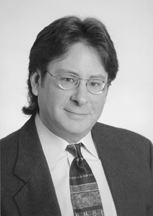
nasw-prNowhere can this status be seen more clearly than in the awarding of prizes. As our awards categories are written, it is virtually impossible for a PIO to win. Elsewhere in this issue you'll find an article about NASW's Science-in-Society Awards, which are given for "investigative or interpretive reporting about the sciences and their impact for good and bad." The award categories are newspaper, magazine, television, radio, book, and Web. In December, Kelli Whitlock sparked the discussion when she asked whether there was any interest in adding categories for science writing by PIOs. She floated the idea of either adding a category for research or news releases or dividing the magazine category, possibly according to circulation or frequency, and possibly into commercial and non-profit magazines. In a later message, Kelli suggested another category: best practices in PIOdom. After some discussion, Carol Morton, who co-chaired the 2000 awards committee, said that the Science-in-Society Award was perhaps not the best vehicle to recognize best practices, and suggested that those interested in such an award might want to conduct independent fundraising to support it. A'ndrea Messer disagreed with this suggestion. "What we, at least I, would like to see is some award that recognizes PIOs for writing. I am not certain how this could fit into the realm of the Science-in-Society Award, but I certainly take exception to the idea that we (PIOs) should go look for support for an award. To my knowledge, no PIO has ever won either the Westinghouse/Whitaker awards or the Science-in-Society awards. I doubt any ever will. I doubt that anyone has even submitted entries." Earle Holland, said, "Regardless of the fact that I personally believe that much of the science writing some PIOs do is as good--if not better--than previous award winners, I don't think we'll ever see any awards along the lines of what we'd collectively like." For one thing, Earle noted, it's difficult to devise categories that would demonstrate best practices. In addition, "Having served three terms on the board, I can tell you that there has always been an extremely high level of active disinterest in gauging what we do on the same level as what our former 'active' member colleagues do . . .. I remember sharing a ride to the airport after a CASW or AAAS meeting some years back and this topic came up, vigorously supported by me. In the vehicle were two NASW presidents, both of whom asked with a decisive snideness in the voice: 'What do you want Earle, an award for the best press release?'" Blake Powers proposed a resolution defining three new categories of Science-in-Society Awards (two including subcategories). Those categories would recognize works from a "nontraditional or nonjournalistic source," "nonjournalistic science communications or educational efforts based on the World Wide Web," and "science illustration and artwork." Carol Morton again suggested that the Science-in-Society Awards were not the best vehicle to honor outstanding work, of whatever stripe, from PIOs. A'ndrea agreed that what PIOs write, whether for a house organ or news release, will never fit the description of the Science-in-Society Awards. And she added, "My intent is not to win an award. My intent is for an award to exist for which I could actually be eligible." To follow the discussion, go to the nasw-talk archives at nasw.org/lists/. Starting on Dec. 18, 2000, follow the subject headers "NASW contests for PIOs?," "Contests for PIOs," and "A Proposal For The Board." Early in the discussion one subscriber's vacation program went kerblooey, and there are several dozen identical messages explaining how long she'd be out of the office and how to reach her. You may safely ignore those messages. nasw-talkMailing-list discussions often stray far off the topic of science writing. But sometimes, just as I'm ready to send a message suggesting that the discussion be taken off nasw-talk, they return to relevance in unexpected ways. On October 31, Jennie Dusheck posted a note (subject header "Canada Caves") about evolution being removed from the curriculum of the Ontario, Canada school system. After some discussion of religion and science, Jennifer Campbell objected to religion being portrayed as an "insipid force." Richard Robinson replied, "I don't think Christianity is insipid, although it's a perfect word to describe Protestant hymns." What followed was a discussion about Protestant hymns, which morphed into a discussion of pop music, which morphed into a discussion of rock music, which morphed into a discussion of country music, which morphed into a discussion of opera. There were lots of opinions expressed about all these musical forms, and just as I was about to say, "De gustibus non est disputandum, already," an interesting discussion of tone deafness broke out. Richard Robinson claimed that it was possible to train people to sing, even people who show little or no aptitude at first. A'ndrea Messer replied with what she described as a rant. Tone deafness is a real disorder, she said, afflicting about one in 30 individuals. She's among that number, and she said that no amount of training would allow her to distinguish musical pieces, just as no amount of training would allow a colorblind person to distinguish colors. A discussion of tone deafness and colorblindness ensued. To zero in on this part of the discussion, go to the archives at nasw.org/lists/, choose a listing of nasw-talk by date, and look for A'ndrea's message on Jan. 2, 2001 with the subject header "Re: opera," as well as the later subject headers "Colorblindness." and "Tone or tune deafness." Bob Finn moderates NASW's Web site and e-mail lists at nasw.org. His e-mail address is cybrarian@nasw.org. Photo: Bob Finn |
 I'm devoting the lion's share
of On The Lists this issue to a discussion on the nasw-pr
mailing list, which is normally the quietest of the three. Although
we eliminated the separate categories of "active" and
"associate" members a couple of years back, many public
information officers--who make up a large percentage of the NASW
membership--clearly feel relegated to second-class citizenship
in this organization.
I'm devoting the lion's share
of On The Lists this issue to a discussion on the nasw-pr
mailing list, which is normally the quietest of the three. Although
we eliminated the separate categories of "active" and
"associate" members a couple of years back, many public
information officers--who make up a large percentage of the NASW
membership--clearly feel relegated to second-class citizenship
in this organization.