
|
| Volume 50, Number 1, Winter 2000-2001 |
President's Letterby Paul Raeburn
Joe Palca deserves his own paragraph. NASW has been fortunate to have him on the board and at the helm. He has made enormous contributions to the organization, always with good humor and a steady hand. Thanks from all of us, Joe. Joe leaves NASW in excellent shape. We're in good financial health. The annual NASW workshops continue to expand and improve-the tickets sold out again this year. But the most important indication of the health of NASW is that many of our members are doing wonderful work. If you have any doubts, take a look at the stories that won this year's NASW Science-in-Society Award. That brings me to the subject of this letter. I would like to talk a bit about writing and reporting, and to share my views about what kinds of science stories are important. We often talk about how much we enjoy the camaraderie in NASW, the friendships and the opportunities to encourage and educate young science writers. But the main reason we come together in this group, I think, is because we care about reporting and writing, and we want to do good work. NASW's primary mission, in my view, is to help us to excel as reporters and writers. A lot of what I've learned about science writing and journalism has come from friends and colleagues in NASW. Sometimes it was during late-night conversations in hotel saloons after we had all filed our stories. Sometimes it was in more formal settings, such as the NASW workshops. Sometimes I learned just by sitting beside talented colleagues at press conferences and in press rooms and watching them do their jobs. And much of what I learned came from reading their work and trying to see how they did it. I still read those stories, and I'm still learning. After many years of learning and doing, I've developed my own ideas about what constitutes good science writing and good journalism. The ability to explain complicated science in clear and evocative language is certainly part of it. Science stories that accomplish that provide a valuable service, because so much of science remains mysterious to non-scientists. But the best science writing ought to go beyond that. We need to use our expertise to give readers not just the details of a piece of scientific research, but some understanding of what the research means to them. The stories we cover have impacts on all aspects of our lives. And many of the things we cover are controversial. As I write this, the Wall Street Journal has a story about the anti-abortion stance of Governor Tommy Thompson of Wisconsin, who has been nominated as secretary of health and human services. Some anti-abortion groups, the Journal says, are critical of Thompson because he supported the University of Wisconsin's research on embryonic stem cells. That's a story that demands our attention. Describing the research is the first thing a story should do. The Journal analyzed the politics, but we, as science writers, have the opportunity to do much more-to analyze the scientific and ethical controversy over stem-cell research, and to clarify the issues and the stakes. This is the kind of story that NASW's Science-in-Society Award is intended to encourage: stories that help us understand the impact of science on the rest of society and on our lives. This morning's papers are full of examples: the energy crisis in California; the debate over the environmental record of Gale Norton, Bush's nominee for secretary of the interior; and Bush's proposal to boost spending on Star Wars missile defense is yet another. Stories that analyze the issues behind these news stories are not easy to write. The science is complicated, and in each case there are "experts" who claim exclusive access to the truth but who disagree bitterly with one another. But these are opportunities for talented science writers to do important work. I recognize that we are not all in a position to take on these kinds of stories. Writers have to get ideas past cranky editors, and editors don't always get the kinds of stories they want from their writers. But many of us have a chance to do more than we are doing. (I don't mean to sound preachy-this is the kind of advice I am always giving myself.) My aim here is not to tell you what stories you should be writing. The idea is to encourage discussion of how we do what we do and how we can do it better. That's what NASW is about. Please share your thoughts with me and with the members on the NASW e-mail lists. And good luck with your next story. I hope it's one of the best things you've done. Paul Raeburn is a senior writer at Business Week. He can be reached at praeburn@nasw.org
|
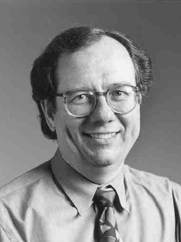 On behalf of Diane McGurgan, the
officers and the board, I'd like to wish everyone a happy New
Year. I would also like to welcome the new slate: Deborah Blum
is our new president-elect; Laura van Dam takes over as treasurer;
and Robert Lee Hotz joins the team as secretary. New board members
are Janet Basu, Peggy Girshman, A.J. Hostetler, and Tammy Powledge.
And I would like to salute departing board members Rick Borchelt,
Elaine Freeman, and Earle Holland. They have provided wise counsel
for many years and spent countless hours, often behind the scenes,
working on NASW programs. We owe them a lot.
On behalf of Diane McGurgan, the
officers and the board, I'd like to wish everyone a happy New
Year. I would also like to welcome the new slate: Deborah Blum
is our new president-elect; Laura van Dam takes over as treasurer;
and Robert Lee Hotz joins the team as secretary. New board members
are Janet Basu, Peggy Girshman, A.J. Hostetler, and Tammy Powledge.
And I would like to salute departing board members Rick Borchelt,
Elaine Freeman, and Earle Holland. They have provided wise counsel
for many years and spent countless hours, often behind the scenes,
working on NASW programs. We owe them a lot.