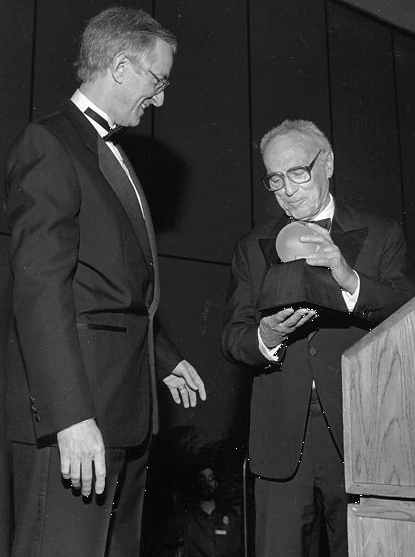
 David Perlman, science editor of the San Francisco Chronicle,
was honored December 10, 1997, by the American Geophysical Union with its
Sustained Achievement Award for Excellence in Science Journalism, at the
AGU Fall Meeting in San Francisco.
David Perlman, science editor of the San Francisco Chronicle,
was honored December 10, 1997, by the American Geophysical Union with its
Sustained Achievement Award for Excellence in Science Journalism, at the
AGU Fall Meeting in San Francisco.David Perlman, science editor of the San Francisco Chronicle,
was honored December 10, 1997, by the American Geophysical Union with its
Sustained Achievement Award for Excellence in Science Journalism, at the
AGU Fall Meeting in San Francisco.
In presenting the award, the AGU recognized Perlman’s “daily devotion to his craft, sturdy sense of responsibility, devotion to accuracy, warm regard for human diversity, and appreciation that science is an uncertain work in progress.”
Freelance writer Jon Krakauer was also honored with the AGU’s Walter Sullivan Award for Excellence in Science Journalism for his article in Smithsonian magazine, “Geologists worry about dangers of living ‘under the volcano.’” The article outlined a future drama that may one day unfold in the shadow of Mount Rainier.
When the AGU decided to present its award to Perlman, it was entirely natural that they turned to Charles Petit to write the citation. Petit was Perlman’s science-writing colleague on the Chronicle and had been since 1972. Petit’s moving tribute to his colleague carried more meaning than the audience knew. Petit was soon to announce that he was leaving the Chronicle to serve as a U.S. News and World Report correspondent in the same city.
Petit’s tribute:
David Perlman has been covering science for most of the 47 years the San Francisco Chronicle has employed him. First and foremost, however, Dave Perlman is a newspaperman. His science writing sense and style all flow from that.
As a 12-year-old New York City boy, he saw the play, The Front Page. That did it. In his teens, he went about with a press card stuck in his hatband. At Columbia University, he edited the college daily newspaper. He served as a foreign correspondent in Europe after World War II. Also, he still recites from memory the play’s opening description of the residents of a Depression-era cop shop, a downtown pressroom where reporters hung out, awaiting word of murder, robbery, and scandal: “Seedy, catatonic Paul Reveres, full of strange oaths and a touch of childhood.”
That is who he is: a reporter. A guy who covers the news, who has seen it all, who cares about truth and justice no matter how rotten things seem, and who stays up late, if necessary, to see some more.
As a science writer, and for the most recent 30 years as the Chronicle’s science editor, he has shared with readers the latest research on restless plates in the Earth’s crust that give California the shakes, volcanic rumblings and eruptions, submarine geysers atop mid-ocean ridges, and probes to distant planets that enlighten us not only about other worlds but about our own blue orb too.
He spreads the word on meteorites, radioisotope dating, and the Chicxulub planet crasher. He explains in plain English the difference between strike-slip and normal faulting, the elusive meaning of “magnitude,” and the common sense precautions that residents and officials should take to minimize damage and injury during natural disasters. When a large earthquake does occur, he not only reports what happened to what fault, but also keeps paramount that such things frighten, injure, and all too often kill people.
But those are just the Earth sciences.
“Science” at a newspaper can mean any story with words ending in -ology or -itis; or simply having more syllables than editors like to see. Dave does them all deftly, against deadlines imposed by breaking news, and with delight and wonder over the splendors of nature.
He has been a mentor to scores of science writers, president of the National Association of Science Writers, and remains a model of the business. Notable moments and achievements during his newswriting career so far include:
Return to ScienceWriters table of contents.