
|
|
| Volume 46, Number 3, Winter 1998-99 |
By Renée Twombly
|
|
|
Gibbs had the idea that the best way to look at the state of medicine today is to spend time at an academic medical center, the place that provides advanced patient treatment and is also a bellwether for the future of health care.
She understood that while medicine is evolving, the current pace of change is unprecedented. Everything about medicine—the science, the economics, the ethics, the law, the way it is practiced—is different than just a few years ago. Changes in medicine, Gibbs said “will affect every household in America.” She wanted to capture the drama of these changes at an academic medical center being stressed by managed care. The mission of academic medicine—to develop and use the best medical techniques, to train the finest physicians, and to conduct research that could save future lives—is a challenge that Duke Medical Center, and similar institutions, is finding difficult to meet.
But, equally, Gibbs wanted to tell the story about what goes on at a major hospital, a place she described in a story proposal to Time as “scary, hectic, mystifying—a world of its own, full of smart people and pain and miracles and moments of our lives where good news or bad news can change them forever.
“We want to do what the media often do not: tell some of the encouraging, and even miraculous, things that are becoming so routine they don’t make headlines,” she said.
While our first reaction to Gibbs’s proposal was one of excitement, if not glee, our next breath was more sobering. How to give Time access to everything and everyone it needed without losing control of myriad issues that requires confidentiality, such as the rights of patients to privacy and the need for the medical center to conduct its business. We wanted to find a way to make it work and, from the beginning, hoped that the story told would be Duke’s as well as every other major academic medical center.
During a site visit in February, Gibbs told administrators that she came to Duke based on several factors, including a news search of the top academic hospitals, and a profile of growth and expansion that made us a contender. We also understood that she had made inquiries about other unspecified medical centers.
Gibbs came to check us out, and we were doing the same. She spent a full day visiting “top docs” and leaders and heard how Duke is forging a future in interdisciplinary basic research, the genetics of common disease, and in “evidence-based” medicine, among other areas. She talked with Dr. Ralph Snyderman, head of the medical center and the Duke University Health System, and was briefed on how Duke is attempting to expand its health care network. In fact, in the following months Duke acquired a small hospital in Raleigh, a major city 25 miles away, and secured a 20-year lease to run the only other hospital in Durham, the county-owned Durham Regional Hospital. We all liked Gibbs. Her warmth, her ability to see the human side of medicine, and her complete lack of big-wig atmospherics impressed us. Here was one of Time’s stars, the person foremost on the Monica and Bill beat, yet she seemed completely normal.
From that visit, discussions and visits by Time staffers continued through the spring and summer with the idea that the actual week of reporting would occur in early September. Most of the communication between our office and Time was with Barrett (Barry) Seaman, the magazine’s director of special projects. Seaman, in a dapper Gene Kelly kind-of-way, is just as likable as Gibbs. At one point, I had to wonder if Time does its investigative reporting by disarming its prey with charm.
There was mutual trust and it had to be that way or the project would have never worked. Time had to rely heavily on the medical center news office for both information and access and we had to believe—nay, pray—that Time didn’t have a hidden agenda. More than once I asked myself, in what I hoped was a rhetorical manner, if I was going to have a job at the end of this adventure. My mantra was that Time wouldn’t sink the effort or money into this project unless they expected to get a story full of life-and-death drama, a sort of “E.R.” on paper. They weren’t out to produce the text for a medical version of “The Sting.” Or, so I hoped.
|
|
The news office arranged interviews and tours for Seaman and the reporters he sent down in several summer visits. It was a tricky business. In June, for example, Seaman arrived with a clutch of four reporters for a three-day stay. While he said in advance he didn’t want definitive appointments, but preferred an array of great people to talk to, we had to find out when our most newsworthy/interesting/controversial/politically important physicians, administrators, nurses, etc., would be available. So we drafted grids with interview availabilities—people we thought Time should get to know. Because time was limited for many of our people, the grid looked like the worst computer program in the world: If you meet X, go here. If not X, then Y or Z. If Y, go there at that time, but only if Y can make it. If Z, page her first. If not X or Y or Z, go to lunch. We quickly learned that the smorgasbord approach would not work, so we drafted a tasty menu with numerous courses, but limited choices.
As well as it went, the visits in June and August were just the warmup for the intense preparation needed for the week of September 7-14, the seven days Time picked for Seaman, Gibbs, photo editor Rick Boeth, seven reporters and four photographers to camp out at Duke. Previous visits by Seaman and some of the reporters on the team were to amass background info through scores of interviews and to generally soak in the flavor of the place. That involved more or less routine work on the part of the news staff. The actual week of reporting, however, presented a substantial challenge, since the goal was to capture the action, much of which was unknowable in advance. For example, while we figured there would be some surgery of note going on that week, many of the most interesting cases were only scheduled a day or two, or even hours, in advance. Emergency medicine is just that.
Nevertheless, we tried as much as possible to present all the possibilities that would occur that week. That meant compiling a loose-leaf notebook, with copies given to each of the 14 Time team members.
The first entries in the notebooks were the ground rules for patient interactions. In many ways, this was the most difficult challenge. We wanted to give Time as much flexibility as possible to follow the good stories as they unfolded, but job number one for us was to protect the privacy of our patients, a mandate Seaman understood and supported. After a good deal of discussion, we decided to designate some of our 35 inpatient units as zones where Time had access to nurses and physicians without having to be accompanied by a news office staffer, although we were always close by. The reporters and photographers could, of course, go anywhere in the hospital or medical center, but they had to be escorted. Importantly, we assigned a news office person to every one of the Time reporters and photographers. Because our staff is limited, we “borrowed” colleagues who were versed in media relations from marketing and development and trained them ahead of time to help us out during the week.
Time interactions with the patients in these designated units, or anywhere in the hospital, were to be approved by the patient in advance, if possible. In some units, nurse managers talked to every patient that was admitted to see if they wanted to participate; if patients agreed, they signed a special consent form drafted by the news office. (We now have on record several hundred such signed consents.) In other units, a news office staffer asked permission of the patient before the interview. Occasionally, because of the speed at which events unfolded, retroactive agreement was sought from the patient or the patient’s family. If that wasn’t in hand by the time the issue went to press, nothing specific about that person was used. As it happened, in several cases, consent was obtained just before the printing deadline. Time and our news office were in total sync regarding patient confidentiality. We agreed that if, for example, a photograph was taken of a patient who had not signed a consent form and all you saw was his shoes, if the shoes were distinctive in any way, the photo wasn’t used. Even if a patient gave consent, physicians had the right to decline discussing aspects of the patient’s medical information. The emergency department had its own set of ground rules for the Time crew regarding coverage.
The right to decline to be interviewed or photographed extended to the Duke staff as well, even though we did not ask them to sign consent forms. Participation was voluntary, and at no time did the news office or the administration tell the staff what to say or do. We even sent a memo to administrators the Friday before the week began telling them that we expected Time was going to do a “balanced story, addressing both the positives and negatives of the academic medical center.” We said that this was not to be a coached or staged event, that staff should act as naturally as is possible with someone aiming a camera at you or listening to your every word. “Honesty and professionalism are the best guides for media interaction,” we wrote—but also reminded them once something was said, it couldn’t be “erased.”
The rest of the news office’s “Time Bible”—as we dubbed our notebook in reference to the seven days and nights both God and Time required for their creative projects—was divided into the following sections: Interview Schedules, Patient Stories, Research Stories, Technology, Employee Profiles, Sidebar Stories, and Fun Facts. This was the meat of months of advance work, our attempt to encapsulate the substance of Duke Med for the Time team. Based on the beats they were following, we outlined workable schedules for each of the reporters and photographers. For example, we were able to suggest to Alice Park that she could round with first-year medical students at 2:30 p.m. on Tuesday or spend time at midnight with interns. Or that photo chief Rick Boeth might like to assign one of his photographers to shoot a surgery on Wednesday in which part of a father’s liver was being donated to his son. Dick Thompson was informed that a woman with advanced breast cancer was going to receive a novel cancer vaccine at 1 p.m. on Thursday. Our “grids” for the seven days were chock full of these kinds of ideas.
We also put together seven, single-spaced typed pages of patients who were coming in for interesting procedures who had already agreed to be interviewed, as well as ideas about who would be expected to come to Duke that week. We drafted pages of potential research and technology stories, and in an effort to include all the people who work to make Duke Med successful, we suggested interviews with the staff who not only park cars for patients, but serve as “ambassadors” for the medical center. In our view, stories about the social worker in the emergency department or the woman who cleans intensive care unit 7200 would help Time see the wealth of dedication that contributes to patient care. To give the reporters a sense of the surrounding superstructure, the news staff pulled together some arcane facts, stuff that had never been accumulated in such a form before. Did you know that every year, Duke Med uses four million syringes, 770,000 adult hospital gowns, and 80,000 light bulbs? Every day, 7,000 doses of medication are dispensed, 46,000 e-mail messages are delivered, as are about 10,000 meals, and 14,000 pounds of laundry are washed aseptically fresh (must be those hospital gowns).
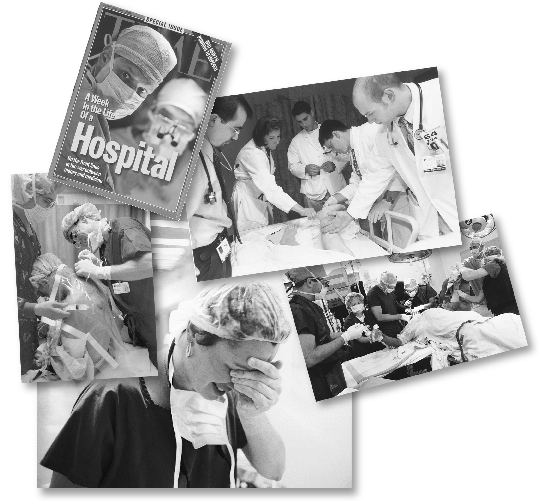
But our notebook was only a template, a framework for action. The Time reporters, Seaman, Gibbs, Park, Thompson, Adam Cohen, Richard Lacayo, Sam Gwynne, David Van Biema, Sylvester Monroe, and, for the last two days, Bill Dowell, and the photographers, Boeth, Andre Lambertson, Brooks Craft, Bob Sacha and Nicole Bengiveno, took off, blanketing the medical center for a week, 24-hours a day, with the news office providing a combination of mentorship, assistance and guardianship. In many cases they followed the suggestions we put forth, but always enterprising, they picked up story threads here and there that led to full-blown drama. They witnessed death and saw the dawn of life. The team collected ten times more stories and photos than they were able to condense into the 36-page feature, which appeared as the October 12 cover story “A Week in the Life of a Hospital,” subtitled “On the front lines in the war between money and medicine.”
The week was a high for the news office. I witnessed as much medical drama in those seven days as I do in a year. I watched surgery to remove a tumor from a man’s brain, while I listened to him chat about his house in California. I was there when a tiny baby was given last rites. I stood as wide-eyed as an owl in the midnight swirl of a busy emergency department.
There were a few tears in the fabric of professionalism during the week, but nothing that couldn’t be mended. And when we thought it was over—7 a.m. on Monday, September 14, there was still work to do. As the Time reporters put their story together, fact checking began. It was impressively extensive and thorough. One question asked was if there was, in fact, a window in a certain treatment room because the reporter had talked about the sunlight spilling on the patient. To me, that question summed up the lengths to which Time went to accurately report what it saw.
I find the issue remarkable because the Time team did exactly what Gibbs had proposed seven months earlier. They told a story about a place of pain and miracles and moments of our lives, about people whose dedication to others will never make the daily news. At the same time, the issue of “money versus medicine” was adroitly focused. As Gibbs put it in her introduction, “Where will the money come from to do the unprofitable things so essential to our well-being: pioneering research, training new doctors, and caring for those who can’t pay?” She could find no easy answers.
With few exceptions, the issue was well received at Duke and other academic medical centers, who see the story, and their struggle for the future, as their own. The errors were minor, the truth was unslanted. Centering a major national story on one hospital and trusting an institutional news staff to help tell it was an unusual experiment in journalism for Time magazine, but the patient survived, and thrived.
Renée Twombly is associate director of the news office at Duke University Medical Center.