
|
|
| Volume 46, Number 3, Winter 1998-99 |
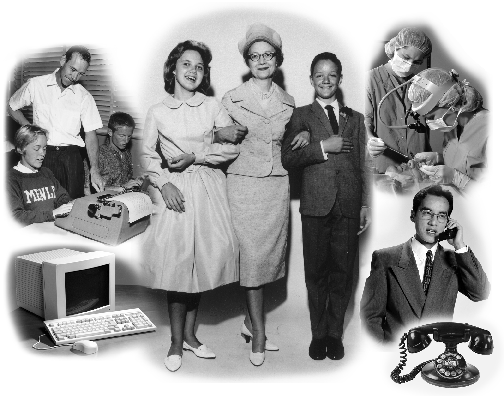 by Victor Cohn
We looked at the future—and found it hopeful.
In the fall of 1954, I tried to predict what would happen in 1999. I was science and medical reporter for the Minneapolis Tribune and we named the series “1999: Our Hopeful Future.” The newspaper promoted the series with large posters on our delivery trucks that depicted a family gazing at a wonderful vista of future technology.
Was our hope justified 45 years ago? In some important ways, yes. We were a country with achievements and problems, and a few grave worries. For example, “1999 Will Be Great If We’re Free,” we wrote in one of our headlines. It may be fading from public memory ten years since the fall of the Berlin Wall but in 1954, one could hardly overestimate the centrality of the struggle between freedom and Communism; who would prevail was far from clear. And this produced internal divisions and questions about the survival of free speech and free politics, inflicted by a scourge called McCarthyism.
In short, we have witnessed the deflation of the greatest foreign policy threat of our lifetimes. We are free and millions are prospering, and hopeful.
Predicting the future is risky business, of course, and as I look back I can cringe at some of the predictions, but take pride in others.
Among the former, this headline from 1954: “You’ll Live 180 Miles From [Your] Job, Commute in 19 Minutes.” Unfortunately, the truth turned out to be 19 miles in 180 minutes. We also talked about helicopter buses and individual auto copters. We’re still waiting.
But as I look back, we also foresaw automatic factories, electronic marvels, new foods and nuclear power. (I wrote, “By 1975, if things go well, 10 percent of all electric power in the United States may come from the atom.” The current figure is 22 percent.). We foresaw the birth control pill and heart transplants. I wrote of a “small oven in your kitchen that will roast an entire turkey in 40 minutes.” Some forecasts were overly cautious. I wrote of reaching the moon by 1999. In fact, we were there 30 years ago, spurred by the Soviets’ space triumphs. Of course, this triumph also led to the litany that is common today: “If we could send men to the moon, why can’t we solve this earthly problem or that?”
Perhaps the most glaring mistake was not a particular prediction, but from the narrative characters I used to construct the series:
I wrote of “John and Emily Future,” a couple invented to portray a 1999 family. But while I envisioned a space-age kitchen, and futuristic gadgets to ease everyday life, John and Emily were essentially Ozzie and Harriet, very much a product of the ’50s. Emily had “the girls” over for cards; she called her husband at work to see when she should start dinner. She was untouched by women’s liberation, women’s new work force, the growth of divorce, the instability of many jobs.
Our rules have changed. Today I’d be murdered if I wrote of “the girls,” but at that time no reader or colleague complained. Women used that language.
I mention this only because often we cannot truly tear ourselves away from the thinking of the present to see the future. We cannot anticipate the surprises—human, political, technological.
Yet the exercise, today as in 1954, can be useful, for at least it requires us to look at things, good and bad, that are happening, things that sometimes surely, sometimes possibly will lead to change, events we must think about if we are to be prepared and survive.
So, back to the future, as I saw it in 1954.
One of the first things to strike me from my watching post of 1999 is the emphasis we placed on chemical advances and how optimistic we were about how chemicals would help us.
“Billeeee!” Emily Future called her 7-year-old. No answer. “Billy!” she called more sharply. Finally, he appeared, a walking mound of mud.
“No matter, it would rinse off. 1999’s test-tube clothes defied dirt, water, wear and flame.”
And again, I wrote:
“Nope,” said John Future. “Not going to buy a new car. These plastic bodies stay nice-looking forever.”
And:
“Tell us what you need,” says today’s chemist, “and we will design a material to meet your requirements.” Plastics may fill almost any future need.
Well, not quite. But we have seen a proliferation of chemicals, plastics, pesticides, and petrochemicals. Synthetic fertilizers and blood plasma extenders. Plastic pipes and plastic boats. Yes, and plastics in autos.
And while washable, stain-resistant and flame-retardant snowsuits are taken for granted today, this would have appeared to be a marvel in 1954, when children were bundled in layers of wool.
These things have happened, making new jobs and helping build our new economy. That was the hopeful vision.
But what has also happened is the seepage of chemicals and chemical wastes into soil and water resources. Humans have been harmed by pesticides, too. We struggle to clean up toxic waste dumps, and try to regulate use of pesticides at the same time we rely on them to feed us.
“Farmers in 1999,” I wrote, “used synthetic fertilizers, soil conditioners, hormones and pesticides, antibiotics, trace minerals, leaf removers, growth regulators.”Indeed they do use such chemicals. But most of us did not realize that farm chemicals would leach into soil and water, or that antibiotics given to animals to promote growth would help create antibiotic resistance.
The lesson we still had to learn and perhaps must still learn: Technology can be a boon or a horror, depending on how we use it.
Most of us were unaware of these paradoxes in 1954. It took environmental disasters—oil spills and blackened beaches littered with dead birds—to produce the first Earth Day in 1971, and a realization that we could no longer use the Earth any way we pleased, without a price. We have indeed learned: There is no free lunch.
Back in 1954, of course, we thought we could find ways to support and feed the growing populations by controlling nature through artificial rain-making, or by developing new sources of power—the atom, the sun—to fuel economies and create jobs.
1999. Atomic energy-produced heat being piped directly to homes.
On millions of rooftops, glass collectors absorbed sun heat, to be stored in tanks.
In mountains, weather-makers built deep snow packs. A 1999 report said, “We are forming new glaciers now.”
“Just beautiful,” [said John Future], “The regional rain-making service is going to make rain here tomorrow. Lawns need an inch.”
The contributions of sun power and rainmaking remain modest, but nuclear power plants now provide a fifth of this nation’s electric power.
But their expansion is stalled by our failure to solve the problem of nuclear waste disposal, by fear of nuclear accidents—Three Mile Island, Chernobyl—and by public mistrust of technologists’ assurances that nuclear power plants and many other new technologies are “safe.” We have too often been told this, only to discover that it was a lie, in part or in whole. Almost nothing we do is perfectly safe, and technologies will always be operated by imperfect humans.
It’s ironic that technology and electronics have advanced the farthest since 1954, and that we were more accurate on that topic than others:
In 1999, You’ll Carry Phone on Wrist.
“Yoo-hoo,” cried Emily Future [as John left for work]. “If I need anything from the city I’ll call you on your pocket phone.”
[And one evening, out shopping] Emily inserted her Chargaplate in a slot. An electronic eye read the prices. A machine would mail the Futures their bill.
We have pocket phones, and they’re getting smaller, if not wrist-sized. And a “smart” new wristwatch can connect to the Internet to collect e-mail. Emily’s “Chargaplate” is today’s credit card, inserted in a slot as that electronic eye scans our groceries.
“Businesses,” said another of our fanciful views of 1999, “held national conventions and sales conferences by television.” Thus we foresaw today’s teleconferences. As well as “high speed radio photo systems” (today’s fax machines), “a cheap TV camera about the size of a movie camera” (camcorders) and in that day when radios were universally bulky—“a personal radio receiver the size of a cigarette pack” (the transistor radio).
But while we correctly saw vacuum tubes being replaced by transistors, we did not know that it would become an even tinier speck, with wires that are mere tracings on the chips that today run factories and computers, including the swarms of personal computers—another development we did not foresee.
And in television, we thought “micro-wave relay, plane-to-plane or ship-to-ship” could carry TV programs or other communications across oceans. We did not foresee signals being bounced off satellites, or the computers on our desks with global reach, creating an information age that is still just beginning.
One more wrong prediction. I wrote that David Sarnoff, then head of the giant corporation RCA “and its subsidiary, NBC,” had told me that “non-entertainment TV will outdo entertainment TV as a business.“
Not quite!
As prescient as we might have been with the cell phone and other communications devices, we and many other futurists of 1954 somehow shot far beyond the mark when we looked at the impact technology would have on our cities and homes:
If we are to arrive safely at tomorrow, we obviously have to conquer our automobiles before they conquer us. We have to break out of today’s tangles of automobiles and tangled cities. We have to decide whether we want cities or auto jams.
Well, we’ve decided. The traffic jams.
I had foreseen, based on my reporting, that by the mid-1960s, we would disperse and decentralize our cities—which did occur with the advent and growth of suburbs, including shopping malls and industrial centers. But rather than decrease traffic, they have simply created more destinations in a populated area.
That’s public life. In the home, we foresaw the space-age image also.
John and Emily Future woke up at 7 a.m. on January 2, 1999….John Future got out of bed (a fact automatically registered by an infrared wall pulse that immediately raises the temperature of the room four degrees), shaved (with a silent, electronic razor minus cord), spent 50 seconds under the fog shower and quick drier, then slipped into his new suit….John’s suit was a one-piece belted job. No necktie, tight collar, lapels or other old-fashioned doodads. Color: a pale yellow. John Future had to dress conservatively. He was a salesman.
Timothy [their baby] had stopped crying. The electronic-brain meal-maker had produced his warm milk and his all-purpose vitamin-multimineral-high protein-amino-acid-hot-flake-sugar-sweet tasti-cereal, Super Mishmosh. Thanks to Super Mishmosh—so his mother said—Timothy had never had a sniffle or cold. Come to think of it, none of the Future kids had. “Ah,” said Mrs. Future, “science.”
The unitog suit never took off as a fashion piece. And the
Space Age house is not quite as sophisticated as I and others
had foreseen. But Little Timothy’s cereal has indeed become
“fortified,” although not to the point where it can
prevent colds.
Today’s foods have indeed changed, but not always in the
ways we envisioned. I wrote of “factory foods,” assembled
from chemicals and artificial proteins. The “factory foods”
now are those that come fully prepared, to be popped into the
oven or microwave. They do have artificial ingredients—read
the lists of chemicals on the labels. John and Emily’s “electronic
breakfast maker” is indeed here—the microwave.
As we look back at the crystal ball of 1954, one of the happier discoveries has been the advance of medicine, a significant and important development in our society. What did we write of 45 years ago?
Medical men in 1999 grew hair on the bald.…They cured thousands of mental patients and alcoholics by diet and chemicals.…A surgeon approached a dying man of 75 in 1999 and said: “A heart replacement should work.”…And babies? Healthy, happy things, though they still cried and wetted.
Almost all came true, more or less. For the chemically dependent, however, group therapy and behavior modification patterned along the old tenets of Alcoholics Anonymous are still the most effective methods of treatment. But doctors do use drugs and other applications such as acupuncture to help ease the disease. Also, many new drugs now help the mentally ill to maintain productive lifestyles and stay out of hospitals, which was their fate in 1954. Transplanted organs, including hearts, are commonplace.
“In heart surgery,” I wrote, “the trend is to machines to take over blood flow. Future surgeons should operate at leisure on leaky heart chambers and valves.” University of Minnesota and Mayo Clinic surgeons were almost simultaneously about to start the first successful series of operations on exposed hearts, with the blood shunted through an artificial heart and lung.
“A huge and promising frontier,” I wrote, “is the chemistry of life.” True! Just in 1953, the year before, James Watson and Francis Crick had determined the spiral structure of DNA, the genetic molecule. The genetic code, the way in which its chemical bases are arrayed to form the stuff of the body, was cracked in the ’60s, and while full understanding is a work still in progress, payoffs are already arriving.
I optimistically wrote that: “The future, say many authorities—the
next 50 years—could see the defeat of cancer, heart disease,
arteriosclerosis, high blood pressure, arthritis, allergies, tooth
decay and the common cold.” Would that any of it were true.
Some things we did not foresee or at least think much about:
The resurgence of infections. In 1954, Jonas Salk was testing his vaccine that would begin wiping out polio. The other infectious diseases, we thought, had been largely conquered. Today, mutated bacteria and viruses have become increasingly resistant to antibiotics. And we have AIDS.
We were just beginning to develop intensive care units—ICUs—and other ways to extend life, even to revive the nearly dead. We had not begun to face the problem of lives so extended that we only extend suffering, or ethical and legal struggles over death’s definition.
And what of our friend, Emily Future? I wrote of the “prepaid health plan to which she and John belonged—it meant her doctor and hospital bills were no problem.” This is true or almost true for many today, but we did not anticipate the fact that more than 40 million Americans would now lack health insurance, or that many with some health coverage would find it irksome or incomplete. We hadn’t foreseen medicine in 1999 as a profit-making business with stockholders demanding returns.
“Man’s Fate in 1999: Master or Slave?”
So we headed the last of our articles.
We worried in 1954. It was a time of what threatened to become a death struggle between democracy and a powerful Communism. It was a time of change in America from a more cohesive society, with neighborhoods where everyone seemed to know everyone, to mass, industrialized living, where one seemed to know no one.
So I asked, reflecting the day’s concerns, “Are we
heading for war, destruction, worldwide dictatorship, tyranny,
the rule of the machine over man?…Are we about to become
robots, test-tube members of an inhuman, brain-molding society?…Are
we heading for ‘1999’ [the optimistic ‘1999’
of our articles] or ‘1984,’ the grim, totalitarian ‘1984’
of George Orwell’s novel?”
World War II had struck terrible fear and disillusionment over
the weapons we had created and our newfound ability to blow up
the world. I wrote:
“War? Science may make wars terrible, but it also provides weapons that have won some battles for freedom, and helped keep our precarious peace…Science is for the first time making want and hunger obsolete….We have spouted forth goods as a result of our happy union of science, technology, alert management and freedom, and everyone has benefited, not just the privileged.”
Much of that is still true. We remain free, if free with flaws. There is still want and hunger, however, and “everyone” has not benefited. Much of what I wrote about—the advances that science and technology could confer—was possible and remains possible.
In short, we must ask: what kind of future do we want? What can we do to try to build it?
The dangers remain great, sometimes overwhelming, seemingly hopeless at times. The novelist and literary critic Doris Grumbach recently wrote: “The most lamentable loss in the elderly spirit is the erosion of hope.“
Yes, we are older, but we still do not know the limits of human achievement. Let us continue to believe in a hopeful future. Let us hope and act.
Excerpted from the Star Tribune, Jan. 1, 1999. © 1999 Star Tribune. All rights reserved.
Victor Cohn was the science and medical reporter for the Minneapolis Tribune for more than 20 years. Moving to the Washington Post in 1968, he spent 25 years as science editor, national science and medical correspondent and senior writer and columnist. He is currently a visiting fellow of the Harvard School of Public Health. He lives in Washington, DC.