This student story was published as part of the 2026 NASW Perlman Virtual Mentoring Program organized by the NASW Education Committee, providing science journalism experience for undergraduate and graduate students.
Story by Stefany N. Haynie
Mentored and edited by Kathryn Hulick
It is June in Bale Mountains National Park, Ethiopia, and the fields glow with red, orange, and yellow. The meter-tall stalks of the red hot poker flower (Kniphofia foliosa) are blooming in a riot of sweet smelling–and tasting–color! Wildlife photographer Adrien Lesaffre, eager to capture this display, ventured to Ethiopia in 2022. Lesaffre captured not only the bright display of flowers and the usual array of bees and other flying visitors, but also wolves licking the blooms. His images may change how we think about pollinators.
Sandra Lai, a predator researcher, saw the photos. She said, “You could see the pollen on the muzzle of the wolves.” That pollen could be transferred between flowers. In 2023, she was with Oxford, working with the Ethiopian Wolf Conservation programme. She and her team began to question: are the wolves simply having a sweet treat, or playing an important role as a pollinator?
Sweet nectar
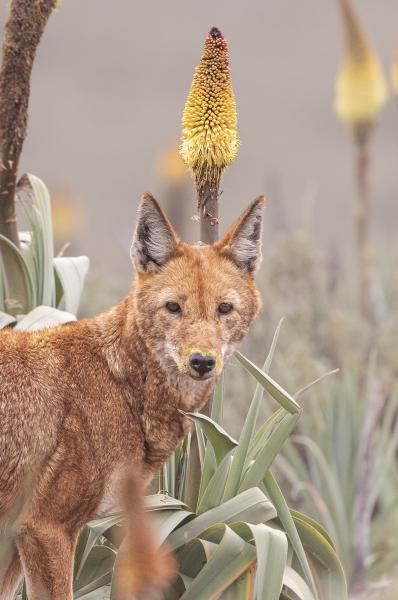
An Ethiopian wolf looks into the camera with pollen visible on its muzzle. Could that pollen be transferred between blooms? Credit: Adrien Lesaffre, wildlife photographer.
Even before seeing the phenomenon for herself, the locals had told Lai to try the nectar, which she said is delicious. The local people will gather the nectar to sweeten their coffee, for its medicinal properties, and local children are often seen licking the flowers like nature’s popsicles.
Lai and her team—which included another wildlife photographer, Bart Dahneke—were already using trail cameras to observe the wolves and foot traps to capture them for vaccinations. The discovery of the nectar-licking behavior led the team to also measure how much pollen was on the muzzle of each wolf they captured. Capturing wolves, for any purpose, is difficult work. Ethiopian Wolves have been proven to be highly adaptable and intelligent, masking their hunting with the sounds of vehicles and evading researchers once their methods of capture were learned. “[I]f you ride up on horseback, you are seen as a trusted individual,” said Dahneke. “Because it's the hikers on foot, the researchers, who usually capture them to inoculate them against rabies.”
Lai’s research showed that there’s enough pollen on the wolves’ muzzles to make it possible to transfer between flowers. But proving they are pollinators would mean isolating a wolf’s visit to a plant to see if it results in flowering, which is a difficult task. Daniel Mutavi Ketumo and co-authors in a study published in Plant Diversity wrote about how many pollinator groups and their plant relationships are not yet well researched. It is a question of "Who does what?” because there is often overlap between many animal visitors on one plant.
Researchers continue to question the extent to which this wolf species might act as a pollinator for the red hot poker flowers. The nectar-licking behavior may be learned and opportunistic, or an adapted relationship between the two species. Lai expressed that many individuals from separate packs spent a significant amount of time foraging and licking the flowers. That points to the nectar being more than an opportunistic sugary treat and having a significant role in their diet. If that’s the case, they are more likely to be pollinators, but research is still ongoing.
Conservation could lead to more discoveries
If Ethiopian wolves drink nectar as a part of their diet and participate as pollinators, why not other wolves? Is this an isolated observation, or do wolves all over the world secretly pollinate our tastiest of fruiting plants? If wolves were proven to be a part of the pollinator network, it would change our understanding of ecosystems. Scientists know that having a diverse array of pollinators provides contingency plans for plants. Often, a single plant species has evolved to attract many different species, including bats, moths, butterflies, hummingbirds, and other insects. Different pollinators also eat different pests. Researchers have found that pollinator diversity increases plant resilience and promotes seed production and seedling survival.
Extrapolating Lai’s findings to other wolf populations before Ethiopian wolves are confirmed pollinators, however, may be jumping the gun. Allison Greenleaf, senior wildlife biologist with the Mexican Wolf Recovery program said she has not seen their wolves nectar foraging. Greenleaf said, “We have a rather small population of Mexican wolves, but they behave exactly as we’d expect based on our observations of grey wolves.” This is to say, they hunt, defend territory, and exhibit normal social behaviors within their pack. Conservationists with the Mexican Wolf Recovery Program are doing their best to rehabilitate the wolves. Once that is achieved, then researching them as pollinators would be possible. Greenleaf said testing this hypothesis would likely involve exposing captive populations of wolves to local species of sweet nectared flowers. If they are drawn to said flowers, it would be easy to extrapolate that wild wolves would be too, and therefore could be pollinating them.
John Oakleaf, senior wolf scientist with U.S. Fish and Wildlife, said that no observations matching the Ethiopian wolf’s behavior have been made in the United States. “Though wolves do enjoy a sweet treat for dessert, they are not nature's best designed pollen transfer agents, and may damage the flowers in the process.” Yellowstone National Park’s Dan Stahler concludes that we have no known allegory for the red hot poker flower in North America. As someone who has studied grey wolves for over thirty years, Stahler cannot speak to any evidence of similar behavior with any known North American plants and grey wolves. He said, “I think the unique aspect of this example in Ethiopian wolves has to do specifically with the poker plant, whose plant structure and nectar provision is large enough to make this a viable plant species for those wolves [to seek out].” Lai said that the plant itself deserves more research. To find out if Ethiopian wolves’ behavior is more widespread, we would want to continue looking for other flowers with sweet nectar. As wolf populations worldwide rebound, the future of such research is promising.
Discovering new pollinators often relies on local citizen scientists and photographers capturing the beauty of wildflower blooms and their visitors. Research scientists must build on this work and do the research to find the details that will reveal previously unknown pollinator relationships.
If Ethiopian wolves are proven to be pollinators, these findings would further support the protection of threatened species and provide fuel for new research avenues on wolves and their ecosystem functions worldwide. Wolves drinking nectar is a fascinating thing to observe. What other amazing things could we learn about wolves if we succeed in conserving their populations?
Main Image Caption: Ethiopian wolves lick nectar from red hot poker flowers. As the wolf licks the nectar, pollen collects on its nose. Credit: Adrien Lesaffre, wildlife photographer

Stefany N. Haynie is a naturalist, artist, and poet working closely with the community to promote humanitarian efforts and conservation through her artwork and writing. She grew up on a farm in the foothills under Yosemite National Park and nature had a strong impact on her childhood. This has led to her passion for learning about and protecting ecosystems. In 2024, she published a poetry series about resilience, loss of innocence, transparency, establishing barriers and boundaries, and transformation. In 2023, she earned the solo slot for The Heartland Arts Grant and worked with Tuolumne County Arts to paint a mural depicting the causes of the homelessness epidemic, and possible solutions centered in the community. She has two bachelor’s degrees from UC San Diego in fine art and literature of the world, focusing on storytelling and languages. Her third degree, currently in progress from Arizona State University, is in planetary science with an emphasis in sustainability. Stefany strongly believes in the power of creativity and interdisciplinary partnerships.

Kathryn Hulick writes about science for young people or anyone who is curious. As a freelance journalist, she primarily covers AI, computing and technology for Science News and Science News Explores. She has also been published in Sierra Magazine and Sky & Telescope and was a contributing editor at Muse magazine for over ten years. Her book for kids, The UFO Files (Quarto, 2025), combines a sci-fi story with scientific explanations of the marvels found on board an alien spacecraft. Hulick’s favorite part of writing about science is getting to speak with researchers in many different fields. Her Substack is called Wow! Tech & Nature.
The NASW Perlman Virtual Mentoring program is named for longtime science writer and past NASW President David Perlman. Dave, who died in 2020 at the age of 101 only three years after his retirement from the San Francisco Chronicle, was a mentor to countless members of the science writing community and always made time for kind and supportive words, especially for early career writers.
You can contact the NASW Education Committee at education@nasw.org. Thank you to the many NASW member volunteers who lead our #SciWriStudent programming year after year.
Founded in 1934 with a mission to fight for the free flow of science news, NASW is an organization of ~ 2,300 professional journalists, authors, editors, producers, public information officers, students and people who write and produce material intended to inform the public about science, health, engineering, and technology. To learn more, visit www.nasw.org