This student story was published as part of the 2026 NASW Perlman Virtual Mentoring Program organized by the NASW Education Committee, providing science journalism experience for undergraduate and graduate students.
Story by Fiona Holmes
Mentored and edited by Erin Woodward
Elon Musk’s SpaceX has asked federal regulators for permission to launch a constellation of up to 1 million orbital artificial intelligence data centers into low Earth orbit. The proposed constellation is nearly 100 times larger than SpaceX’s current Starlink network of around 9,600 live satellites, and it has set off alarm bells across the astronomical community, where researchers are warning of interference with scientific observations, orbital safety hazards, and lasting environmental damage.
Unlike Starlink’s communications satellites, these proposed orbital AI data centers would use powerful computers to process data in space. SpaceX argues that orbital data centers could help meet soaring AI computing demands through near-constant solar energy input and reduced environmental costs compared with Earth-based centers.
Astronomers see it differently. They warn that orbital AI data centers would create challenges not previously posed by traditional communications satellites, including interfering with optical, infrared, and radio astronomy, as well as adding to the growing problem of orbital debris and satellite clutter. Some question whether the proposal is even possible, noting that this scale of in-space computing has never been attempted and introduces massive engineering challenges involving power generation, heat removal, radio interference, and space debris.
Obscuring the Night Sky
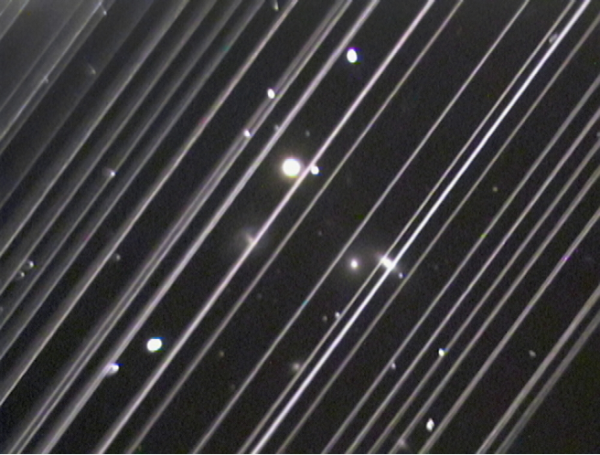
Reflected light from recently launched Starlink satellites causes streaks of light to appear in an astronomical image of the NGC 5353/4 galaxy group. Credit: Lowell Observatory at the US National Science Foundation National Optical-Infrared Astronomy Research Laboratory.
Much of what is known about SpaceX's plan comes from a January 2026 filing with the Federal Communications Commission (FCC) which oversees satellite frequency use in U.S. skies. Because the application is still in early review stages, key details are missing. SpaceX has not disclosed the satellites’ expected size, computing hardware, thermal systems, manufacturing plans, deployment timeline, or computing capacity.
A more detailed filing from a different company offers a clearer picture of how firms in this space imagine this technology working. In February 2026, Starcloud filed its own FCC application to deploy 88,000 orbital data center satellites.
In response to the filing, the American Astronomical Society (AAS) issued a statement regarding the potential effects on astronomy and the space environment. AAS warned that large constellations of data centers could dramatically affect astronomical observations across optical, infrared, and radio astronomy, some of the primary tools that scientists use to study the cosmos.
Optical and infrared astronomy use visible and infrared light to study celestial objects. Large satellite constellations can affect observations by reflecting sunlight or producing infrared signals that mask distant objects. Radio astronomy is particularly vulnerable, as radio waves are extremely weak signals. A constellation consisting of tens of thousands of satellites would create enough artificial radio noise to completely overwhelm these natural signals, leaving astronomers unable to study unique signal sources, such as pulsars, quasars, and black holes.
AAS also raised concerns about the environmental impact of the constant deployment and replacement of thousands of satellites. Atmospheric reentries release metals and particles into Earth’s upper atmosphere, and increased debris in Earth’s low orbit could make space operations more difficult in the future. This risk was demonstrated in 2025 when China’s Shenzhou-20 craft suffered suspected debris damage, delaying the crew’s planned return. Even small fragments of debris can travel faster than a bullet, creating risks for spacecraft crews and essential satellite systems responsible for communication, navigation, and weather forecasting.
AAS’s statement addressed the details of Starcloud’s 88,000-satellite filing, and its concerns are magnified by the 1 million-satellite proposal from SpaceX. A system at that scale could create an unprecedented challenge for managing the space environment.
The engineering challenge
Beyond ecological concerns, orbital data centers pose significant engineering obstacles.
Matthew McGill, director of the Iowa Atmospheric Sensor Development Laboratory, studies remote-sensing technology used to measure atmospheric particles and climate. He pointed to cooling and power as the two most daunting hurdles to operating orbital AI data centers.
On Earth, data centers cool their servers with enormous quantities of water. “In space, you have to radiate to cold space,” McGill said. “That’s the only way you can cool.”
Cooling AI processors could require radiator systems large and heavy enough to complicate satellite design, and the heat released by these systems would create additional infrared emissions that interfere with sensitive telescopes. McGill questioned whether orbital data centers could realistically replace ground-based facilities. “I don't see any way it’s a one-to-one replacement for a ground-based data center, given power requirements and cooling requirements,” he said.
Large-scale AI computing would also demand larger solar arrays than those used in Starlink’s constellation. SpaceX has not explained how it would overcome these engineering limitations. “You'd have to convince me that you can get enough power out of solar panels without blotting out the sun,” McGill said.
A May 2026 engineering analysis preprint from the European Southern Observatory reached a similar conclusion, finding that current launch costs and spacecraft requirements make large orbital data centers economically impractical for now.
Rival satellite operators have also raised doubts. Amazon has argued that the SpaceX filing lacks the technical detail needed to evaluate the plan, citing missing information about orbital design, radio frequency use, and debris mitigation.
The night sky as a shared resource
For some astronomers, the stakes go beyond scientific research. Steven Spangler, who spent years at the University of Iowa teaching and researching astronomy, noted that the field has already given rise to technologies like GPS, satellite communications, weather monitoring, medical imaging, and sensor systems used far beyond the observatory. But beyond its scientific and technological value, Spangler argued, the night sky itself is worth protecting.
“What I think is the worst aspect of this is not so much the impact on research instruments,” Spangler said. “But to me, it’s just vandalizing the sky.” He compared the potential loss of a dark, unobstructed night sky to ecological destruction: “It’s like going and poisoning the rivers or chopping down all the forests and killing the birds. It’s destroying nature, essentially.”
Whether SpaceX can successfully deploy its proposed 1 million orbital data centers remains an open question. The project is still in early FCC review, with many technical details about design, operation, and environmental impacts unreleased. The FCC’s process allows concerns from scientists, companies, and other organizations to be considered before authorization is granted. As of publication, neither SpaceX nor Starcloud has responded to requests for comment.
Main header image caption: A composite image shows parallel trails from Starlink satellites over southern Brazil in 2019, captured across 33 exposures. Credit: Egon Filter.
Fiona Holmes is an alumna of the University of Iowa with bachelor's degrees in applied physics, specializing in geophysics, and in astronomy. Her work with the School of Earth, Environment, and Sustainability is for planetary geology involving micro- and macro-scale analysis of minerals and remote sensing of Martian volcanic landscapes. She is interested in the promotion of science through scientific communication and making physics and astronomy more accessible and engaging to everyone.
The NASW Perlman Virtual Mentoring program is named for longtime science writer and past NASW President David Perlman. Dave, who died in 2020 at the age of 101 only three years after his retirement from the San Francisco Chronicle, was a mentor to countless members of the science writing community and always made time for kind and supportive words, especially for early career writers.
You can contact the NASW Education Committee at education@nasw.org. Thank you to the many NASW member volunteers who lead our #SciWriStudent programming year after year.
Founded in 1934 with a mission to fight for the free flow of science news, NASW is an organization of ~ 2,300 professional journalists, authors, editors, producers, public information officers, students and people who write and produce material intended to inform the public about science, health, engineering, and technology. To learn more, visit www.nasw.org