This student story is one of five winners of the Summer Writing Awards as part of the 2026 NASW Perlman Virtual Mentoring Program organized by the NASW Education Committee, providing science journalism experience for undergraduate and graduate students.
Story by Emily Davies
Mentored and edited by Amber Dance
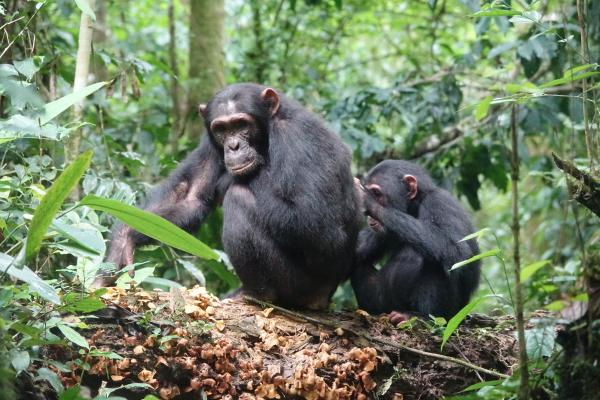
Deep in the dense forests of Uganda, a group of chimpanzees sat on top of a fallen tree trunk, where the gap in the forest canopy bathed them in sunlight. While grooming himself, Kavera, a juvenile, found a parasite in his fur and placed it on a leaf to investigate. As he held the leaf up to his face for closer inspection, his infant niece Karoline watched intently.
Perhaps unbeknownst to her, Karoline was also being watched. Some distance away, Nora Slania, a graduate student with the Max Planck Institute of Animal Behavior, was carefully capturing a photo. It was May 2023, and for the previous year and a half, Slania and her colleagues had been observing the chimpanzees to study their culture — and finding it’s much more extensive than researchers realized.
Like humans, other animals have culture: Behavior that is socially learned and transmitted through generations. Thirty-nine behaviors had previously been identified as cultural in chimpanzees, but Slania’s study, published in iScience in June 2026, nearly doubles that figure in a single chimpanzee community. The findings fit into scientists’ expanding understanding of chimpanzee behavior, connect to their knowledge of human psychology, and raise important questions about conservation strategies.
“Chimpanzee culture,” Slania said, “is more extensive, and in a way more similar to what we consider culture in humans, than what we’ve previously known.”
A well-known example of chimpanzee culture is primatologist Jane Goodall’s famous observations of chimps using stems to “fish” for termites. Most of the existing literature on chimpanzee culture focused on complex behaviors and tool use like this. Slania predicted that culture was involved in a wider range of chimpanzee behaviors, however.
Many behaviors are learned to support chimpanzees’ “rich social life,” said Andy Whiten, a primatologist and evolutionary psychologist at the University of St. Andrews who was not involved in the study. Chimpanzees live in what is called a fission-fusion society, forming temporary associations as they travel around their range. “There's a lot a youngster needs to learn about, not only about its physical environment, but about its social environment,” Whiten said.
Orphaned brothers Mbotella (left) and Muhumza (right) engaged in grooming. Credit: Nora Slania.
Peering into chimpanzee culture
To investigate the potential cultural basis of behaviors beyond tool use, Slania and her colleagues observed the eastern chimpanzees of the Sonso community in the Budongo Central Forest Reserve. They observed 28 animals for 2.5 years, about 1,100 hours of observations in total.
Because social transmission is an essential part of the definition of culture, Slania and her colleagues sought first to identify an indicator of observational social learning. They focused on peering, where one chimpanzee closely observes another performing an action, like when Karoline watched her older relative inspect a parasite. In congruence with prior studies, the researchers found that peering correlated with situations where learning was expected — often, the performance of complex and rare tasks such as wound treatment. Though such tasks were only a small portion of the observed behaviors, they were disproportionately peered-at.
After establishing that peering reflected social learning, the researchers analyzed how often chimps peered at different activities and found that, in fact, chimpanzees most often peered at common behaviors like feeding and grooming. Chimpanzees often groom as a way of social bonding, similar to how humans chat or gossip, Slania said, and it is an important everyday behavior. Crucially, they noted that the peered-at behaviors included mundane, simple and non-tool-assisted behaviors
As humans’ closest evolutionary relatives, chimpanzees have long been studied in comparison to people. Peering is not only done by chimps; human children exhibit similar behavior in parallel contexts. Whiten, who has done work on both animal culture and human developmental psychology, said, “Youngsters of both species are intensely interested in what their elders are doing.” Thus, individuals born into different communities may learn different behaviors.
Culture has also begun to play a role in conservation efforts. In 2020, the UN’s Convention on the Conservation of Migratory Species (CMS) specified chimp nut-cracking as a behavior that should be conserved, the first time the organization has listed a specific animal behavior like this. “As their habitats change, being able to maintain a certain level of behavioral diversity means that they can better adapt,” said Gal Badihi, a postdoctoral researcher at the Max Planck Institute for Evolutionary Anthropology who was not involved in this study but has worked closely with Slania in the past. “By protecting their cultures, we're actually better able to protect the species.”
___
Main image caption: An infant chimpanzee, Karoline, peers at the actions of an adolescent, Kavera, who is using a leaf to inspect a parasite found during grooming. Credit: Nora Slania.

Emily Davies is incoming post-baccalaureate fellow in the Division of Translational Toxicology at the National Institute of Environmental Health Sciences. She studied cell biology at the University of Maryland and enjoys writing about the intersections between science and philosophy. Her interests span animal behavior, animal ethics, neuroscience, computational biology and bioethics. She can be reached by email at emrdavies11@proton.me