Roughly 95% of the observable universe remains little more than a mystery. But data from the Dark Energy Spectroscopic Institute (DESI) could bring us closer to coaxing it out of its shadow.
This student story was published as part of the 2026 NASW Perlman Virtual Mentoring Program organized by the NASW Education Committee, providing science journalism experience for undergraduate and graduate students.
Story by Grace Paxton
Mentored and edited by Emily Greenhalgh
In the night sky, the brilliant twinkling of stars only constitutes a fraction of what’s really out there. Normal matter (everything from our local neighborhood to the farthest-flung galaxies) makes up less than 5% of the universe.
Dark energy, which makes up most of the remainder, is the term coined for the phenomenon propelling the universe’s expansion to accelerate. Because it interacts with neither light nor matter directly, we can only explain its effects, such as the stretching of light from distant galaxies. Since its discovery in 1998, cosmologists have raced to decipher this astronomical white whale. The general consensus for the field was that dark energy was static and unchanging with time.
But, mounted on a 4-meter telescope and with 47 million galaxies of data, the Dark Energy Spectroscopic Instrument (DESI) may start to shake decades worth of assumptions.
“We don't know what it is, but we know there is something that is making the universe expand faster,” said Otávio Alves, DESI scientist and member of its outreach committee. “What we are really trying to do is to map the dynamics of this component of the universe.”

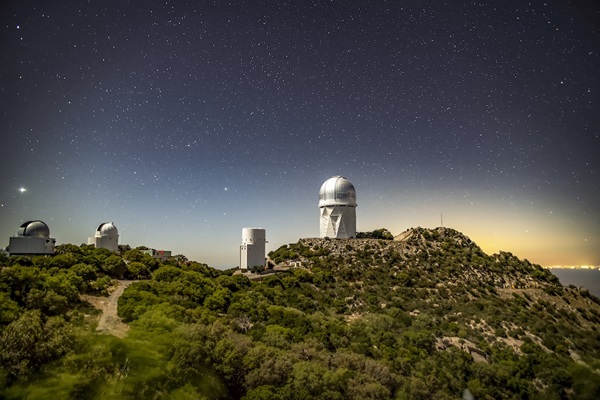
Situated at Kitt Peak National Observatory DESI uses a system of 5,000 robotic hands to align fiber optic cables to collect spectra, or light patterns from faraway galaxies. During the millions or billions of years’ long journey from its galaxy of origin to ours, the expansion of the universe stretches the light like a slinky, making it redder. Using these spectra, astronomers can determine how much stretching, or redshift, is present and work backwards to determine how the universe grew in that time, as well as get a more direct look into what the universe used to be like. And with its impressive repertoire of tools, DESI has been able to form the most comprehensive 3D map of the universe to date.
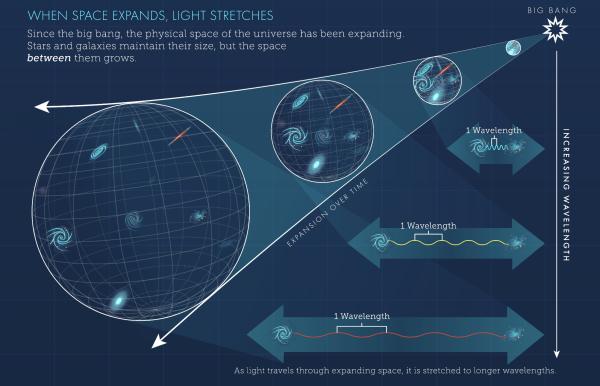
Diagram demonstrating the stretching and reddening of light as the universe expands. Photo credit: NASA. Created: Leah Hustak.
Einstein’s ‘Greatest Blunder’
Like much of modern cosmology, the most popular model has its roots with Einstein. In 1917, he
proposed the existence of a cosmological constant, dubbed lambda. Back then it was used as gravity’s antithesis — a way to explain how the universe remained static.
As evidence mounted that the universe was expanding, the constant was thrown out for decades until redshift measurements of distant supernovae in 1998 came out to be stronger than expected. Data proved to scientists that the universe’s expansion was accelerating and Einstein's so-called greatest blunder formed the backbone of the most widely accepted cosmological model. In most cases, lambda explains much of what we see throughout the universe with high accuracy.
Keyword: Most.
Under this model, the Hubble Constant, which describes expansion, should remain constant regardless of how you measure it: for every 3.26 million light years an object is away from us, it recedes another ~70 km/s faster. (That’s not to say we’re stationary – the walnut only sees the others getting farther and not itself moving). But time and time again, that’s shown not to be the case, instead revealing a troubling gap. DESI is trying to figure out why.
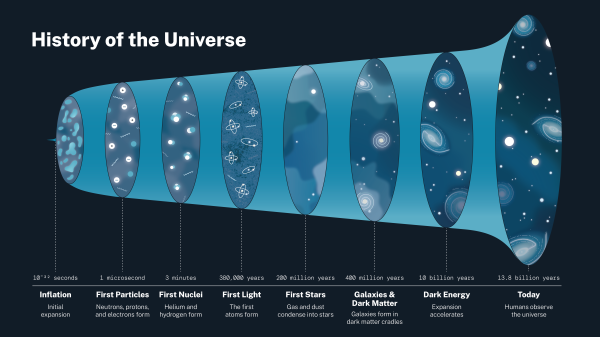
A diagram showcasing the expansion universe throughout its history. Photo credits: NASA.
One of the steps DESI is taking to resolve this conflict is measuring baryonic acoustic oscillations (BAOs). Much like ripples in a pond, BAOs are leftover waves from when the universe was young and competing forces of gravity and pressure from light rocked matter back and forth. Now, imprints of these waves are detectable by measuring the density of galaxies, giving us an invaluable look into how the early universe behaved. Each measurement taken acts as a screenshot of how expansion acted at one particular epoch, like frames in an animation.
DESI’s first data release, published in March 2025, affirmed this difference in Hubble Constants, giving preliminary hints to an evolving dark energy as its solution. The team’s sophomore data release later that year strengthened these trends, setting the cosmological field ablaze with debate.
Both matter and light dilute with volume, explained Alves. Density goes down as the universe expands. If dark energy is a cosmological constant, then its density would be constant with the expansion. But DESI’s data doesn’t align with that expectation.
“That's the first hint that dark energy is not just a cosmological constant; it's something dynamical,” Alves said.
While this new framework is gaining popularity in cosmological circles, not everyone is convinced. One paper, published in the Royal Society in 2025, reiterates the accuracy the current model has shown in explaining the phenomena seen in the universe’s early days. It and others propose ideas of a field peaking in strength early on or systemic errors in data collection.
“Whatever the nature of dark energy is, it will shape the future of our universe,” DESI Director Michael Levi said in a press release. “It’s pretty remarkable that we can look up at the sky with our telescopes and try to answer one of the biggest questions that humanity has ever asked.”
DESI’s third data release, set for late next year, will be its most comprehensive yet. Whether dark energy proves to be dynamic or the standard cosmological model ultimately prevails, the coming years are likely to reshape our understanding of the force driving the universe’s expansion. In other words: we may be starting to take our first step out of the dark.
Main Header Image Caption: The Mayall Telescope and greater Kitt Peak National Observatory as seen from a distance. Located southern Arizona, the complex houses both the telescope and DESI’s spectrograph. Credit: Marilyn Chung/Lawrence Berkeley National Lab/KPNO/NOIRLab/NSF/AURA
Grace Paxton is a first-year master’s student at the University of Iowa, studying physics and working on high energy particle simulations and assembly of DUNE detectors. She can be contacted via her email at gracep241@gmail.com
Emily Greenhalgh is a marine biologist-turned-science communicator and the author of three children’s science activity books: Fun with Oceans and Seas, Fun with Outer Space, and Bug Explorers! She is Associate Director of Content at The Jackson Laboratory.
The NASW Perlman Virtual Mentoring program is named for longtime science writer and past NASW President David Perlman. Dave, who died in 2020 at the age of 101 only three years after his retirement from the San Francisco Chronicle, was a mentor to countless members of the science writing community and always made time for kind and supportive words, especially for early career writers.
You can contact the NASW Education Committee at education@nasw.org. Thank you to the many NASW member volunteers who lead our #SciWriStudent programming year after year.
Founded in 1934 with a mission to fight for the free flow of science news, NASW is an organization of ~ 2,300 professional journalists, authors, editors, producers, public information officers, students and people who write and produce material intended to inform the public about science, health, engineering, and technology. To learn more, visit www.nasw.org