This student story was published as part of the 2026 NASW Perlman Virtual Mentoring Program organized by the NASW Education Committee, providing science journalism experience for undergraduate and graduate students.
Story by Maren Fuller
Mentored and edited by Julia Ostmann
Aliens are on the collective mind lately. Project Hail Mary came out in March, featuring a lovable, intelligent alien. It’s also the 10-year anniversary of the film adaptation of Arrival, where aliens seek communication with humans. In real life, NASA’s Europa Clipper is about to get a gravity assist from Earth toward Jupiter’s second closest moon, looking for any ingredients of life in Europa’s subsurface ocean.

A variety of pages with math equations. Credit: Wikimedia.
What happens if the spacecraft does make contact with alien life? Will it be like the movies, or have we gotten it all wrong?
The answer is no longer science fiction. For 50+ years, the field of exosociology has studied how communication with an extraterrestrial society could be possible. New advances reveal that movies are at least partially wrong in regards to the type of extraterrestrial life to be found, the way people would respond, and how we would communicate with aliens.
Anybody out there?
Many sci-fi movies have the main character meet intelligent extraterrestrial life. After all, what’s the fun in discovering aliens that are microscopic and can’t talk? In Arrival, the characters meet intelligent alien “heptapods.” Even in Project Hail Mary, the protagonist first encounters microbial alien life, but then spends most of the film interacting with intelligent Rocky.
The reality is that scientists will most likely discover unintelligent microbial (bacteria, plants, etc.) alien life first. Scientists know that extremophiles already live under intense conditions, meaning that alien microbial life could be hidden within our very Solar System in places we’d never think to look. You can’t have a “conversation” with microbial life, at least in the way humans think of a conversation.
Finding intelligent life will be trickier. Intelligent aliens are most likely too far away (we haven’t detected their radio signals yet), hiding from us (yes, that’s an actual theory), or are not intelligent enough to create a signature indicating where they are.
Whether Europa Clipper or some future spacecraft discovers intelligent or microbial life, recent studies indicate that our fellow humans will have an overall positive reaction.
How would we feel?
In both Arrival and Project Hail Mary, the first response to the discovery of intelligent life is fear and curiosity, with a touch of excitement.
But exosociological research over the last few years suggests that when real people were asked how they thought they’d respond to the discovery of alien life, or actually told that alien life had been discovered (it hadn’t!), their responses were mostly positive.
In May, Volkan Duran, a psychology researcher, released a paper in Human Arenas exploring how Turkish undergrad students responded to the hypothetical discovery of intelligent alien life by saying how strongly they agreed or disagreed with certain statements.
Duran expected subjects would report fear.
When it comes to first contact between humans and aliens, with "intelligence, intention, consciousness...rivalry or conflict might happen,” Duran said. “That’s why people, you know, might be afraid of such a case.”
Seeing that people today are afraid of AI, he predicted that humans might also fear intelligent aliens.
However, the results showed a positive response. But that response contained variety. Subjects were either “protocol-oriented rationalists,” who wanted strict ground rules in place during contact, and “conviction driven searchers,” who were more cautious and wanted to hide and have aliens find humans first.
“Normally we think that…people react positively, or people react, you know, in panic. But these [kinds] of studies show the richness of the responses…we can see the different opinions much more deeply,” said Duran.
Duran’s study builds on previous findings. A 2018 paper published in Frontiers in Psychology on humans’ reactions to the discovery of microbial alien life also saw an overall positive response, though there wasn't much variation.
If we find intelligent life, scientists need to learn what aliens think of us, and if they are willing to have a conversation.
Will a simple DM work?
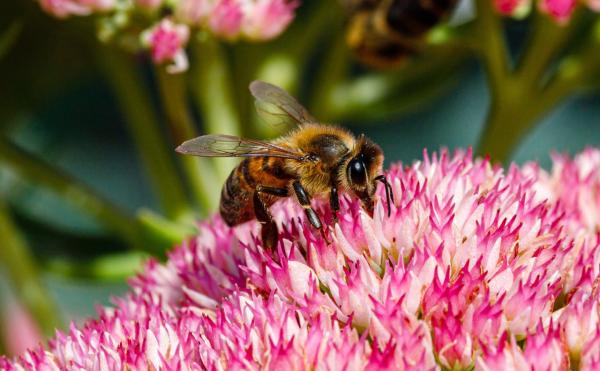
A bee pollinating a flower. Credit: Wikimedia
In Arrival, aliens and humans communicated through movements and writing, while in Project Hail Mary, the protagonist and Rocky eventually learned each other’s spoken language.
In reality, the best way to communicate with an alien is likely through math. A February study in Leonardo investigated whether bees and humans could communicate through math. The answer was yes: bees were able to add or subtract numbers when prompted. This experiment suggests math is a universal language that can actually cross species, possibly even to aliens.
However, intelligent extraterrestrials may not use the same type of math we do. For example, they could start with a different geometry and derive laws of motion based on that instead. Their results could be very different from the formulation of laws that humans know. So the movies may be more accurate than we think.
What do we really know?
If Europa Clipper finds any trace of extraterrestrial life (likely microbial first), movies paint a picture of an initially fearful human response, and spoken communication. But exosociology suggests this picture likely isn’t preparing us for actual extraterrestrial contact, which may be more positive and mathematically driven. We’ll just have to wait and see how much the fun ideas made up by some serious space nerds really represent reality.
Main Header Image Caption: Astronaut meets alien. Credit: Magnific.
Maren Fuller is a science writer who studied Astrophysical and Planetary Sciences from CU Boulder. She loves reporting on the latest updates in astrobiology, from the missions to explore potentially habitable worlds to the research done on Earth’s biological history to learn how life elsewhere could be possible. You can email her at mfuller.astr@gmail.com.
Julia Ostmann is a freelance science writer who has written for outlets and organizations including the Santa Fe Institute, Sierra, the American Physical Society, Harvard Magazine, Dumbarton Oaks, and the Broad Institute.
The NASW Perlman Virtual Mentoring program is named for longtime science writer and past NASW President David Perlman. Dave, who died in 2020 at the age of 101 only three years after his retirement from the San Francisco Chronicle, was a mentor to countless members of the science writing community and always made time for kind and supportive words, especially for early career writers.
You can contact the NASW Education Committee at education@nasw.org. Thank you to the many NASW member volunteers who lead our #SciWriStudent programming year after year.
Founded in 1934 with a mission to fight for the free flow of science news, NASW is an organization of ~ 2,300 professional journalists, authors, editors, producers, public information officers, students and people who write and produce material intended to inform the public about science, health, engineering, and technology. To learn more, visit www.nasw.org