This student story was published as part of the 2026 NASW Perlman Virtual Mentoring Program organized by the NASW Education Committee, providing science journalism experience for undergraduate and graduate students.
Story by Jada Summerville
Mentored and edited by Sarah Nightingale
We may be able to control New World screwworm (NWS) outbreaks threatening the U.S. with a parasitoid wasp no bigger than a grain of rice.
Led by researchers at the United States Department of Agriculture (USDA) in Florida and Texas, a recent study published in the Journal of Medical Entomology reports that secondary screwworm (Cochliomyia macellaria) — a fly species of the same genus as NWS (Cochliomyia hominivorax) — is a suitable host for a parasitoid wasp, Tachinaephagus zealandicus.
NWS is a devastating parasitic pest typically found in South and Central America. The fly lays its eggs in the wounds of warm-blooded animals, such as cattle and other livestock. The subsequent larvae feed on live tissue, killing the animal if left untreated and posing risks to livestock populations.
The U.S. is one of the world’s largest producers of beef, generating roughly 12 million metric tons annually, with Texas leading the nation in production. Although NWS was once eradicated in the United States, the fly’s recent re-emergence in Texas this past June has jeopardized U.S. livestock and wildlife. To date, 42 cases of the parasitic fly have been confirmed, with 41 in Texas and one in New Mexico, according to USDA data.
Seeking a solution, the study authors explored the use of the parasitoid wasp T. zealandicus as a new method of biological control for NWS infestations.
“Combatting New World screwworm requires a multi-pronged approach,” said Chris Geden, a research entomologist at the USDA’s Center for Medical, Agricultural, and Veterinary Entomology, who led the study. “Wasp releases could be helpful for treating localized hot spots where NWS populations are gaining a foothold.”
A lethal weapon
Because NWS is a quarantine pest, it carries great risk to work with. Hence, the study authors utilized a proxy species, the secondary screwworm. The study examined whether T. zealandicus is effective in killing secondary screwworms as a natural biological control approach.
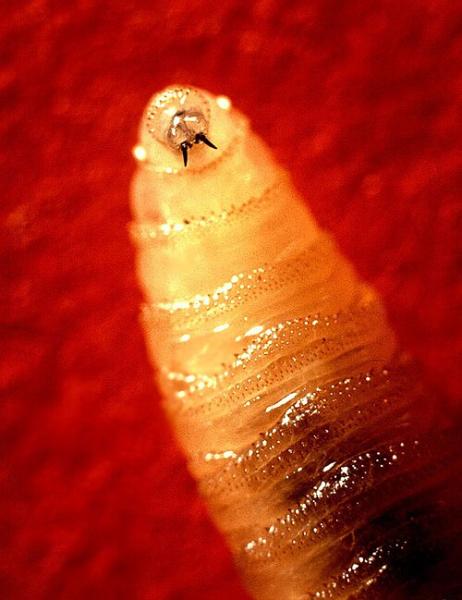
The larval stage of the New World screwworm (Cochliomyia hominivorax). Credit: Photo by John Kucharski, USDA Agricultural Research Service.
The biocontrol strategy the authors tested relied on the tiny parasitoid wasp targeting secondary screwworm larvae during their “wandering stage.” This is the final larval stage of the screwworm where it drops from the animal host to burrow in the ground before pupating. The wasp injects its eggs into larvae that are more than double their size. The hatching offspring consume it from the inside out, killing the fly before it can mature into an adult.
The authors first tested if the secondary screwworm was susceptible to T. zealandicus. By exposing screwworm larvae to adult wasps, they found that the parasitoids killed the screwworms at rates similar to other fly species parasitized by T. zealandicus. When screwworm larvae were highly abundant at a 40-to-1 ratio, just five wasps achieved a maximum kill rate of almost half the population.
T. zealandicus has a broad range of suitable hosts to parasitize, providing competition that may leave screwworm less desirable in comparison. The authors then investigated the wasp’s preference for the screwworm compared to another known fly host, S. bullata. The wasps did not prefer one fly over the other, showing screwworm is a suitable host for T. zealandicus.
Like many insects, T. zealandicus finds its prey through smell. Because wandering screwworm larvae burrow into the ground to pupate, different terrains might pose differing challenges to the wasps.
The authors found that providing clay or moist soil for larvae to burrow in did not prevent the wasps from hunting and parasitizing them. However, dry soil provided some protection from the wasps by allowing the larvae to thrash more effectively and escape the wasps.
Together, these experiments demonstrate that T. zealandicus is highly effective at killing secondary screwworms across various soil environments.
Death by a thousand cuts
While the U.S. and other countries control NWS reproduction using Sterile Insect Techniques (SIT), some flies slip through the cracks. This study suggests biological control approaches may offer a promising tool to help eradicate NWS from the U.S. and endemic countries.
“It fits into our approach of integrated pest management,” said Phillip Kaufman, a professor and head of the entomology department at Texas A&M University, who was not involved in the study. “It’s sort of like death by a thousand cuts. Everything you do takes a little bit more of the population away.”
Geden stated additional studies are needed to determine if these results can be replicated in field settings and with the NWS itself, rather than the proxy species.
“Our lab has developed methods for economical mass-production of T. zealandicus,” Geden said. “A critical next step would be to see whether mass-rearing and release of wasps reduces fly populations.”
Main Header Image Caption: The parasitoid wasp Tachinaephagus zealandicus is being evaluated as a potential biological control tool in the fight against New World screwworm (NWS). Creator/Credit: Photo by Alandmanson via Wikimedia Commons / CC BY 4.0.

Jada Summerville is a Ph.D. student at Albert Einstein College of Medicine. She studies synapse development in the nematode Caenorhabditis elegans. She enjoys science outreach and communication and loves to use journalism as a way of reaching general and young audiences to spark an interest in science. You can find her on LinkedIn or email her at jada.summerville@einsteinmed.edu.
Sarah Nightingale is assistant director of news and content at the University of California, Riverside. An experienced writer and editor, she enjoys untangling complex concepts and crafting stories readers can understand and enjoy. She earned a Ph.D. in molecular microbiology and immunology from the University of Southern California and a master’s in journalism from Kansas State University. Her bachelor’s in biochemistry is from Imperial College, London.
The NASW Perlman Virtual Mentoring program is named for longtime science writer and past NASW President David Perlman. Dave, who died in 2020 at the age of 101 only three years after his retirement from the San Francisco Chronicle, was a mentor to countless members of the science writing community and always made time for kind and supportive words, especially for early career writers.
You can contact the NASW Education Committee at education@nasw.org. Thank you to the many NASW member volunteers who lead our #SciWriStudent programming year after year.
Founded in 1934 with a mission to fight for the free flow of science news, NASW is an organization of ~ 2,300 professional journalists, authors, editors, producers, public information officers, students and people who write and produce material intended to inform the public about science, health, engineering, and technology. To learn more, visit www.nasw.org