Should conservation organizations train frogs and other amphibians to prosper when they are reintroduced into the wild?
This student story is one of five winners of the Summer Writing Awards as part of the 2026 NASW Perlman Virtual Mentoring Program organized by the NASW Education Committee, providing science journalism experience for undergraduate and graduate students.
Story by Breyton Hill
Mentored and edited by Eric Bender
Almost half of amphibian species are globally endangered by loss of habitat, disease, climate change, over-exploitation and other threats. Conservation groups try to meet this huge challenge by raising threatened frogs and other amphibians in captivity and re-introducing these cultivated animals into the wild.
All too often, however, such re-introduction efforts fail, said Michael Lannoo, professor of anatomy at the Indiana University School of Medicine in Terre Haute. Visiting release sites for the amphibians months or years later often is disheartening because there are no signs of the thousands of animals released.
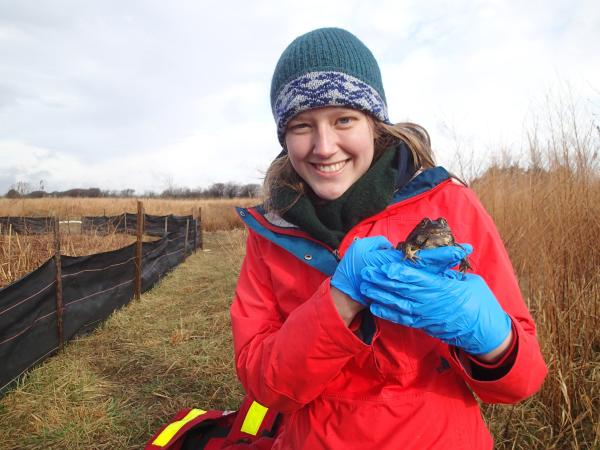
Rochelle Stiles, director of conservation at the San Francisco Zoo & Gardens and corresponding author on the Ecology and Diversity paper, holding a crawfish frog. Credit: Michael Lannoo.
Lannoo points to one major contributing factor: amphibians bred in captivity with every need met never learn the self-preservation skills they need to survive in the wild.
In a paper published in Ecology and Diversity in June, Lannoo and 13 fellow experts propose a radically different perspective, advocating systematic attempts to provide captive amphibians with cognitive training that can help them prosper in the wild.
The researchers acknowledge, however, that recreating scenarios that occur in the wild will raise ethical concerns for the zoos and aquaria that breed the animals. It may be difficult, for example, to teach frogs about predators if no frogs get eaten.
Better with brainpower
Decades of research have convincingly demonstrated that many amphibian species are capable of learning and forming memories, rather than being “simple reflex machines,” Lannoo emphasized. Amphibians show this intelligence through complex social behaviors, an understanding of environmental stimuli, and reliable geographical navigation.
Poison dart frogs offer examples of complex social behaviors, said Bibiana Rojas, an associate professor of global change biology at the University of Veterinary Medicine in Vienna. Depending on the species, either male or female frogs will carry tadpoles in a clutch on their back to nearby water sources such as tree holes or cupped leaves.
Andrius Pašukonis, a senior researcher and poison dart frog expert at Vilnius University in Vilnius, Lithuania, stressed the importance of navigation for poison frogs that “really, really depend on knowing where the breeding sites are.” Similarly, the crawfish frog, which Lannoo studies, must travel from its burrow in the woods to a wetland breeding site thousands of feet away. Then, it must remember how to return to its individual burrow.
How do these amphibians learn and remember, and how do those capabilities evolve over time?
Neuroplasticity (the ability of the brain to rapidly process and adapt to change) is more prominent in younger animals, Lanno said. For example, humans find it easier to learn another language before puberty, as our brains are more capable of forming the necessary connections. Many of the same attributes of early learning apply in amphibians. Lannoo underlines the need for research on each amphibian species to understand neuroplasticity, including the critical periods of neural development that could aid training.
Scientists have found plenty of evidence that tadpoles learn to avoid aquatic predators, said Pašukonis. It’s not so clear, however, how well such crucial knowledge carries over when tadpoles evolve into frogs, and this process could vary greatly among the vast array of frog species.
In any case, it’s improbable that an amphibian experiencing a predator or dangerous habitat for the first time as an adult in the wild will recognize it as such.
A captive frog knows a large looming shadow as the hand that feeds them, Lannoo said. However, put that animal in the wild and it will move towards such a shadow, perhaps only to find it is not a food source but a hungry bird or snake.
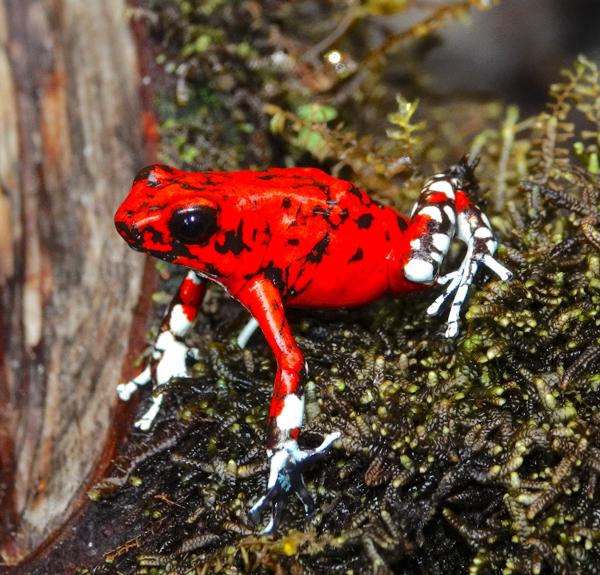
Little devil poison frog (Oophaga sylvatica), among the species studied by Andrius Pašukonis that display complex social behaviors. Credit: Wikimedia Commons.
Jumping to the future
This altered perspective on training animals before their release is just that, a perspective, Lannoo said. He and his co-authors suggest experimenting with an array of training methods to best prepare amphibians for their natural environments.
Frog training, for instance, might involve introducing aquatic predators or large objects flying overhead to stimulate the fear circuits in tadpole brains. Other experiments might include exposing tadpoles to wetland water from the landscape where they will be reintroduced, with varying water temperatures, a behavior cue for some species. Another option would be to offer food that differs in quality, quantity, and timing throughout the day, to help tadpoles understand foraging conditions.
Some of these experiments will undoubtedly have negative effects on some of the animals, potentially including death. Lannoo responded that without training, most of these reintroduced amphibians may die anyway.
Still, the approach flies in the face of ethics accreditation standards promoted by the Association of Zoos and Aquariums that intend to guarantee proper treatment for captive animals. Some experts understandably may push back against the need to sacrifice some animals for the greater survival of all, Lannoo acknowledged.
Pašukonis notes that efforts to reintroduce endangered mammals or birds routinely do consider the effects of learning. “We tend to ignore that for amphibians, because we know so little about it, and also traditionally they’ve been considered sort of stupid,” he said.
Current reintroduction programs often “measure success by the number of animals released, not the number of animals that survive,” Lannoo said. “Some programs have been going on for decades and they still haven’t established populations…The definition of insanity is doing the same thing over and over and over again and expecting different results.”
Main image caption: Sierra Nevada yellow-legged frogs, one-year-olds that the San Francisco Zoo has reared from tadpoles and released in national parks and forests. Credit: San Francisco Zoo & Gardens.

Breyton Hill is an aspiring science journalist. She graduated from North Carolina State University in May with a bachelor’s degree in Genetics. During her time there, she found an appreciation for science writing and communication, and she will attend University of California/Santa Cruz in the fall to earn her masters in science communication. When she is not doing research or writing, Breyton can be found on a walk with her dog or reading a good book.
Eric Bender is a retired science writer whose career began in a time when you needed two people to carry a video camera.