This student story was published as part of the 2026 NASW Perlman Virtual Mentoring Program organized by the NASW Education Committee, providing science journalism experience for undergraduate and graduate students.
Story by Adriana Coke
Mentored and edited by Daniel Serrano
In a forest near the coast of North Carolina, a Venus flytrap quickly snaps its jaws shut to catch a beetle. This native species, and many others, face a looming threat: globally increasing temperatures.
With the goal of protecting the Venus flytrap and the fragile habitat it calls home, researchers at Kansas State University, Duke University, and the North Carolina Botanical Garden are currently conducting experiments to predict the effects that climate change will have on native flytrap populations.
Field experiments mimic future climate conditions
The Venus flytrap is an iconic species, known around the world for its unique ability to catch and digest insects in its jaw-like leaves. Despite its popularity, this species is native only to a very small region near the southeastern coast of the United States: It is found in just 11 counties of North Carolina and one county of South Carolina.
Native flytrap populations are not currently declining, but “there certainly are far, far fewer than there were historically,” said professor William Morris of Duke University, one of the principal investigators on the Venus flytrap research project. It has been estimated that 90% of wild plants and over 1.5 million acres of habitat have been lost over time.
The primary reason for the historical population decline of the Venus flytrap is human activity. “Flytraps used to be common everywhere on the coastal plain,” said Morris. “They like very wet soils. When the coastal plain swamps were drained […] to make them more suitable for agriculture, that eliminated a lot of flytrap habitat. So they're not on the verge of extinction, but there's concern that they may be declining.”
In addition to direct human activity, climate change may also threaten the Venus flytrap. Increasing global temperatures is one reason, but climate change is also predicted to have a drastic impact on weather patterns. For example, record-breaking droughts have been reported across the United States in 2026.
To predict how the Venus flytrap will respond to climate change, scientists from Kansas State, Duke University, and the NC Botanical Gardens are conducting experiments to directly manipulate climate variables. In summer 2025, at a site near Wilmington, North Carolina, these scientists constructed 48 structures out of PVC pipes and greenhouse-grade plastic that sit overtop of natural Venus flytrap populations.
“The experiment combines little greenhouses that warm the temperature by a few degrees centigrade and cages that have a roof that collects the rain and diverts it away,” Morris explained. Under this experiment, some flytrap populations will experience increased temperatures and decreased precipitation compared to controls.
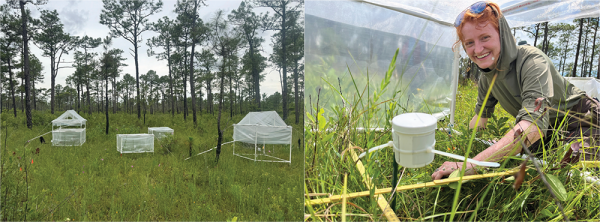
Plots for field experiments are made of PVC pipes and greenhouse plastic. Scientists like Emily Babb (shown) collect data from flytraps growing in these plots. Credit: Emily Babb, Venus Flytrap Intern at North Carolina Botanical Garden (left), Michael Kunz, North Carolina Botanical Garden (right). Used with permission.
Last month, one year after the experiment began, scientists collected data about how the flytraps have so far responded to these different conditions: Which plants survived the entire year? How many leaves do individual plants have? How many fruits are present on reproductive plants?
Taken together, this data will allow the scientists to predict how Venus flytrap populations will respond to climate change conditions in the future.
For Venus flytraps, fire is required for life
A land manager near Wilmington, North Carolina lights a small fire in the dry, wiry grass. It catches quickly, then begins spreading along the ground. Venus flytraps grow here, beneath the grasses. When the fire reaches one flytrap, its leaves and stems are singed, but the flames pass by quickly as the grass burns away. The flytrap’s roots remain untouched. Once the fire is gone, the lack of taller plants around it allows the flytrap plenty of light. It begins to regrow. Within a month, the plant is back to catching beetles. It even produces flowers that wait patiently to be pollinated.
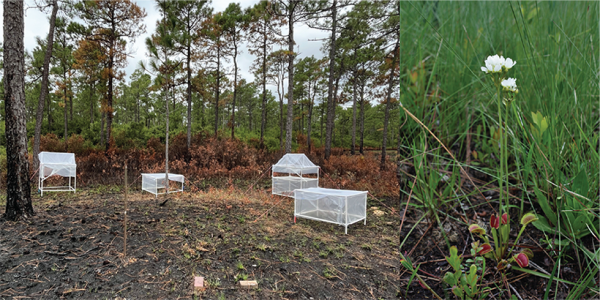
A recently-burned experiment plot alongside a blooming Venus flytrap plant. Credit: Michael Kunz, North Carolina Botanical Garden. Used with permission.
In addition to temperature and precipitation, the Venus flytrap experiments manipulate one additional variable: fire.
The frequency of wildfires has been increasing as the climate changes. These fires can be devastating, destroying both natural habitats and residential homes. However, some ecosystems actually rely on fires in order to survive. The coastal plain where wild Venus flytraps can be found is one of them. In these locations, burns are conducted in a controlled way by local land managers, so as to not cause damage.
“If you go to a place that's burned regularly, the trees are spaced out and the understory is all grass, wire grass, which burns quickly and not very hot,” Morris said. “[Regular burns] mean that the things that grow in between the grass have very high light. Flytraps need that high light environment.”
The scientists from Kansas State, Duke, and the NC Botanical Gardens wondered, if conditions are warmer and drier, what will be the optimal burn frequency for survival and reproduction of the flytraps?
To answer this question, the scientists are also manipulating burn frequency in their field experiments. The results from these experiments will inform land managers about the optimal schedule for burning the coastal plains as climate conditions change over time.
The Venus flytrap study described here is one of many worldwide to understand how various species will respond to climate change and how we can help them to survive. The evidence suggests that human action such as habitat management and species recovery intervention often has a positive impact on threatened species.
Morris said he hopes that the knowledge gained from the current study will help to protect the Venus flytrap, which due to its limited range is ”a unique part of our heritage in the Carolinas.”
Main Header Image Caption: A Venus flytrap, scientific name Dionaea muscipula*, with several open jaw-like structures for catching insects. Credit: Michael Kunz, North Carolina Botanical Garden. Used with permission.*

Adriana Coke is a recent PhD graduate from the University of North Carolina at Chapel Hill with a passion for scientific writing and communication. She studies tardigrades, microscopic animals found anywhere there is water, to understand how they reproduce and their evolutionary histories. You can find her on LinkedIn, https://www.linkedin.com/in/adricoke/, or email her at adriana.ncoke@gmail.com.

Daniel Serrano is a Senior Faculty Specialist at the University of Maryland, College Park. Upon obtaining his Biology PhD (2014, UMD College Park), he worked as an AAAS Mass Media Fellow in television science journalism at NTN24. In his current role, he coordinates science outreach initiatives, teaches science communication, manages interdisciplinary science training programs, and develops grant proposals.
The NASW Perlman Virtual Mentoring program is named for longtime science writer and past NASW President David Perlman. Dave, who died in 2020 at the age of 101 only three years after his retirement from the San Francisco Chronicle, was a mentor to countless members of the science writing community and always made time for kind and supportive words, especially for early career writers.
You can contact the NASW Education Committee at education@nasw.org. Thank you to the many NASW member volunteers who lead our #SciWriStudent programming year after year.
Founded in 1934 with a mission to fight for the free flow of science news, NASW is an organization of ~ 2,300 professional journalists, authors, editors, producers, public information officers, students and people who write and produce material intended to inform the public about science, health, engineering, and technology. To learn more, visit www.nasw.org