This student story was published as part of the 2026 NASW Perlman Virtual Mentoring Program organized by the NASW Education Committee, providing science journalism experience for undergraduate and graduate students.
Story by Lauren Shank
Mentored and edited by Kerry Klein
On a chilly February morning in early 2026, within the choppy waves of the Salish Sea near Seattle and Vancouver, 18 southern resident killer whales traveled east just offshore, black dorsal fins bobbing up and down. This subset of killer whales, primarily native to the Pacific Northwest, consists of 77 members. Southern residents travel in three major pods – J pod, L pod and K pod – and were labeled as an endangered species in 2005.
But on that morning, researchers from the nonprofit Center for Whale Research in San Juan Island, who have dedicated decades to tracking these orcas, made a joyous discovery: the researchers’ orca count came up one higher than usual. Amongst the elongated dorsal fins, an additional small, curved fin followed closely.
“There was a very young calf in the mix with members of the L pod!” wrote the researchers in their encounter log on Feb. 16, 2026. A calf hadn’t been born in the L pod since 2024. Researchers would soon identify the orca calf as L129.
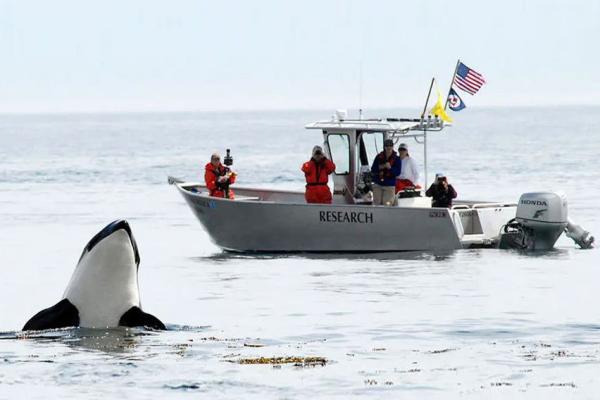
Researchers from NOAA look on as an orca spyhops near San Juan Island. Credit: NOAA.
Four months later, however, L129 would be declared missing when her pod was seen on multiple encounters without her. Researchers assume she didn’t survive.
She’s part of a troubling statistic. According to a 2022 study published in PLOS One, within the first year of life, 50% of all southern resident orca calves will die due to stress on the mothers and a lack of nutrition. Researchers are noticing an increasing number of malnourished whales due to decreasing salmon populations.
One of the main drivers of these trends is ever-increasing ocean noise. Caused by shipping lanes and offshore energy production including wind farms and oil drilling, this noise has been recognized to harm a wide spectrum of marine life. Increased noise levels encourage masking behaviors, leading whales and other wildlife to expend more energy to find the same amount of food. Extended exposure to noise can also disrupt species’ behavior and reproductive abilities.
Only a patchwork of noise-related regulations is in place around the world, however, and addressing these regulations through research was one of the priorities of the 2026 Oceanoise Conference held recently in Vilanova i la Geltrú, Spain.
"People are starting to realize it's an intractable problem [and] we have to figure out how to address it,” said Michael Stocker, a conference attendee and executive director of the nonprofit Ocean Conservation Research in Lagunitas, California.
‘The impacts are real,’ agree researchers
Every three years, the Oceanoise Conference facilitates discussions around ocean conservation amongst researchers, scientists, academics, industry representatives and other stakeholders. The most recent conference, which took place during five days in June, brought in over 150 speakers from all over the globe. With sessions on renewable energy, policy, and explosive sources, attendees discussed topics such as mapping underwater noise from boats and auditory dynamics of whale echolocation.
Stocker has been a regular attendee for over 10 years. Despite attendees’ different perspectives and occupations, he thought they were generally more open to exploring potential solutions compared to past conferences.
“We actually had a lot of progress. We agreed on a lot of terminology. We came to terms with the fact that the impacts are real,” Stocker said.
The conference resulted in a call for immediate action by the Oceanoise Science Committee. Published on June 8 on the conference website, the statement advocated for acoustic impact assessment requirements for projects in development and demanded that sound be recognized as a part of ocean health.
“Ocean noise cannot be considered a marginal environmental issue,” said Douglas Nowacek, a professor at the Duke University Marine Lab. “It is a systemic environmental challenge to the health and resilience of our ocean.”
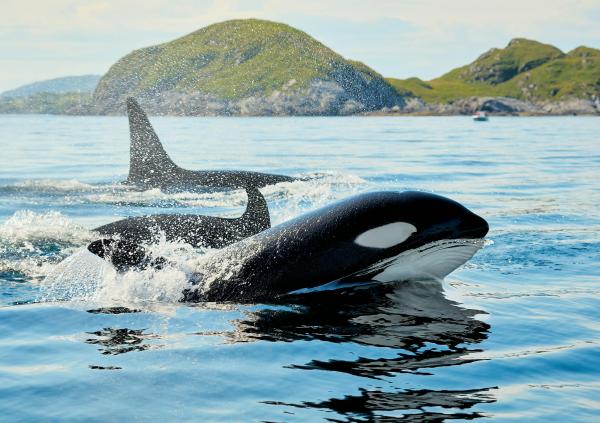
A close encounter with multiple orcas in Arctic Norway. Credit: Vidar Nordli-Mathisen, Unsplash.
Industrial sounds disrupt ocean soundscapes
Beneath the crashing waves of the Salish Sea, the ocean soundscape features echolocation clicks from southern residents, fin drumming by a fish known as the plainfish midshipmen, humpback whale whistles, and low moans from grey whales. In between, motorized propellers slash through and seismic air guns explode.
A 2026 study of underwater acoustics by the Port of Seattle and the National Oceanic and Atmospheric Administration (NOAA) discovered fishing vessels emit sonar levels from 30 to 50 kHz, which overlap with the frequencies southern residents use to communicate and forage.
One of the results is masking, a strategy in which whales change frequency or pitch to be heard.
The animals find themselves ”repeating over and over because there’s noise in the channel, in hopes the message goes through,” Nowacek said, which can lead to rising stress levels and may contribute to the decline of some whales like L129.
“We focus on three areas [masking, repeating, and stress] where the interaction between human sound changes their behavior,” he added. “[Ocean noise] is not a direct correlation but could be a reason why they stop foraging.”
A call for more regulation
Despite the risk to wildlife, no federal laws specifically regulate ocean noise. Rather, some laws, like the Marine Mammal Protection Act, focus more generally on protecting habitats.
At the state level, legislation can vary. In Washington, for instance, a law that recently went into effect aims to lessen boaters' impact on southern residents. As of January 2026, boaters, kayakers and paddleboarders must stay 1,000 yards away from the whales while following a 7-knot speed limit.
In their call to action, the Oceanoise Conference advocates go a step further by calling for protecting all marine life and ecosystems from sound and vibration, instead of only advocating for endangered species.
On the horizon, there’s a sliver of hope for both the southern resident population and conservation researchers. This past June, a small orca named L130 became a new addition to the L pod. So far, the calf has been observed to be in excellent health.
Main Header Image Caption: Orcas breach out of the water, likely to communicate or display playful behavior. Credit: NOAA
Lauren Shank is currently a master’s student in the Rhetoric and Composition program with a focus on species conservation at NC State University. Growing up camping with her dad, Lauren fostered a love for the environment and is drawn to stories on rehabilitating endangered species. When Lauren is not working, she loves gardening, baking, and spending time with her dog Toby.
Kerry Klein is an award-winning reporter, editor and educator with more than 15 years of experience in journalism. As a reporter for KVPR in Central California, she has reported extensively on issues including public health, agriculture and underserved communities. Her work has earned multiple regional and national honors and has aired on NPR programs such as Morning Edition, Marketplace and Science Friday. Kerry is also the creator and host of several podcasts, including the nationally-recognized Escape from Mammoth Pool. Kerry also serves as an associate editor at KVPR, where she mentors emerging journalists and guides editorial development.
The NASW Perlman Virtual Mentoring program is named for longtime science writer and past NASW President David Perlman. Dave, who died in 2020 at the age of 101 only three years after his retirement from the San Francisco Chronicle, was a mentor to countless members of the science writing community and always made time for kind and supportive words, especially for early career writers.
You can contact the NASW Education Committee at education@nasw.org. Thank you to the many NASW member volunteers who lead our #SciWriStudent programming year after year.
Founded in 1934 with a mission to fight for the free flow of science news, NASW is an organization of ~ 2,300 professional journalists, authors, editors, producers, public information officers, students and people who write and produce material intended to inform the public about science, health, engineering, and technology. To learn more, visit www.nasw.org