This student story was published as part of the 2026 NASW Perlman Virtual Mentoring Program organized by the NASW Education Committee, providing science journalism experience for undergraduate and graduate students.
Story by Ye (Vivian) Chen
Mentored and edited by Cay Leytham-Powell
In 2004, scientists found bones from a gibbon — the smallest of the apes — in an ancient tomb built for the grandmother of China’s first emperor. The remains were believed to have belonged to an extinct branch of the family, but a new study revises that idea. It also clarifies a decades-long family tree debate that could shape how the species is conserved.
The study, published in Cell, brought together researchers from China, India, the U.K., and Germany to analyze living and extinct gibbon species. The team did something previous studies had not: They built a complete DNA instruction manual, or genome, for each gibbon group and compared them directly. The result is the most complete genomic picture of gibbons to date, revealing which populations of this understudied, threatened primate are most in need of protection.
“Our study stands out because we obtained very high‑quality genomes for the first time, giving us much more precise data,” said Peng-fei Fan, an author on the study and professor of behavioral ecology and conservation biology at Sun Yat-sen University.
The mysterious gibbon family tree
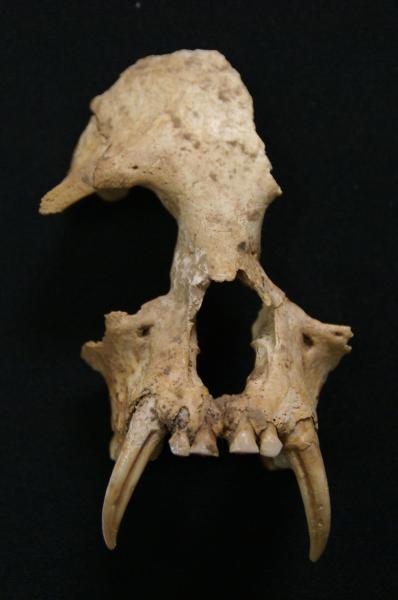
A partial gibbon skull (Junzi imperialis) found in the 2,200-year-old tomb of the grandmother of China's first emperor. Credit: Samuel Turvey.
There are four living genera (clusters of closely related species) of gibbons and 20 total recognized living species: Hylobates (nine species), Nomascus (seven), Hoolock (three), and Symphalangus (one).
All living gibbons come from a single ancestral species. From that ancestor, the four modern gibbon groups split from one another between roughly 7.5 and 6 million years ago, a narrow window only about one‑seventh the time typically needed for gibbons’ DNA to fully sort.
That burst of evolution left a big challenge for today’s scientists. Some ancestral DNA variants were randomly passed down to descendants, so parts of their genomes tell different stories about how the groups split. This mix‑and‑match inheritance, known as incomplete lineage sorting, is what made the family tree so hard to resolve.
To tackle that question, the team sequenced the whole genome of 75 individuals across 18 living species, as well as DNA recovered from three ancient gibbon specimens. DNA from one of those ancient gibbons, Junzi imperialis, came from a partial gibbon skull found in the 2,200-year-old tomb of Lady Xia, grandmother of China’s first emperor, Qin Shihuang.
Researchers were able to use that genomic data to clarify how the four gibbon genera split. Hylobates branched off first, Nomascus followed, and Hoolock and Symphalangus turned out to be each other’s closest relatives, settling a long‑running debate.
With that framework, the team was able to reconstruct relationships within each genus.
From the Junzi imperialis remains, researchers extracted 251 mg of tooth‑bone powder, but the tomb’s harsh conditions meant that only some DNA survived. Using a tool originally developed for piecing together highly degraded Neanderthal DNA, the scientists found that Junzi imperialis was not a new genus, which was suggested in a 2018 Science study. Instead, it fits within the existing Nomascus group.
“This study is significant, and it clarifies gibbon evolutionary history,” said Paul Garber, a primate behavioral ecologist and emeritus professor at the University of Illinois Urbana-Champaign, who was unaffiliated with the study.
From ancient climate swings to modern human pressures
The genomic data let the team reconstruct how gibbon population sizes rose and fell over the past 120,000 years.
All four genera went through a population squeeze, or bottleneck, around 100,000 to 200,000 years ago, followed by a recovery until about 70,000 years ago. Researchers linked this pattern to climate: models show that gibbon habitat expanded around 60,000 to 70,000 years ago, when sea levels dropped and exposed more land in Southeast Asia.
That history left a genetic signature still visible today. Species that never fully rebounded from ancient bottlenecks, like the Hoolock gibbons, carry the lowest genetic diversity and show signs of past inbreeding. That means they entered the modern era already genetically thinned out.
Within the Hoolock group, the Skywalker hoolock gibbon stands out. Named in 2017 by Fan, it diverged from its closest relative within the past million years and occupies a range cut off by the Irrawaddy River, making it a distinct species worth protecting.
That low genetic diversity puts that species, and others like it, most at risk from today’s pressures.
“Changes in climate, ecology and barriers to population isolation that gibbons faced in the past were much more gradual and allowed populations to adapt,” Garber said. “The pressures gibbons face today, from hunting and deforestation to the accelerating effects of climate change, have occurred so quickly that no population or species can adapt.”
China, like many countries, has dramatically reshaped its natural landscape over the past few thousand years — and especially in the last century. Meanwhile, suitable habitats for gibbons continue to shrink.
“Historically, they [gibbons] may have lived farther north in China, but some of those species have already disappeared, and the rest are on the brink,” Fan said.
Main Header Image Caption: A female Skywalker gibbon in Yunnan, China. Credit: Fan Peng-fei.

Ye (Vivian) Chen is a graduate student in science and technology journalism at Texas A&M University. Drawn to interdisciplinary approaches to conservation and grounded in a deep love of nature and wildlife, she’s committed to helping the public better understand our changing planet and to rethinking how we relate to the natural world. Outside of her work, she enjoys running, yoga and traveling around the world. She can be found on LinkedIn.
The NASW Perlman Virtual Mentoring program is named for longtime science writer and past NASW President David Perlman. Dave, who died in 2020 at the age of 101 only three years after his retirement from the San Francisco Chronicle, was a mentor to countless members of the science writing community and always made time for kind and supportive words, especially for early career writers.
You can contact the NASW Education Committee at education@nasw.org. Thank you to the many NASW member volunteers who lead our #SciWriStudent programming year after year.
Founded in 1934 with a mission to fight for the free flow of science news, NASW is an organization of ~ 2,300 professional journalists, authors, editors, producers, public information officers, students, and people who write and produce material intended to inform the public about science, health, engineering, and technology. To learn more, visit www.nasw.org.