This student story was published as part of the 2026 NASW Perlman Virtual Mentoring Program organized by the NASW Education Committee, providing science journalism experience for undergraduate and graduate students.
Story by Margaret Langgin
Mentored and edited by Ariana Remmel
Caterpillars can eat their way through entire crop fields, but rice plants have a unique way of biting back.
Fall armyworm (Spodoptera frugiperda) caterpillars are notorious pests of soy, corn, rice and other important food crops. While pesticides are an important tool for managing infestations, plants have evolved their own strategies to protect themselves from predators.
Researchers at the University of Arkansas recently observed how flowering rice plants can use special hair-like structures to ensnare the predatory caterpillars. The finding offers farmers and scientists a fresh look at the natural defenses that plants deploy in the fight against pests.
Hungry caterpillars
Fall armyworm is a moth that lays its eggs on a wide variety of plant crops. The freshly hatched caterpillars are roughly the length of a sesame seed, but eventually grow to nearly 2 inches long as they feed on the leaves and other aboveground parts of plants. Despite their small size, these voracious insects are a big problem in agriculture.
Fall armyworm is native to the Americas where it has long been a threat to crop farmers. As the insects have spread to new regions in the last decade, they’ve brought economic losses with them. In Kenya, researchers calculated that fall armyworm caterpillars destroyed roughly 1 million tons of corn in 2018 alone.
Controlling fall armyworm outbreaks can be a difficult task because pests inevitably adapt and develop resistance to pesticides, says Christian Krupke, an entomologist at Purdue University. That is why many organizations, including the U.S. Department of Agriculture, encourage farmers to prioritize infestation prevention and use a wide variety of methods to manage pests, including taking advantage of a plant’s built-in safeguards.
“It’s not just these plants are sitting there defenseless waiting for us to show up with the pesticides,” Krupke says.
Flower power
Plants defend against herbivores in many ways including physical barriers such as trichomes, tiny hair-like structures on the surface of plants. Trichomes may be small, but some can still be seen with the naked eye on plants such as tomatoes, cannabis and sunflowers.
Rupesh Kariyat, a botanist at the University of Arkansas, has previously demonstrated that trichomes not only act as a physical deterrent against leaf-eating insects but can cause damage to the predator’s gut lining when ingested. Kariyat and co-author Devi Balakrishna were excited to find fall armyworms trapped by these tiny hairs inside the flowering parts of the rice plants called spikelets.
Rice plants (Oryza sativa) produce clusters of spikelets that enclose each flower in a pair of specialized leaves that protect the growing grain. Credit: International Rice Research Institute/CC BY-NC-SA 2.0 / Creator Rowena Oane.
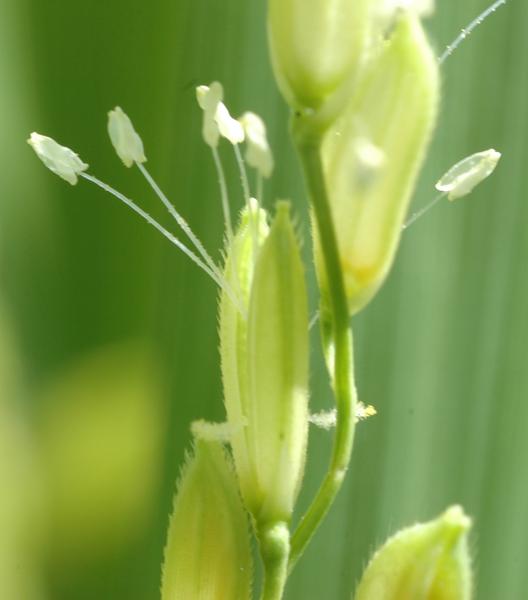
Rice plants, like other grasses, produce clusters of spikelets that will eventually hold the edible grain. Each spikelet has two specialized leaf-like structures that open to reveal the flower when it’s ready to pollinate, then close together to protect the developing seed. These spikelets are covered in trichomes inside and out.
When the spikelet is open, fall armyworm caterpillars can easily crawl from the leaves to feast on the flower. But as the spikelet naturally begins to close at the end of the flowering stage, the unsuspecting caterpillars can become trapped.
To see this mechanism in action, Kariyat and his team enclosed 30 young fall armyworm caterpillars in a mesh bag with an offering of rice – complete with a cluster of open spikelets and attached leaf. Within 48 hours Kariyat and his team found that half of the caterpillars had been trapped by the closing of the spikelet, according to a report published in Ecological Processes in March 2026.
Detailed imaging of the spikelets after the experiment revealed the trapped caterpillars had been skewered by the trichomes as well as crushed between the spikelet’s outer leaves. These findings show that rice plants are causing significant damage, says Krupke, who was not involved in the study.
Adding to the arsenal
Before researchers jump to breeding the most trichome dense rice spikelet possible, Kariyat says there’s still much to consider. Further research is needed to investigate how this mechanism might unfold in a more natural environment, with larger caterpillars and different varieties of rice crops.
Even so, understanding a plant's natural defenses can help scientists engineer crops that are more resistant to insects. Rice aren’t the only plants out there with unique ways of protecting themselves. The world of plants is full of amazing defensive adaptations.
After all, herbivores and plants have been co-evolving for centuries before humans invented pesticides, Krupke says.
Kariyat agrees that plants deserve more credit and is excited to add caterpillar-crushing spikelets to the known arsenal of rice protection strategies. Plants are not defenseless, they might not be able to run away, but within that limitation they are pretty solid, Kariyat says.
Main Image Caption: Rice plants, like many grasses, produce clusters of flowers. The open flowers are easily accessible to predatory caterpillars who sometimes get trapped midmeal. Credit: UADA/CC BY-SA Creator: Paden Johnson.

Margaret Langgin is pursuing her master’s in science and technology journalism at Texas A&M University. When she’s not working she’s lost in a book or appreciating nature with her canine companions.
The NASW Perlman Virtual Mentoring program is named for longtime science writer and past NASW President David Perlman. Dave, who died in 2020 at the age of 101 only three years after his retirement from the San Francisco Chronicle, was a mentor to countless members of the science writing community and always made time for kind and supportive words, especially for early career writers.
You can contact the NASW Education Committee at education@nasw.org. Thank you to the many NASW member volunteers who lead our #SciWriStudent programming year after year.
Founded in 1934 with a mission to fight for the free flow of science news, NASW is an organization of ~ 2,300 professional journalists, authors, editors, producers, public information officers, students and people who write and produce material intended to inform the public about science, health, engineering, and technology. To learn more, visit www.nasw.org