This student story is one of five winners of the Summer Writing Awards as part of the 2026 NASW Perlman Virtual Mentoring Program organized by the NASW Education Committee, providing science journalism experience for undergraduate and graduate students.
Story by Beverly Casillas
Mentored and edited by Nancy Averett
Marine biologist Tokea Payton was submerged in the warm, blue waters off the coast of Bali when she spotted a sea urchin, its delicate spines draped in the plastic film from a discarded water bottle. When she reached out to remove the trash, the urchin’s grip surprised her.
“It was actively holding it onto its body,” said Payton, who was in Indonesia on a research trip.
The prickly creature was a “collector” urchin, a species that normally picks up shells and algae for protection. As Payton floated next to it, debating the right thing to do, she realized that the relationship between trash and marine life was more complicated than it seemed.
Plastic waste and discarded fishing gear pose a serious threat to coral reefs around the world, and NOAA estimates nearly 1.8 billion pieces of marine debris litter U.S. shorelines alone. To combat this problem, many scuba organizations host dives that haul up thousands of pounds of garbage from the ocean each year.
Yet, a recent study conducted by Payton shows that these clean-up dives have side effects. Many small sea creatures use human-made debris for shelter, defense or camouflage. When that trash is removed, so are these hitchhikers.
“Oftentimes, when you do that removal, all these crabs and other organisms fall on the deck of the boat,” she said, warning that their displacement has consequences. “There’s implications and impacts there that we don’t know.”
The little guys
These hitchhikers are called cryptofauna, a diverse group of small animals that live in and around coral reefs, like worms, crustaceans and juvenile fishes. They each have a different role to play in the food chain, eating plants and animals or acting as decomposers. Like an orchestra, the reef needs all parts working together to succeed.
“So if you’re missing a functional group, then your reef is not a healthy reef,” Payton said.
To learn more about how cryptofauna interact with marine litter, Payton and colleagues joined 18 cleanup dives in the Florida Keys from 2020 to 2023. The researchers recorded, measured and weighed any creatures they discovered clinging to or spilling out of the debris.
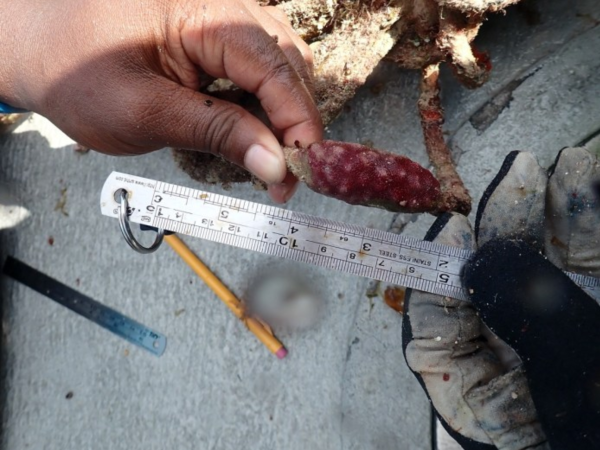
Researchers measured small creatures removed during trash clean-up dives. Creator: Kylie Smith.
Polychaete worms, clinging crabs and corals themselves were most often dislodged with the trash. Crabs normally account for around 4% of cryptofauna by weight in the wild, but made up nearly 25% of cryptofauna that the researchers found attached to litter. While gastropods like snails were mostly attached to cloth, bivalves like oysters stuck mainly to plastic.
Though these creatures are small—18 dives collected about three pounds of cryptofauna—the impact scales over time. Payton’s team estimated that over 130,000 individual creatures may have been accidentally removed over the past decade.
In a previous study, she and colleagues found that, although some cryptofauna used trash, only certain kinds of creatures benefited, creating an unbalanced ecosystem. “It may attract them, but it's not attracting all their food,” she said. Her latest work shows that cleaning up garbage has a similar effect, removing only the creatures that were using it.
Despite their importance, cryptofauna are poorly understood, in part because they’re not as visible as endangered whales or sea turtles. But “the little guys keep the world going around,” she said. “A whale can’t live if it doesn’t have krill.”
Careful clean-up
Payton has worked with organizations in the Florida Keys that empower local divers to help with conservation. I.CARE, one such group based in Islamorada, hosts an annual “trash derby” that has removed nearly 100,000 pounds of litter in the past four years. Their most common targets include abandoned lobster traps, lost anchors, and fishing lines, which damage coral and entangle marine life.
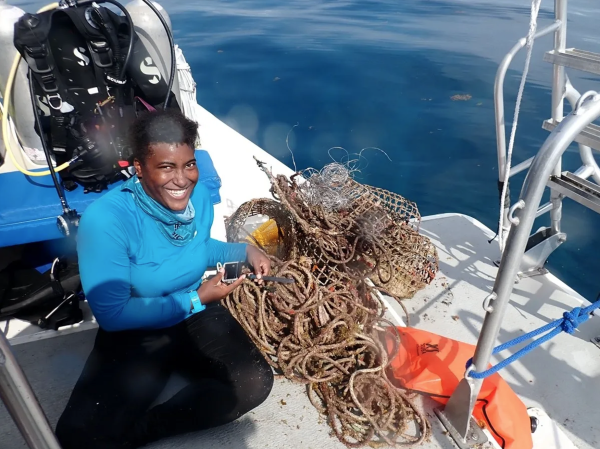
Tokea Payton searches for cryptofauna in a bundle of debris collected during one of her study’s earliest dives in 2020. Creator: Kylie Smith.
“Those are great deeds,” Payton said, but she feels better guidelines are needed to measure and control the ecological impact of these dives.
However, policies that restrict trash removal can be frustrating to volunteers. “It’s hard to explain that to divers,” said Kylie Smith, a coral reef ecologist and co-founder of I.CARE. If coral has started growing on a lobster trap, she said, divers are required to leave it alone—even though a 70-pound trap could damage the reef if it gets tossed around by a storm.
As for cryptofauna, Michael Goldberg, I.CARE’s other co-founder, said divers are used to seeing marine life crawl out of trash brought to the surface. “It’s not readily visible until you inspect it when you’re on the boat,” he said. “All we can do at that point is put them back in the ocean and hope for the best.”
Still, Smith and Goldberg are open to ways they can protect cryptofauna while still removing harmful trash. “It’s difficult to police, but there could be protocols to follow,” said Goldberg.
Payton says that could be as simple as shaking debris in the water to free organisms, or timing dives to occur when cryptofauna are less present. A database could also track when and how cryptofauna are found to be using debris, so divers can better target their removal efforts in the future.
Ultimately, as divers work to protect coral reefs, Payton believes their cleanup efforts must stay informed by science. But she hopes the nuance of the problem doesn’t discourage people from trying to help.
“I’m not advocating for you to leave trash in the ocean,” she aid. “But I am advocating for us to take a different look at things.”
Main image caption: A pile of rope and debris supports a fragile ecosystem of marine life, including sponges, corals, and fish. Credit: Tokea Payton.
Beverly is an engineer, artist, and writer for Space Scout, a volunteer-run news outlet covering the space industry. She is passionate about the human element in science and technology and enjoys making complex subjects accessible to a wide audience. Beverly holds a B.S. in Aerospace Engineering from Texas A&M University and an M.S. in Space Architecture from the University of Houston. You can find her on LinkedIn or email her at casi.bev@gmail.com.