The eyes may have it, but the nose knows more than you think
This student story was published as part of the 2026 NASW Perlman Virtual Mentoring Program organized by the NASW Education Committee, providing science journalism experience for undergraduate and graduate students.
Story by Olena Kolumba
Mentored and edited by Michele Dula Baum
Have you ever smelled something that immediately transported you to another place and time?
I am not the most smell-proficient person. My sense of smell is average, and I rarely pay attention to perfumes. Yet still, the memories of childhood summers in my family country house are incomplete without their characteristic scents: A fresh salad with ripe tomatoes, cucumbers, onions and sunflower oil. Sitting on the patio after the summer rain. Watermelon for dessert.
Olfaction piqued my curiosity after I started working with ants, which communicate via odors to determine if you are a queen, a worker, or an intruder. But I always assumed that people — highly visual creatures — do not use smell beyond simple attraction or repulsion by specific scents. That was a fun misconception to debunk: emerging research suggests sense of smell is linked to healthy cognition.
Smells and Memories
It turns out that the speed with which we associate certain smells with memories — like eating fresh watermelon in New York City and feeling transported to the countryside — has a clear physiological reason behind it.
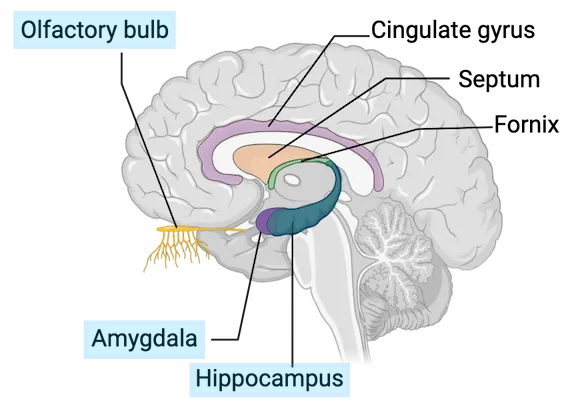
A schematic showing the relevant human inner brain structures: amygdala (emotion center), hippocampus (memory center) and the olfactory bulb (smell center). Credit: Adapted from Limbic system by Life Science Databases (LSDB) / Anatomography, via Wikimedia Commons (CC BY-SA 2.1 JP). Modified to add labels.
The amygdala (responsible for emotion), the hippocampus (our memory center), and the olfactory bulb (which processes smells) are located physically close in the brain. Unlike visual signals that travel from our eyes farther into the visual cortex, smell signals quickly relay to the amygdala and the hippocampus, before conscious awareness.
The connection between smell and memory is so strong that smell loss is considered an early symptom of Alzheimer’s, Parkinson’s, and other neurodegenerative diseases. Researchers are developing tests using the sense of smell to evaluate high-risk patients, even before they show physical or cognitive symptoms.
Immune System Links
Both smell loss and decreased memory occur with aging, but preliminary research shows that stimulating the olfactory system can improve cognitive decline. Juan Lasarte from the University of Navarra, Spain, and his lab team tested a panel of odors on mouse models of Alzheimer’s disease. The team observed an increase in memory function upon exposure to scents that stimulated the immune system like menthol. Even more than that, Lasarte describes that “when you stop or you break the olfactory system of the animals by a chemical treatment, they lose their memory.”
Researchers also find benefits from smell exposure in humans, although conclusive evidence on how odors affect cognitive function remains scarce due to the diversity of the human population and the absence of large-scale studies. Nevertheless, a clinical trial from the University of California, Irvine, tested the effects of overnight exposure of 43 older adults to a panel of five rotating smells. After six months, the team detected an over 200% improvement in performance in the Rey Auditory Verbal Learning Test, which evaluates memory and verbal learning. In other words, exposure to a variety of smells was observed to improve brain function.
It would be interesting to directly test the immune effects of these varying odors. Lasarte discusses that “some of them boost the immune response, and others reduce the immune response.” These effects could also vary from one person to another. Lasarte says, “You can combine biochemical measurements and do a screening of odor candidates, and then select personal treatments.”
Determining which scents are the most beneficial to an individual could help personalized treatments. Imagine learning that lemon, menthol and grass smells stimulate your immune system. Perhaps, the grass odor reminds you of cilantro, which you do not like. No problem: rotate between lemon and menthol on a home diffuser, knowing this could help you maintain cognitive function from a younger age.
Many questions remain about the connection between smell and memory, with studies underway. However, retirement homes like Silverado Hospice (Irvine, California) and Maplewood (Danbury, Connecticut) have already started using aromatherapy for patients, noting benefits for stress and anxiety reduction. This practice may become more widespread as we learn about the benefits of smells for our health.
While the advantages of aromatherapy may be most critical for older people whose memory has decreased, we all can use scents to improve cognitive function. In Lasarte’s study, even healthy mice exposed to the smell of menthol performed better in a cognitive task. In humans, olfactory training is likewise associated with improved verbal training and memory.
Whether you prefer essential oils, flowers, or just sitting on the grass in a park every Saturday morning, exposure to a variety of smells may be more beneficial than previously thought. Although humans are not as dependent on smell as Indian jumping ants, scents can help us improve and maintain our cognition.
Main Header Image Caption: A Venus flytrap, scientific name Dionaea muscipula*, with several open jaw-like structures for catching insects. Credit: Michael Kunz, North Carolina Botanical Garden. Used with permission.*

Olena Kolumba is a Biology PhD candidate studying molecular mechanisms of singular odor receptor choice in ants at New York University. She takes every chance to write science stories tailored to general audiences and enjoys communicating scientific advances to people outside academia. You can find her portfolio here or reach Olena by email at ook208@nyu.edu or olena.kolumba@gmail.com.
The NASW Perlman Virtual Mentoring program is named for longtime science writer and past NASW President David Perlman. Dave, who died in 2020 at the age of 101 only three years after his retirement from the San Francisco Chronicle, was a mentor to countless members of the science writing community and always made time for kind and supportive words, especially for early career writers.
You can contact the NASW Education Committee at education@nasw.org. Thank you to the many NASW member volunteers who lead our #SciWriStudent programming year after year.
Founded in 1934 with a mission to fight for the free flow of science news, NASW is an organization of ~ 2,300 professional journalists, authors, editors, producers, public information officers, students and people who write and produce material intended to inform the public about science, health, engineering, and technology. To learn more, visit www.nasw.org