Why an uncoordinated transition from fossil fuels to climate-friendly energy will strand consumers without power, gas for their cars, or heat for their homes and disrupt local economies that depend on the industry.
This student story was published as part of the 2026 NASW Perlman Virtual Mentoring Program organized by the NASW Education Committee, providing science journalism experience for undergraduate and graduate students.
Story by Ann Whipple
Mentored and edited by Mary Hoff
Carbon-emitting fossil fuels urgently need to come offline to avoid climate catastrophe, according to the International Energy Agency. But as people shift from gas stoves to induction and from coal and oil to sun and wind, new research raises concerns that refineries and other fossil fuel infrastructure will face sudden closures, equipment failures, and bankruptcy while many still depend on them.
Emily Grubert, a civil engineer and environmental sociologist at the University of Notre Dame, and Joshua Lappen, a historian and engineer at the University of Notre Dame’s Pulte Institute, warn in a recent paper published in Science that if an oil refinery were to lose one-third of its customers as drivers shift to electric cars, it would likely become unprofitable and close. This would leave people who still depend on fossil fuels stranded.
And for gas pipelines, the cost of maintaining the entire system is fixed. So when some customers exit, those costs have to be spread over fewer people who remain, raising their prices — and the risk of sudden collapse.
Coal is vulnerable, too. Even though major coal mines sell coal to multiple power plants, only a few power plant closures can strangle a mine.
And most critically, the researchers explain, fossil industries are highly interconnected, so failure of a single component, such as a coal mine, could reverberate through the entire system: A coal mine closes, causing a power plant to close, and then another coal mine, and on and on.
Defining and identifying 'minimum viable scale'
The first step in figuring out how to ease the trauma of the transition, the researchers posit, is to determine the “minimum viable scale” for each type of fossil fuel infrastructure — the lowest level of demand they can accommodate without shutting down. Their initial efforts to do this suggest that this level is much higher than previously thought. Refineries, for example, can operate at about 70% of current demand but become unprofitable below that. In other words, even while a vast majority of its customers still remain, a refinery can go under. And rather than a steady, linear decline, fossil infrastructure will go over these “closure cliffs” before renewable systems are prepared to completely take over.
According to Lappen, the massive decline in coal production over the past 15 years is a cautionary tale for what it means to reach the minimum viable scale in other fossil industries. In coal, “decline past a certain threshold leads to much less safe and predictable operating conditions, or failures and a lot of sudden closures and bankruptcies,” Lappen said.
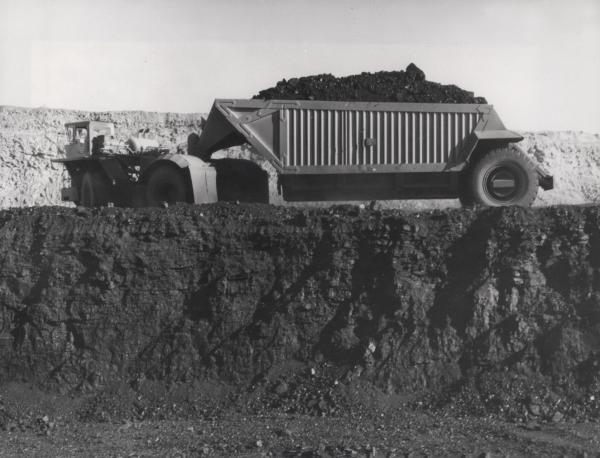
In Wyoming in 1976, a truck transports coal from the mine to the Jim Bridger Power Plant six miles south. Credit: U.S. Department of Energy.
In addition, he notes, when coal companies shut down, they not only disrupt energy supplies, they also can leave behind contaminated land for the public to remediate. And in communities once economically and culturally centered around mines or coal-fired power plants, many people lose meaningful work.
Why a for-profit model doesn’t work for declining infrastructure
When profit alone determines whether oil and gas pipelines keep pumping, Lappen and Grubert predict similar problems. They argue that the most essential infrastructure needs to stay online to achieve the energy transition. This means supporting fossil fuel infrastructure while it declines, the researchers say.
A profit-driven framework could lead gas-station owners to shut down dozens of pumps in an area simultaneously. But if someone could decide which stations are most needed, rather than those most profitable, these could be kept afloat. The problem is that anti-collusion laws make it impossible for companies to make these decisions. So Grubert and Lappen argue that these industries must come under public control before fossil fuel networks collapse.
Electric utilities are a model of what coordinated planning in power infrastructure might look like in fossil infrastructure. Electric utilities are highly regulated, and energy operators are incentivized by the government to serve communities; they procure the right transmission lines or transformers and conduct maintenance. In other words, “the future system is in the shape we need and has the capacities we need,” Lappen said.
With more regulation and oversight, governments can provide funding that allows companies to stay solvent with less profit. And with the transparency intrinsic to public management, communities can be assured that fossil fuel businesses aren’t taking advantage of public funding. “If you can shrink that system and its fixed costs in parallel with declining revenues, you can maintain system stability for a long time, potentially,” Lappen said.
Thomas Hersbach, a policy fellow at the Stanford Climate and Energy Policy Program, underscores the importance of this research. “Recognizing this reality sets the stage for policy discussions on how to decarbonize in a way that ensures that people's basic needs like electricity and transportation are being met,” he said.
Lappen’s bottom line is that the magnitude and severity of risks related to non-intervention in fossil decline demands action.
“In the end, we're talking about people's lives,” Lappen said. “And we have a robust tradition in this country of when it comes down to it, valuing property less than lives.”
Main Header Image Caption: An aerial photograph of the sprawling Pine Bend Oil Refinery in Rosemont, Minnesota, at sunset. Smoke is rising from structures in the background. The refinery employs more than 1,000 people and is considered Minnesota’s most active work site. Credit: Pexels / Tom Fisk.

Ann Whipple is a freelance writer covering science and technology with a particular interest in sustainability and the energy sector. She has written about the innovation that underlies the decline in the cost of solar systems and the synthesis of abiotic life for the Santa Fe Institute and writes for an industry publication called Our Industrial Life. She has a dual degree in philosophy and the history of math and science from St. John's College and will be pursuing her master’s in Science, Health and Environmental Reporting at NYU this fall. Email: awhipplenm@gmail.com.
Mary Hoff is a writer, editor, and communication strategist with special interest and expertise in life sciences and the environment. As communications and outreach manager for the nonprofit Project Drawdown, she develops and disseminates communication products focused on climate solutions. As a freelance science writer, she has published in numerous outlets, including Discover, Scientific American, The Guardian, and National Geographic Explorer. She holds a BS in zoology from the University of Wisconsin and MA degrees in strategic communication and journalism & mass communication from the University of Minnesota.
The NASW Perlman Virtual Mentoring program is named for longtime science writer and past NASW President David Perlman. Dave, who died in 2020 at the age of 101 only three years after his retirement from the San Francisco Chronicle, was a mentor to countless members of the science writing community and always made time for kind and supportive words, especially for early career writers.
You can contact the NASW Education Committee at education@nasw.org. Thank you to the many NASW member volunteers who lead our #SciWriStudent programming year after year.
Founded in 1934 with a mission to fight for the free flow of science news, NASW is an organization of ~ 2,300 professional journalists, authors, editors, producers, public information officers, students and people who write and produce material intended to inform the public about science, health, engineering, and technology. To learn more, visit www.nasw.org