

Study using big data could pinpoint how to protect species and functional ecosystems from particular human threats
This student story was published as part of the 2026 NASW Perlman Virtual Mentoring Program organized by the NASW Education Committee, providing science journalism experience for undergraduate and graduate students.
Story by Hannah Pletcher
Mentored and edited by Robin Meadows
Earth has undergone five mass extinction events, and now scientists think we are in the sixth. But instead of blaming ice ages, volcanic eruptions, or asteroid collisions, this time around they say the culprit is us.
Studies have shown that animals with large bodies or highly specialized diets are more likely to go extinct, but little is known about which threats in particular are worse for a given species. A new study using the most comprehensive database on species conservation status worldwide revealed that particular human threats, such as agriculture and logging, selectively impact groups of mammals and birds with distinct diets or body sizes.
“This is quite an advance,” said Pedro Cardoso, an extinction expert at the University of Lisbon who was not involved with the study. “[The researchers] used a lot of data to test these ideas and in fact found that there are these strong interactions with traits and threats driving the extinction risk of species.”
Wildlife populations have shrunk by an average of nearly 75% over the last 50 years, according to the World Wide Fund for Nature. The new study paves the way for targeting conservation efforts more effectively.
Dangerous diets and scary sizes
Diet and body size are characteristics used to sort animals into functional groups, which reflect the roles species play in their ecosystems. The researchers set out to see if animals in particular functional groups are vulnerable to particular threats.
The team found that for both mammals and birds, species that eat other vertebrates are most threatened by infrastructure development and agriculture, including crops and livestock. Mammal and bird species that eat fruit are most threatened by logging. Aquatic predators in both mammals and birds are most threatened by climate change and pollution.
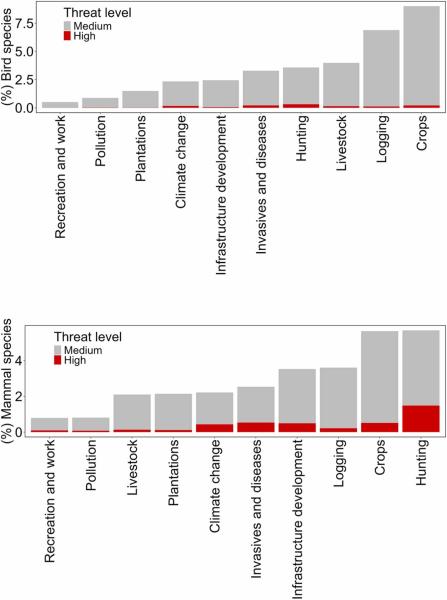
Specific human threats, like hunting and crops, adversely affect mammals and birds, while recreation and work are not as dangerous. Credit: Ayebare et al., 2026 under CC-BY-NC-ND 4.0
“I guess we say, ‘you are what you eat,’ right?” said Sarah Converse, a research ecologist with the U.S. Geological Survey who was not involved in the study. “Here, what you eat is actually sort of driving the degree to which you are threatened.” Likewise, what animals eat also drives what threatens them.
Interestingly, when it comes to body size, bigger is definitely not better. The study showed that nearly all human threats impact larger species more than smaller species. “Especially if you can be eaten or you’re a nuisance, then you’re kind of in this situation where you’re going to be more targeted,” study co-author Elise Zipkin, a quantitative ecologist at Michigan State University, explained about larger species.
Zipkin was struck by how the same human activities threatened both birds and mammals with particular diets or body sizes and suggested that these big-picture similarities could make conservation efforts more straightforward. For example, the study shows that addressing habitat loss and hunting would have the largest conservation impact on mammals and birds.
Preserving functional ecosystems
Identifying specific threats to species will help determine how to restore ecosystems and select relocation sites to preserve species—and the functions they serve—in ecosystems. Losing a functionally unique species is like losing a profession such as doctors or teachers, said study lead Samuel Ayebare, a quantitative ecologist at the Wildlife Conservation Society in Uganda, via email. “Society would no longer be able to function effectively,” he shared. The same goes for ecosystems missing a functional group.
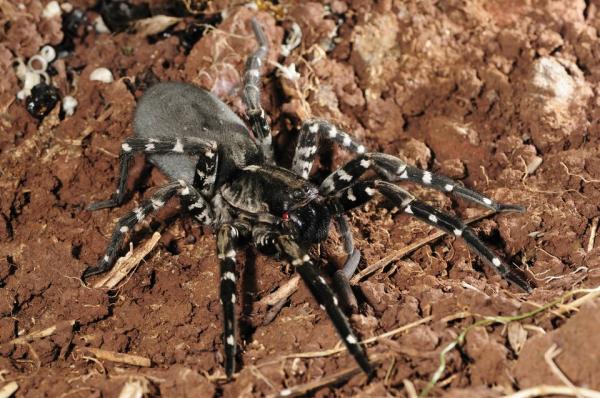
The Desertas Wolf Spider (Hogna ingens), threatened by invasive species, was classified as critically endangered by the IUCN Red List in 2014. Credit: Pedro Cardoso; available through Wikimedia Commons under Creative Commons Attribution 4.0 International license.
Moreover, the study could help pinpoint potential threats for lesser-known species. Cardoso’s work includes insects and invertebrates, and monitoring data is lacking for the vast majority of them. He noted that connecting functional groups to specific threats could serve as “indirect data” that could help prioritize unmonitored species for protection.
By using large-scale data about many types of animals, the new study could also help zero in on hot spots that protect the most threatened species. Cardoso pointed out that this could convince people to create protected areas where they are most needed “to cover as much biodiversity as possible.”
Main Header Image Caption: The Western Lowland Gorilla (Gorilla gorilla gorilla) is classified as critically endangered by the IUCN Red List and is threatened by hunting, disease, habitat loss, and climate change. Credit: Jackhynes; available through Wikimedia Commons under Creative Commons Attribution-Share Alike 3.0 Unported license.

Hannah Pletcher is a Ph.D. candidate at Washington University in St. Louis, studying mitochondrial metabolism and how it is regulated. She is passionate about sharing new discoveries and making complex ideas accessible through freelance science communication work. You can find her on LinkedIn at linkedin.com/in/hannah-pletcher/, her website https://hannahpletcher.journoportfolio.com/, or email at h.e.pletcher@wustl.edu.
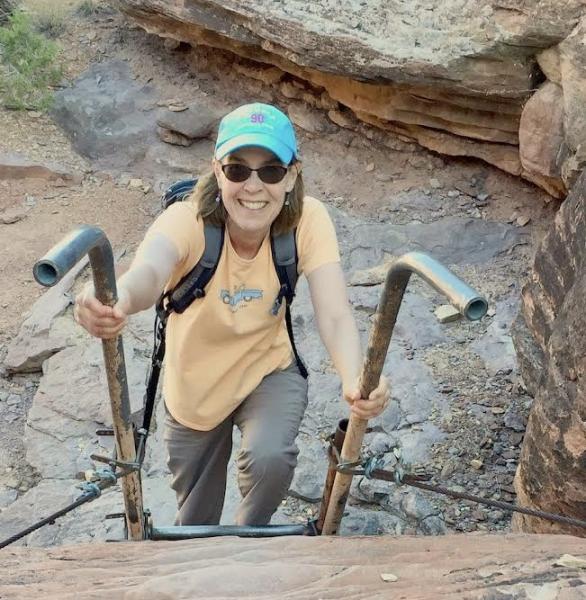
Robin Meadows is an independent science journalist who covers water, environmental justice, and environmental policy for Maven's Notebook, a California water news site. Her work has also appeared in bioGraphic, Chemical & Engineering News, High Country News, Scientific American, and elsewhere. Robin is a Pulitzer Center on Crisis Reporting grantee, an Institute for Journalism & Natural Resources fellow, a contributor to The Craft of Science Writing, and a Northern California Science Writers Association board member. She lives in the San Francisco Bay area near Suisun Marsh, the largest brackish wetland on the West Coast.
The NASW Perlman Virtual Mentoring program is named for longtime science writer and past NASW President David Perlman. Dave, who died in 2020 at the age of 101 only three years after his retirement from the San Francisco Chronicle, was a mentor to countless members of the science writing community and always made time for kind and supportive words, especially for early career writers.
You can contact the NASW Education Committee at education@nasw.org. Thank you to the many NASW member volunteers who lead our #SciWriStudent programming year after year.
Founded in 1934 with a mission to fight for the free flow of science news, NASW is an organization of ~ 2,300 professional journalists, authors, editors, producers, public information officers, students and people who write and produce material intended to inform the public about science, health, engineering, and technology. To learn more, visit www.nasw.org


_closeup_eating.jpg)