This student story was published as part of the 2026 NASW Perlman Virtual Mentoring Program organized by the NASW Education Committee, providing science journalism experience for undergraduate and graduate students.
Story by Julia Simpson Mentored and edited by Denise Gellene
It started small: rice growing in a petri dish.
While studying how rice responded to salt variations – environmental salinity has major impacts on growth – José Dinneny, then at Singapore’s Temesk Life Sciences Laboratory, observed that new lateral (horizontal) roots predominantly grew on the root side in contact with agar, a moist, nutrient-rich growing medium.
“That’s kind of, at some level, very obvious – like, oh yeah, of course, plants are gonna make branches towards water,” said Dinneny, who led the team that published the initial findings in 2014. “But it actually was never described before.”
This phenomenon, dubbed hydropatterning, may help scientists develop drought-resistant crops. A recent study led by Dinneny’s lab, now based at Stanford University, has made great strides towards that goal.
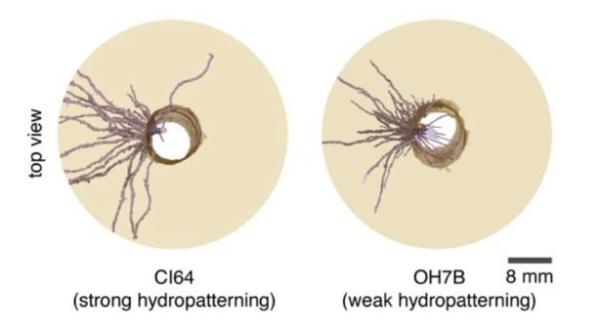
Maize roots demonstrating either strong (left) or weak (right) hydropatterning ability. Maize with stronger hydropatterning showed a strong preference for growing roots exclusively into the soil, where moisture could be found. Meanwhile, maize with weaker hydropatterning ability had lateral roots that also grew into the open soil pore. Source: *Science*. Image originally part of Dinneny’s 2025 paper, Figure 1E. Dinneny’s lab examined and compared the hydropatterning abilities of hundreds of genetically distinct maize plants in an effort to better understand the genetic roots of the phenomenon.
Dinneny’s work could not come at a more crucial time. A 2024 study reported that the global area of drought- and flood-sensitive regions has significantly increased in recent decades, with the majority of affected regions consisting of forested and agricultural land. Since much staple crop production is region-restricted due to climate, even localized droughts can cause big disruptions in global food supplies. In 2025, scientists predicted that food production from staple crops like maize, soybean, and wheat will severely decline by 2100 due to global warming, and that adaptive farming practices – like adjustments in fertilizer use or harvest dates – will be insufficient to prevent devastating losses.
Scientists like Dinneny are hungry for solutions. Japanese researchers recently identified a gene mutation conferring better heat-exposure resilience to tomato seeds, and Korean scientists found a gene that increases rice’s drought tolerance. Teams from China, Tunisia, and elsewhere have seen success in improving plants’ drought resilience via treatments with plant hormones, amino acids, and other compounds. A collaborative team from Vietnam and Germany found that microscopic fungi can help soybeans resist drought stress, and another Japanese group discovered that inoculating wheat with heat-resilient spore-forming bacteria improved the resilience of treated crops.
“There’s no silver bullet to developing a drought-resistant plant,” Dinneny said.
Dinneny’s lab continues to drive advances in this field. Last year, an international collaboration led by Johannes Scharwies, then-postdoctoral researcher in Dinneny’s lab, explored in unprecedented detail how maize – the world’s largest cereal crop – exhibits hydropatterning. With experiments first on nutrient-rich germination paper, and later in soil, the team observed new lateral roots growing preferentially on the side contacting a wet surface. Interestingly, a minority of maize grew lateral roots on the air-exposed side; this was significant, because the existence of such variation meant it would likely be possible to identify specific hydropatterning-related genes. Genetic analyses indicated that plants weak in hydropatterning were more likely to have shallow root systems, suggesting that stronger hydropatterning helps roots grow deeper and lends plants greater stability.
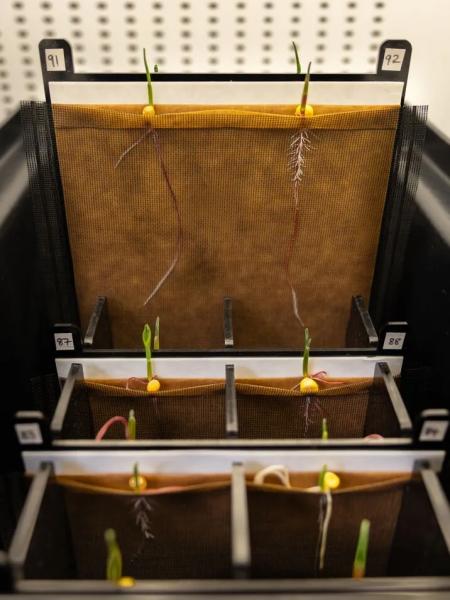
Setup of the Dinneny Lab’s custom-built hydropatterning experimental apparatus, allowing for large-scale, easily visualized assessment of hydropatterning in hundreds of maize seedlings. Plants were grown vertically with one side contacting moist paper, while being held in place by a mesh cover. Credit: LiPo Ching, Stanford University.
The team dug further. What chemical sensors and signals tell roots which way to grow?
The team found that genes related to auxin, a hormone known to contribute to hydropatterning in Arabidopsis (a weed often used in plant research), also contribute to maize hydropatterning. Further experiments identified a new player in the field: FLA4, a gene involved in producing a different plant hormone called ethylene.
The ethylene discovery was particularly exciting to Scharwies. Although the FLA4 gene was known to plant researchers, he said, “no one really knew what it was doing.”
“What we currently think,” Dinneny said, “is the auxin and ethylene pathways may be essentially communicating different aspects of soil properties to the root.” Auxin acts as a green light, and ethylene, as a stop sign. Auxin tells the plant, there’s water over here, so grow this way; meanwhile, ethylene senses oxygen availability – indicative of open pores or drier soil – and says, don’t grow that way.
This study, Dinneny said, “is an important milestone in giving us the tools that we need to ultimately bring these discoveries to a field context.”
Once the genetic underpinnings of hydropatterning are understood, scientists can target this trait with gene editing and ideally engineer crops with improved drought resilience. “We’re very much gearing up to generate these gene-edited varieties,” Dinneny said.
Scharwies, now a scientist at Google X spinoff Heritable Agriculture, remains devoted to this research field. “The goal of the company [is] to develop AI tools for plant breeding,” he said. He describes his current role as “the glue between the farmers and the computational team.” One current project aims to determine which genetic tweaks may help strawberries grow better in Canada’s environmental conditions.
Regarding the outlook of agricultural climate-resilience research, Dinneny is optimistic. “I tell people all the time: [It’s] the most exciting time in my entire career to do science,” he said.
Still, Dinneny acknowledges challenges, given the current science funding atmosphere. “It is harder to acquire funding for basic research,” he said. “But a lot of science is based on individual curiosity and intuition. And I think it’s becoming harder for individual scientists to follow that path of their own curiosity.”
He views his lab’s original observation – the rice roots that branched into so many promising research questions – as a manifestation of this ideal.
“Those moments of insight where curiosity meets something unexpected are magical,” he said. “And that’s what brought me to science, and what keeps me in science as a practitioner.”
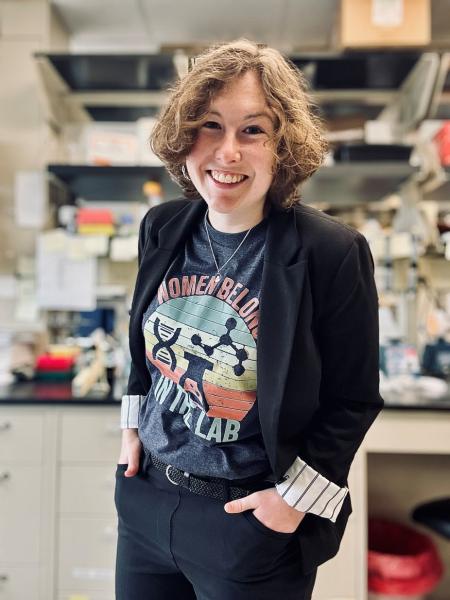
Julia Simpson is a PhD candidate at Penn State studying how viruses operate on the cellular level. Her dissertation work focuses on Human Cytomegalovirus. When not labouring towards completion of her thesis research under the red lighting of the microscope room, she can be found with her feet on a hiking trail or her nose in a book. Her science writing can be found at lions-talk-science.org and micro-bites.org, and her poetry appears or is forthcoming in Heartlines Spec, Dreams & Nightmares, the Cimarron Review, and elsewhere. Keep up with Julia’s professional endeavours on LinkedIn or Instagram (@microscopehope).
Denise Gellene is a former science and medical writer for the Los Angeles Times and a scientific editor and writing coach for the UCLA Clinical and Translational Science Institute.
The NASW Perlman Virtual Mentoring program is named for longtime science writer and past NASW President David Perlman. Dave, who died in 2020 at the age of 101 only three years after his retirement from the San Francisco Chronicle, was a mentor to countless members of the science writing community and always made time for kind and supportive words, especially for early career writers.
You can contact the NASW Education Committee at education@nasw.org. Thank you to the many NASW member volunteers who lead our #SciWriStudent programming year after year.
Founded in 1934 with a mission to fight for the free flow of science news, NASW is an organization of ~ 2,300 professional journalists, authors, editors, producers, public information officers, students and people who write and produce material intended to inform the public about science, health, engineering, and technology. To learn more, visit www.nasw.org