This student story was published as part of the 2026 NASW Perlman Virtual Mentoring Program organized by the NASW Education Committee, providing science journalism experience for undergraduate and graduate students.
Story by Claire Brandes
Mentored and edited by Madeline Bodin
A TikTok search for “baby monkey” yields pages and pages of videos — not of primates in the wild, but of pets in diapers and other human clothes, living in private homes. In recent years, the practice of keeping wild primates as pets has been driven by increased consumer demand in large part due to social media, a new study found.
The report, “Primates for Purchase: The Surge in Sales on Social Media in the US,” found 1,614 live primates for sale across four different social media platforms over the course of just six weeks. The researchers found that social media plays an important role in connecting buyers and sellers of exotic pets like primates.
“Before we started, I thought, very naively, getting 500 of these listings would be a lot for us,” said Polen Cisneros, a project manager at the International Fund for Animal Welfare who was involved in the development of the report.
The research was conducted in collaboration with the Association of Zoos and Aquariums, the International Fund for Animal Welfare, and World Wildlife Fund in May after a contact in the Department of Homeland Security said they were seeing a lot of spider monkeys coming through the U.S.-Mexico border. The organizations hired a former special agent with U.S. Fish and Wildlife Service to conduct daily searches across Facebook, Instagram, TikTok, and YouTube using a list of search terms associated with exotic animal sales.
Whether or not owning a lemur, monkey, or ape as a pet is legal depends on the state, but it is illegal to import primates into the country for the pet trade, according to Gabe Wigtil, the program director for wildlife trafficking at Humane World for Animals, formerly called the Humane Society of the United States. That’s why many wild-caught primates are laundered through captive breeders to bypass international laws, Cisneros said.
According to the report, it is illegal in 27 U.S. states to own primates, partially legal in 8 states, and legal in 15 states.
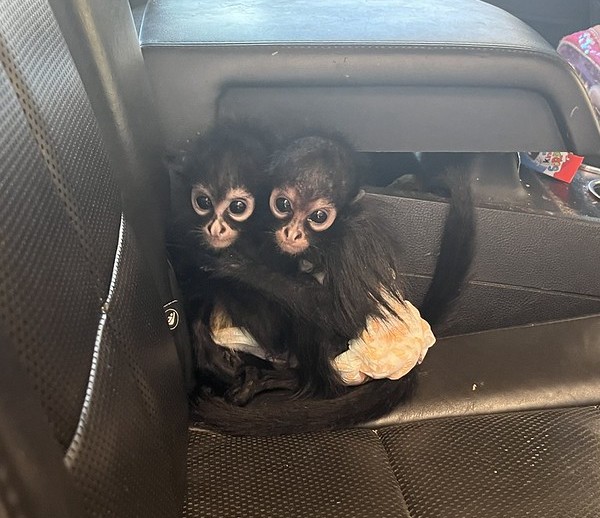
Infant spider monkeys (Ateles) seized by U.S. Fish and Wildlife Service at the U.S.-Mexico border. Credit: U.S. Fish and Wildlife Service/ Creator: Estrella Posada.
“There are states that basically say individuals cannot have non-human primates as pets, and then there are states where there’s no laws at all, and then there’s this group in the middle that has a range of different permissibility, whether it’s permits needed or certain species that are outlawed,” Wigtil said.
For example, Wigtil described Texas as a permissive state, which only requires that four primate species — chimpanzees, gorillas, orangutans, and baboons — are registered with the state when kept as pets, per Texas Health and Safety Code Chapter 822.
“That’s missing basically all the New World monkeys, all the Old World monkeys, lemurs, tarsiers — all of those are missing,” Wigtil said. Texas ranked second in the states with the highest number of primates listed for sale on social media, and Florida ranked first, the report found.
Wildlife trafficking is a lucrative trade, particularly in economically vulnerable regions, according to World Wildlife Fund (WWF). Primates for sale identified by the report ranged in price from a few hundred dollars to a few thousand dollars, with social media posts facilitating the transactions.
“A lot of wild animal depictions on social media lend themselves to a normalization that can increase demand,” Wigtil said.
Sellers on social media often use language that obscures the reality of the wild pet trade, the report found. Posts often featured young primates “looking for a home” or in need of “adoption.”
“It makes the buyer think they need a home, that they’ve been abandoned or something. They don’t really paint the true reality of how a monkey got to be in a position where they need to be adopted,” said Cisneros. In truth, primates that are smuggled into the U.S. are often ripped from their mothers in the wild at a young age, according to the report.
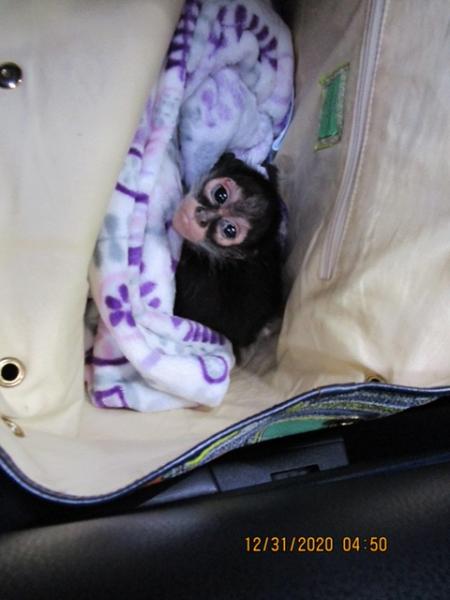
An infant spider monkey hidden inside a purse. Credit: U.S. Fish and Wildlife Service.
The trauma for a young primate doesn’t end there. The researchers say that once a primate makes its way into a private home, it lacks the space, mental stimulation, and socialization with other primates that would be otherwise experienced in the wild.
“Primates are extremely intelligent, and their complex social, physical, and psychological needs cannot be met in captivity,” said Starlynn Costa, a spokesperson for People for the Ethical Treatment of Animals (PETA).
Furthermore, pet primates often become a health and safety risk to both the owner and the community at large. Since 1990, Humane World for Animals has collected data on more than 380 dangerous incidents involving pet primates, resulting in injuries to 273 people — nearly a third of them children, according to Wigtil.
“They’re strong, unpredictable animals. Escapes and attacks don’t just occur in the privacy where this primate is kept. These often become community issues,” said Wigtil.
Ending the pet primate trade is a complex political, socioeconomic, and legislative issue, but the root cause is demand, according to WWF. Cisneros said the exotic pet trade is facilitated by trendiness. “This is definitely a newer trend that has become more viral in the last five years because social media is giving it a different light. Without social media, people can’t see what a cute baby monkey looks like in diapers” she said. Primates may be popular for now, thanks to social media, and there’s no telling what comes next.
Main Header Image Caption: A juvenile monkey seized in Spain during an anti-wildlife trafficking initiative. Credit: U.S. Fish and Wildlife Service/ Creator: INTERPOL

Claire Brandes is a Ph.D. student studying biological anthropology at the University of Texas at Austin. Her research employs faunal remains as proxies to reconstruct past human environments. Claire is passionate about using writing to connect the public with science. You can email her at claire.brandes@utexas.edu.
Madeline Bodin is a freelance science journalist who frequently writes about biodiversity, wildlife conservation and natural history.
The NASW Perlman Virtual Mentoring program is named for longtime science writer and past NASW President David Perlman. Dave, who died in 2020 at the age of 101 only three years after his retirement from the San Francisco Chronicle, was a mentor to countless members of the science writing community and always made time for kind and supportive words, especially for early career writers.
You can contact the NASW Education Committee at education@nasw.org. Thank you to the many NASW member volunteers who lead our #SciWriStudent programming year after year.
Founded in 1934 with a mission to fight for the free flow of science news, NASW is an organization of ~ 2,300 professional journalists, authors, editors, producers, public information officers, students and people who write and produce material intended to inform the public about science, health, engineering, and technology.