NASW Awards 3 Diversity Summer Fellowships
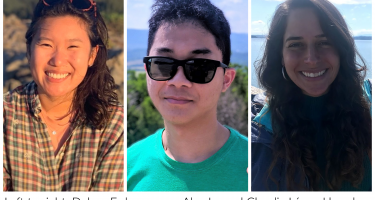
Congratulations to Delger Erdenesanaa, Alex Ip, and Claudia López Lloreda, who are recipients of this year’s Diversity Summer Fellowships.
Congratulations to Delger Erdenesanaa, Alex Ip, and Claudia López Lloreda, who are recipients of this year’s Diversity Summer Fellowships.

“Why am I here?” The hospitalized man asked again. After overdosing on an illicit drug, possibly fentanyl, he couldn’t retain memories. Nor could some other opioid users. The area of their brains critical to memory formation and storage, the hippocampus, had been damaged. In The Memory Thief & the Secrets Behind How We Remember, Lauren Aguirre explores causes and potential help for memory loss.
In 1940s Germany, Nobel laureate Otto Warburg found cancer cells consume 10 times as much glucose as healthy cells. “Like shipwrecked sailors, they were ravenous,” Sam Apple notes. Warburg’s metabolic studies excite new interest today, as does the story of his survival as a Jew protected by Hitler, Apple reports in Ravenous: Otto Warburg, the Nazis, and the Search for the Cancer-Diet Connection.

Inside the May 2021 edition: Desk Notes: Join us for events and networking, sign up as a student or volunteer for our Perlman Virtual Mentoring Program, meet a new member, & more.

Millions of people saw a dress in a 2015 internet photo as blue, millions more as white. “The way people see color, with their eyes and with their mind, was the biggest news story of the day,” Adam Rogers says. We all process the physics of light and chemistry of pigments differently to create billions of individual palettes, he reports in Full Spectrum: How the Science of Color Made Us Modern.
Vanessa Wamsley, a Nebraska-based science writer and editor, shares #WhySciWri in this short Q&A.
This summer, NASW's Education Committee is once again offering an online virtual summer mentoring program for graduate and undergraduate students. We invite students and volunteer mentors to sign up by June 1.
Please join us on Wednesday, May 26 at 6 p.m. Eastern Time for a Zoom happy hour event to get to know some of our Latin American science communication colleagues.