
NASW contributes to WCSJ 2023 speakers travel fund
The National Association of Science Writers has provided financial support for the upcoming 12th World Conference of Science Journalists hosted by Colombia.
The National Association of Science Writers has provided financial support for the upcoming 12th World Conference of Science Journalists hosted by Colombia.
The National Association of Science Writers invites applications for its inaugural Pivot Grants, providing funding for science journalists and writers facing unexpected challenges and transitions.
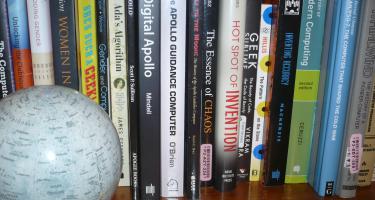
In thousands of hours of manned spaceflight, all dependent on computers, the Apollo Guidance Computer never failed. In an era when men dominated computers and spaceflight, Margaret Hamilton and her team wrote AGC’s software. Richard Maurer interviewed Hamilton and tells her story for readers age 10-14 in The Woman in the Moon: How Margaret Hamilton Helped Fly the First Astronauts to the Moon.
The National Association of Science Writers invites applications for its 2023 Diversity Summer Fellowships, providing funding to supplement a trainee's summer internship stipends.

This latest NASW Virtual Business Chat is brought to you by the NASW Advance Copy column.
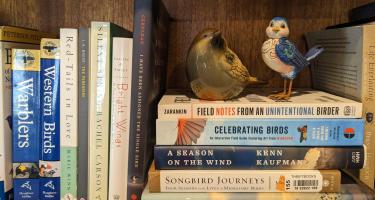
Where do birds go when seasons change? A 17th-century theory posited they flew to the moon. Researchers today use radar, satellites, light-level geolocation, DNA, data from community bird-watchers, and more to track and understand migration patterns, as Rebecca Heisman details in Flight Paths: How a Passionate and Quirky Group of Pioneering Scientists Solved the Mystery of Bird Migration.

Parents of children with rare, potentially fatal, disorders, building on activism by people with breast cancer and HIV, have spurred the burgeoning citizen-science movement. Their efforts, Amy Dockser Marcus reports in We the Scientists: How a Daring Team of Parents and Doctors Forged a New Path for Medicine, have improved both national health policy and social and political equality.

From the 1890s to the 1920s, reporter/photographer Eliza Scidmore covered Alaska’s Klondike gold rush, Japan’s emergence as a modern world power, and other world events for National Geographic and other publications. She also orchestrated Japan’s 1912 gift of 3000 cherry trees to Washington, DC, Diana Parsell recounts in Eliza Scidmore: The Trailblazing Journalist Behind Washington's Cherry Trees.

This latest NASW Virtual Business Chat is brought to you by the NASW Advance Copy column.